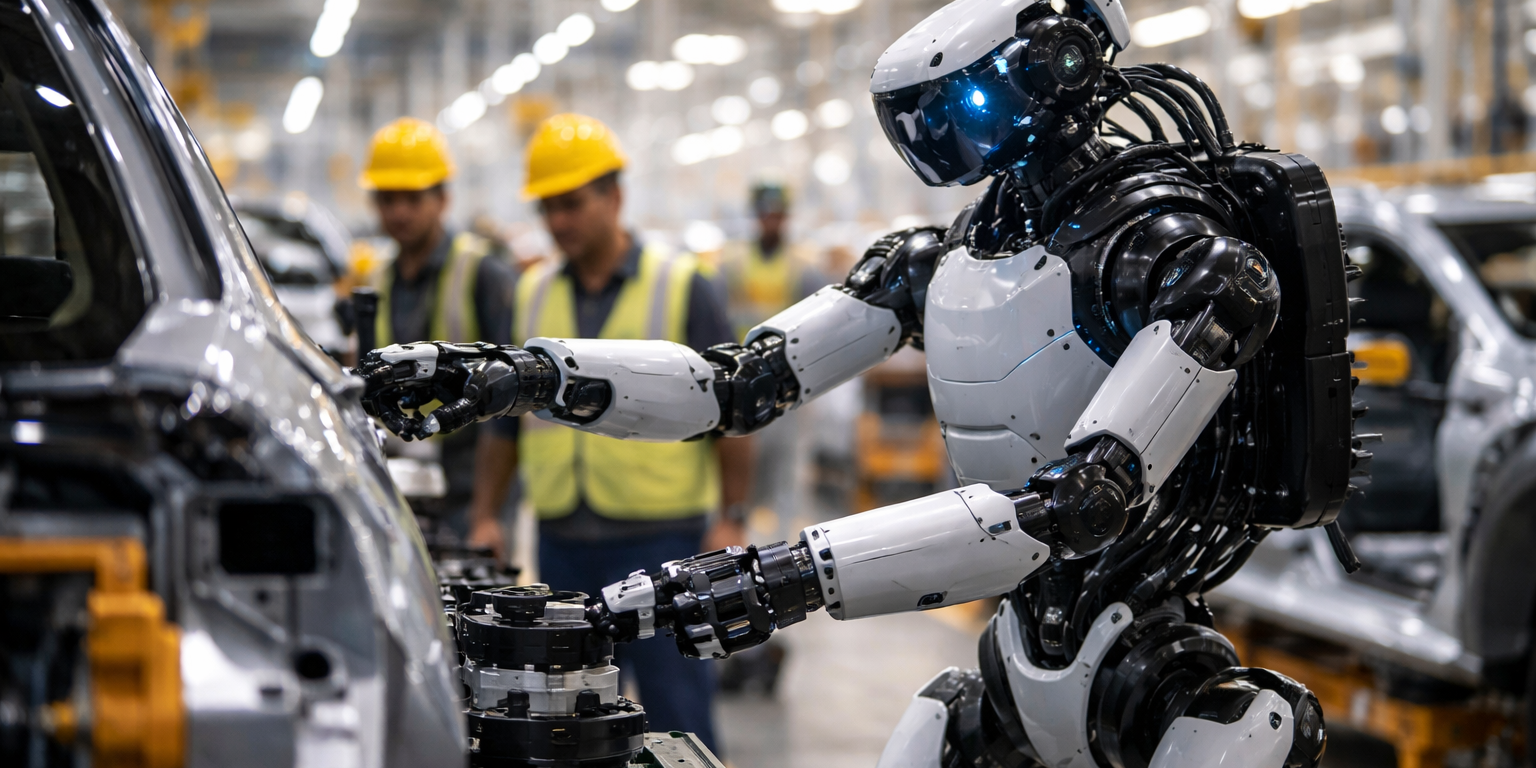

The manufacturer commanding the largest production volume in humanoid robotics has declared the sector within months of its commercial tipping point, a timeline that carries unusual weight given the company's visibility into industrial purchasing cycles and deployment economics. Speaking to investors and partners in recent weeks, executives pointed to three converging factors: total cost of ownership dropping below critical thresholds, artificial intelligence systems reaching task-generalization capabilities, and early logistics pilots demonstrating measurable productivity gains. The assessment arrives as the industry transitions from laboratory demonstrations to paid deployments, a shift that separates speculative ventures from viable automation platforms. Unlike previous waves of robotics hype, this projection is grounded in specific cost curves and named customer commitments rather than hypothetical scenarios.
The company's forecast hinges on unit economics reaching parity with human labor in targeted applications, specifically warehouse picking, material handling, and light assembly work. Internal modeling suggests annual deployment costs have fallen to approximately $48,000 per humanoid when calculated across a five-year operational lifespan, factoring in hardware amortization, software subscriptions, and maintenance contracts. That figure now competes directly with fully-loaded labor costs in developed markets, particularly for overnight shifts and physically demanding roles where recruitment has grown difficult. The manufacturer points to pilot programs at three unnamed logistics operators where humanoids have achieved 87% uptime across 16-hour shifts, handling repetitive tasks that previously required rotating human crews. These early results provide the empirical foundation that corporate buyers require before committing capital to unproven automation categories.
On the question of workforce impact, the company has adopted a deliberately measured stance that reflects both market reality and public relations prudence. Executives describe a five-to-ten-year integration period during which humanoids will augment human workers rather than displace them wholesale, focusing initially on roles with acute labor shortages or safety concerns. The vision centers on human-robot collaboration: humans handling judgment-intensive tasks, exception management, and customer interaction while humanoids execute the repetitive physical loops that comprise perhaps 40% of warehouse and light manufacturing work. This positioning acknowledges that labor unions, regulators, and the broader public remain skeptical of automation's social costs, making gradual adoption politically and operationally safer than aggressive replacement strategies. The company also recognizes technical limitations—current humanoids struggle with fine manipulation, complex decision trees, and unstructured environments—that make full autonomy unrealistic in the near term.
The manufacturer's commentary on Chinese competition revealed pragmatic acceptance of globalized supply chain realities that many Western observers prefer to ignore. China has built dominant positions in actuators, lithium batteries, and sensor arrays that all humanoid makers depend on, regardless of where final assembly occurs. The company urged potential customers to evaluate Chinese robotics firms on technical capability, intellectual property practices, and long-term service commitments rather than dismissing them based on national origin. This stance reflects industry economics: attempting to build humanoids without Chinese components would add 30-40% to production costs and delay time-to-market by 18-24 months while alternate supply chains mature. The manufacturer acknowledged that data security, export controls, and geopolitical tensions create legitimate concerns for defense, critical infrastructure, and sensitive manufacturing applications, but argued that commercial deployments in warehouses and light industry should prioritize performance and cost. The position implicitly concedes that Chinese manufacturers have closed the technology gap in hardware while maintaining cost advantages, making them formidable competitors in price-sensitive commercial markets.
What to Watch: Track whether any of the three unnamed logistics operators currently piloting humanoids publicly commits to multi-unit deployments in Q2 2025, as that would validate the business case beyond controlled trials. Monitor if actuator and battery prices continue declining at their current quarterly rate, which the manufacturer considers essential to reaching the $40,000 annual cost target for broader adoption. Watch for regulatory frameworks emerging in the EU and US around humanoid safety standards and workplace integration requirements, as clarity would accelerate corporate purchasing decisions currently stalled by liability uncertainty.