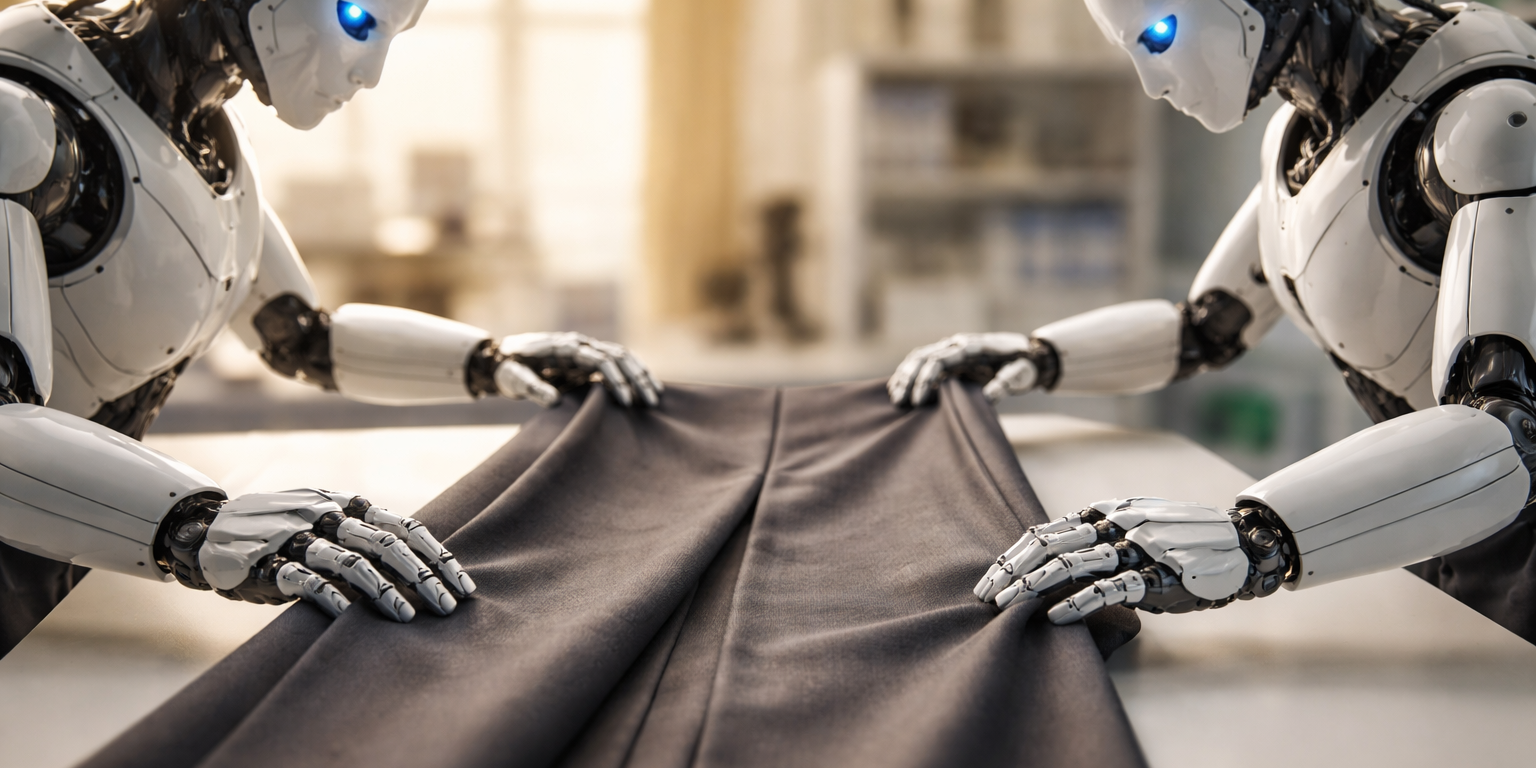
Folding trousers is a problem that looks trivial and behaves like a nightmare. Cloth has no fixed shape, no rigid edges to grip, and no reliable way to predict how it will drape after each touch. Westlake Robotics has now put two humanoids on that problem at the same time. In footage first reported by Pandaily, a pair of robots grasp opposite ends of a pair of trousers and fold them together, each coordinating with the other through fingers that must pinch, smooth, and release fabric without tearing or bunching it. The company calls it a world first for dexterous hands. Both machines run on a single piece of software, the WR1 general brain.
The trouser fold is only half of what Westlake showed. The same WR1 system also carried a humanoid through a chore run that began in a kitchen and ended in a bedroom, stringing together household tasks across two distinct rooms. That matters more than it might sound. Most humanoid demonstrations in the past two years have been tightly scripted: one robot, one task, one environment, often with a policy trained for that exact sequence. A general brain that moves between contexts without being rebuilt for each is the stated goal of nearly every serious player in the field, from Figure AI and Physical Intelligence in the United States to a growing cluster of Chinese startups. Westlake is positioning WR1 as its answer to that race.
The technical weight of the cloth demo sits in two places. The first is the hand. Deformable-object manipulation demands tactile sensitivity and fine finger control that many humanoid platforms still lack, which is why dexterous hands have become a bottleneck component across the industry. Hands with enough degrees of freedom to pinch a fabric edge are mechanically complex, expensive, and fragile, and they generate a flood of contact data the control software has to interpret in real time. The second is coordination. Two robots handling one shared, floppy object must continuously adjust to each other's grip and tension, because any mismatch pulls the fabric out of shape. Solving that with a single shared brain, rather than two independent controllers, is the harder and more interesting claim.
Westlake's approach reflects a broader shift in how Chinese humanoid developers frame their pitch. The emphasis has moved from locomotion tricks, such as running, flipping, and dancing, toward economically meaningful manipulation. Folding laundry is a favorite benchmark precisely because it is a real household chore with a real market behind it, and because failure is easy to see. Companies from Shenzhen to Hangzhou have been racing to show cloth-handling videos, and the genre has become something of a proving ground for embodied AI. What distinguishes this demonstration is the two-robot format. Multi-agent cooperation on a single deformable object is rarer than solo folding, and it hints at factory and logistics settings where humanoids would need to share loads instead of working in isolation.
A senior engineer will still want answers the footage cannot supply. How many takes preceded the clean run? How long did the fold take compared with a human? What is the failure rate when the fabric type, color, or starting position changes? Demonstrations of general brains tend to flatter the system, and the gap between a polished lab clip and a deployable product is where most humanoid programs stall. Investors should treat the world-first label as a marketing claim until independent verification or a published success rate appears. Still, the combination of cooperative manipulation and cross-room task chaining under one brain is a credible step, and it raises the bar for what rivals will need to show at their next public outing.
What to Watch Watch for Westlake to publish success rates, cycle times, or a technical report on WR1 in the coming 30 to 60 days; without those numbers, the demo stays a video rather than a benchmark. Track whether competitors such as Unitree, UBTech, and Agibot answer with their own multi-robot cloth-handling clips before the end of 2026, since that would confirm the two-robot fold is becoming a standard test. Also monitor any commercial pilot announcements tying WR1 to a named customer in home services, hospitality, or garment logistics, which would be the first real signal that the general brain can leave the lab.