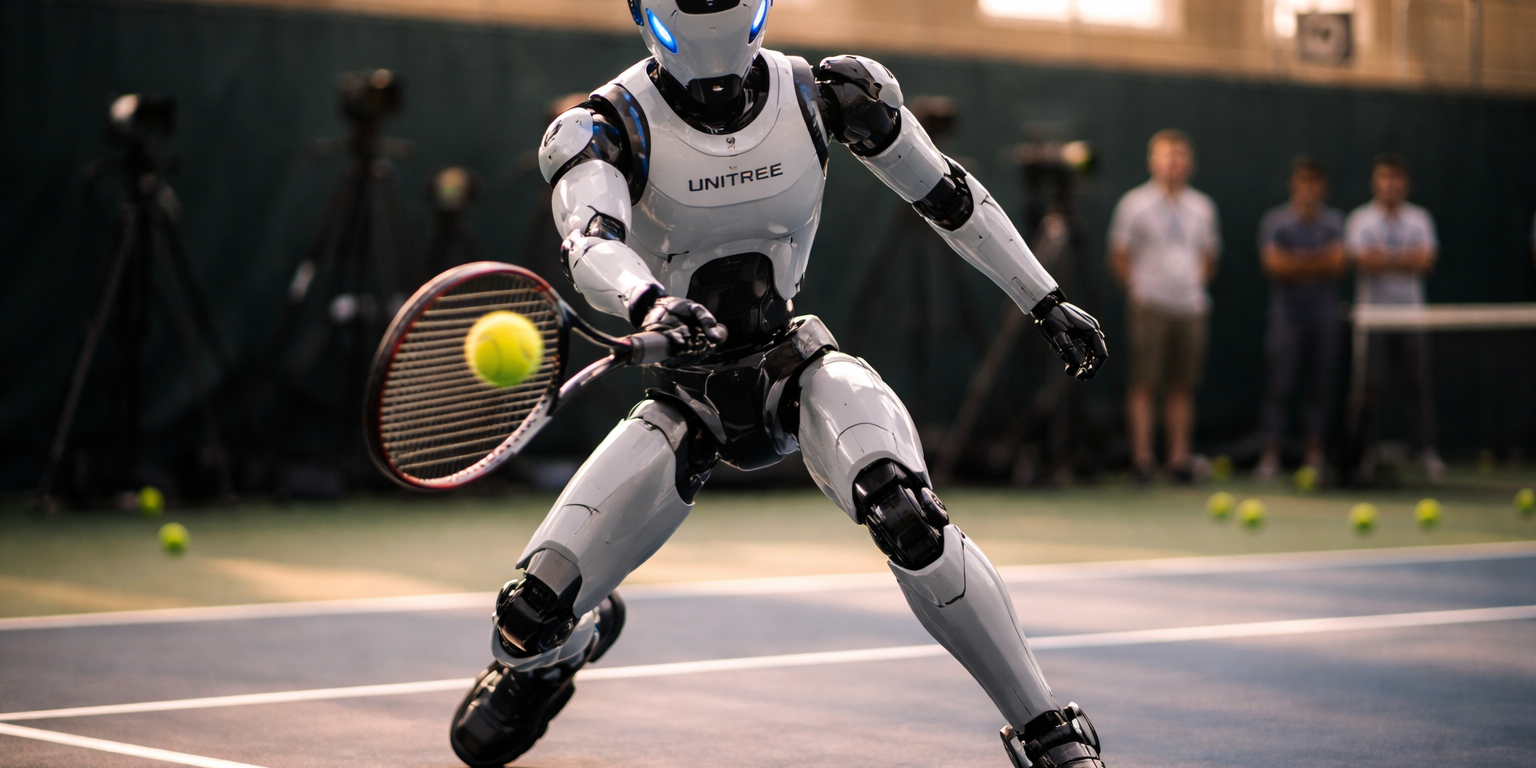
Twenty rallies. Roughly 91 percent of forehands returned. Those are the headline numbers behind LATENT, a humanoid tennis system from Galbot, Tsinghua University and collaborators that has just taken an entertainment paper award at IROS 2026. The robot in question is not a bespoke research machine. It is a Unitree G1, the same compact humanoid that labs and integrators can buy today, and the rallies were driven by human motion-capture data rather than hand-tuned controllers. For a field that has spent much of the past two years demonstrating robots that walk, wave and fold laundry in slow motion, a humanoid that tracks a fast-moving ball and swings through it is a pointed change of pace.
Tennis is a deceptively hostile benchmark. The ball arrives quickly, the window for deciding where to stand is measured in fractions of a second, and the racket has to meet the ball at the right place, angle and speed while the rest of the body stays upright. Legged humanoids have historically handled these demands badly, because locomotion controllers and manipulation controllers were developed as separate problems and stitched together afterward. Sports tasks expose the seams. A policy that keeps the robot balanced can fight a policy that wants a powerful swing, and the result is a machine that either falls over or returns nothing. That is why a forehand, one of the most whole-body strokes in the sport, makes a useful stress test for any claim of integrated control.
The awards committee categorized the work under entertainment, a track that rewards demonstrations with clear public appeal, but the underlying approach speaks to a more serious problem: how to get usable skills out of human motion data without painstaking reward engineering for every behavior. Motion capture gives a rich record of how people actually coordinate legs, torso and arms during a swing. Converting that record into something a G1 can execute, with different proportions, joint limits and actuator torque than a human body, is the hard part. The reported result suggests the team found a workable way to bridge that gap, at least for a single stroke and a controlled setting. Galbot, a Beijing-based embodied-AI company, has focused on general-purpose manipulation, and its collaboration with Tsinghua reflects the tight pipeline between Chinese universities and robotics startups that has become a defining feature of the sector.
The caveats deserve equal billing. A 91 percent return rate across 20 rallies is a small sample, the paper's scope is a forehand rather than a full match, and the evaluation conditions in a lab differ sharply from a live court with wind, spin variation and an opponent trying to win. A senior engineer will also want to know how much of the result depends on the motion-capture setup that tracks the ball and the robot, since an external sensing rig is a very different proposition from onboard perception. Those questions do not diminish the result so much as define the next set of experiments. Still, the use of a stock Unitree G1 matters commercially. It lowers the barrier for other groups to reproduce and extend the work, and it reinforces the G1's role as a de facto reference platform for academic humanoid research.
For investors and industrial buyers, the lesson is about transferable method rather than sport. The same ingredients that let a humanoid chase and strike a tennis ball, fast perception feeding whole-body control learned from human demonstration, are the ingredients needed for catching falling parts, handing objects over mid-stride or recovering from a shove on a factory floor. Warehouse and assembly deployments tend to fail at exactly these dynamic moments, not during the slow, scripted portions of a task. A technique that scales across skills by drawing on motion data, instead of requiring a new controller each time, would cut one of the largest engineering costs in humanoid development. Whether LATENT generalizes beyond a forehand is the open question, but the award puts a credible data point behind the argument that dynamic skills are within reach of today's commercial hardware.
What to Watch
Watch for whether the LATENT authors release code, motion-capture datasets or a follow-up preprint extending the system to backhands, serves or live opponents, since reproducibility will determine how far the result travels. Track Unitree's G1 firmware and SDK updates through the rest of 2026 for any native support for high-speed whole-body tracking, which would show the vendor absorbing lessons from academic work. Keep an eye on Galbot's commercial announcements, including any move to apply motion-derived skills to its logistics and retail manipulation products, as the clearest test of whether sports demos turn into deployments. Finally, follow other IROS 2026 award papers and the next wave of humanoid sports demonstrations, as competing labs are likely to answer with faster or more autonomous variants.