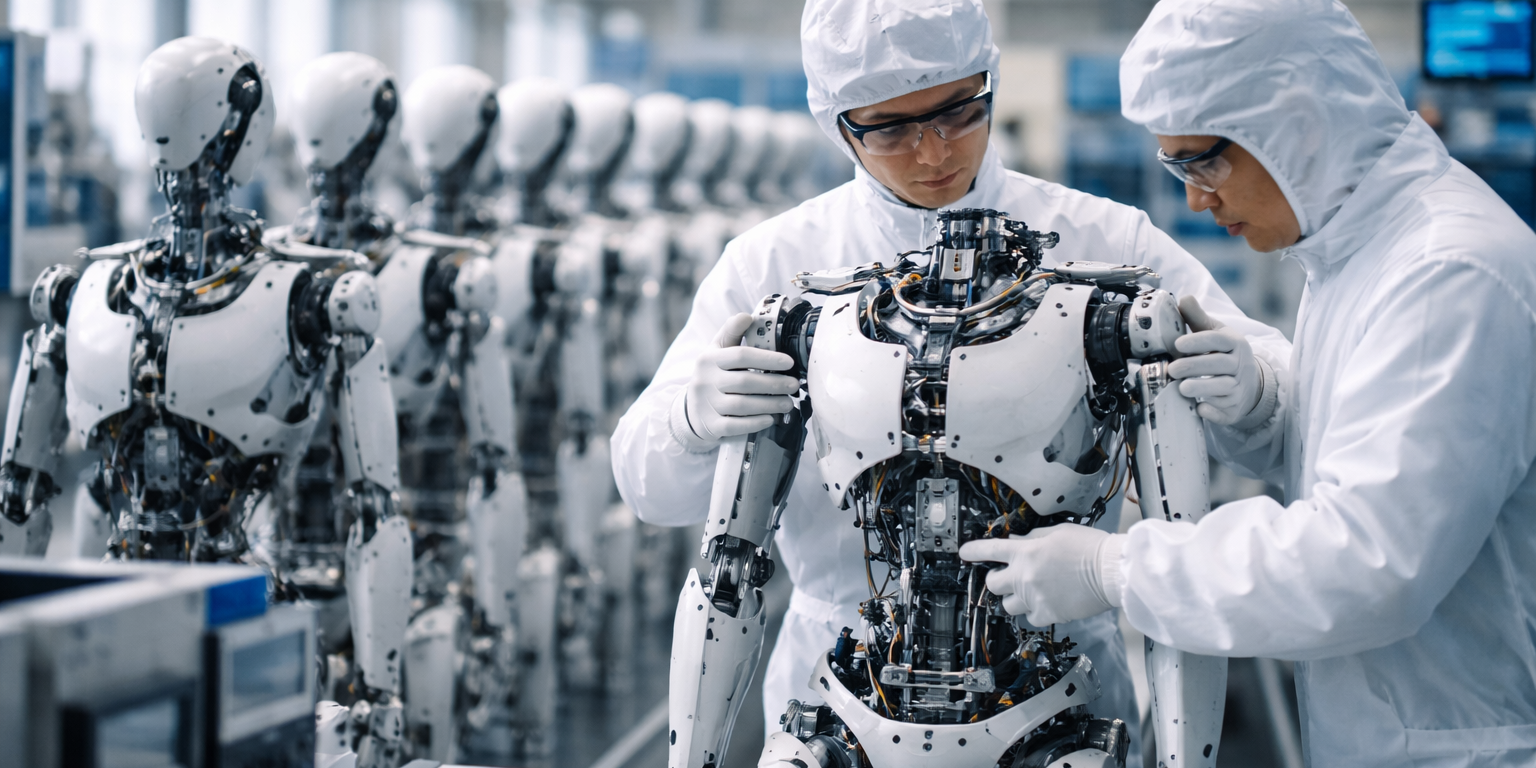
Building one humanoid robot is a research problem. Building a thousand is a manufacturing problem, and the two require different skills, different suppliers, and very different tolerances for failure. That distinction sits at the center of the view offered by Jabil, the Florida-based contract manufacturer that has quietly become a production partner to humanoid developers such as Apptronik. Speaking to The Robot Report about the pace of humanoid development, Jabil framed the sector through a design perspective rather than a demonstration one. Its vantage point is unusual. Jabil does not sell a humanoid. It sees the bills of materials, the yield problems, and the tolerance stack-ups that developers rarely discuss in public.
That vantage point matters because the humanoid field has spent three years rewarding spectacle. Impressive videos drew funding rounds; funding rounds drew more videos. Meanwhile the unglamorous questions piled up. Can an actuator survive 10,000 duty cycles? Can a hand assembly be built without a technician hand-tuning every unit? Can a battery pack be certified for use near people on a factory floor? A contract manufacturer lives inside those questions. Jabil's participation signals that at least some developers have moved past the prototype phase and into the harder work of designing for repeatable assembly, where every extra part and every custom fastener becomes a cost and a risk.
Apptronik is the clearest example of why the partnership carries weight. The Austin-based company, which spun out of the University of Texas Human Centered Robotics Lab and built its Apollo humanoid around industrial use cases, has leaned on outside manufacturing capacity rather than trying to build a factory of its own. That is a deliberate choice. Capital that would go to tooling and assembly lines can instead go to software, safety validation, and customer pilots. It also mirrors how the electronics industry scaled: design houses concentrate on intellectual property while specialists like Jabil handle volume, quality systems, and component sourcing across global supply chains.
For the wider industry, the implication is that humanoid progress will be gated by components as much as by intelligence. Actuators, harmonic reducers, high-torque-density motors, tactile sensors, and dexterous hands remain specialized parts with thin supplier bases, and many are still produced in volumes better suited to research labs than to automotive-scale programs. A manufacturer with purchasing power and established supplier relationships can pull those costs down, but only if designs converge enough to share parts. That is the quiet tension in the sector. Every developer wants a differentiated machine, yet cost reduction depends on standardization that few have been willing to accept so far.
There is a second consequence for investors, and it is less comfortable. If contract manufacturers become the scaling engine, the competitive moat for humanoid developers shifts away from hardware and toward software, data, and deployment know-how. Hardware that a third party can build is hardware a rival can eventually copy or buy. The durable advantage then belongs to whoever has the most capable control stack, the safest operating record, and the deepest customer integrations. Jabil's design-first framing points in that direction: the physical robot is becoming a manufacturable product, and the value is migrating to everything wrapped around it.
What to Watch Track whether Apptronik announces production volumes or a named customer fleet size through the end of 2026, since a unit count would be the first hard evidence that outsourced manufacturing is working. Watch for additional contract manufacturers, including Foxconn and Flex, publicly tying themselves to humanoid programs in the fourth quarter. Pay attention to actuator and reducer pricing disclosures from suppliers, which will show whether component costs are falling fast enough to support commercial deployments in 2027. Finally, monitor any safety certification milestones for humanoids working beside people, because those approvals, not demo footage, will determine how quickly factory pilots become purchase orders.