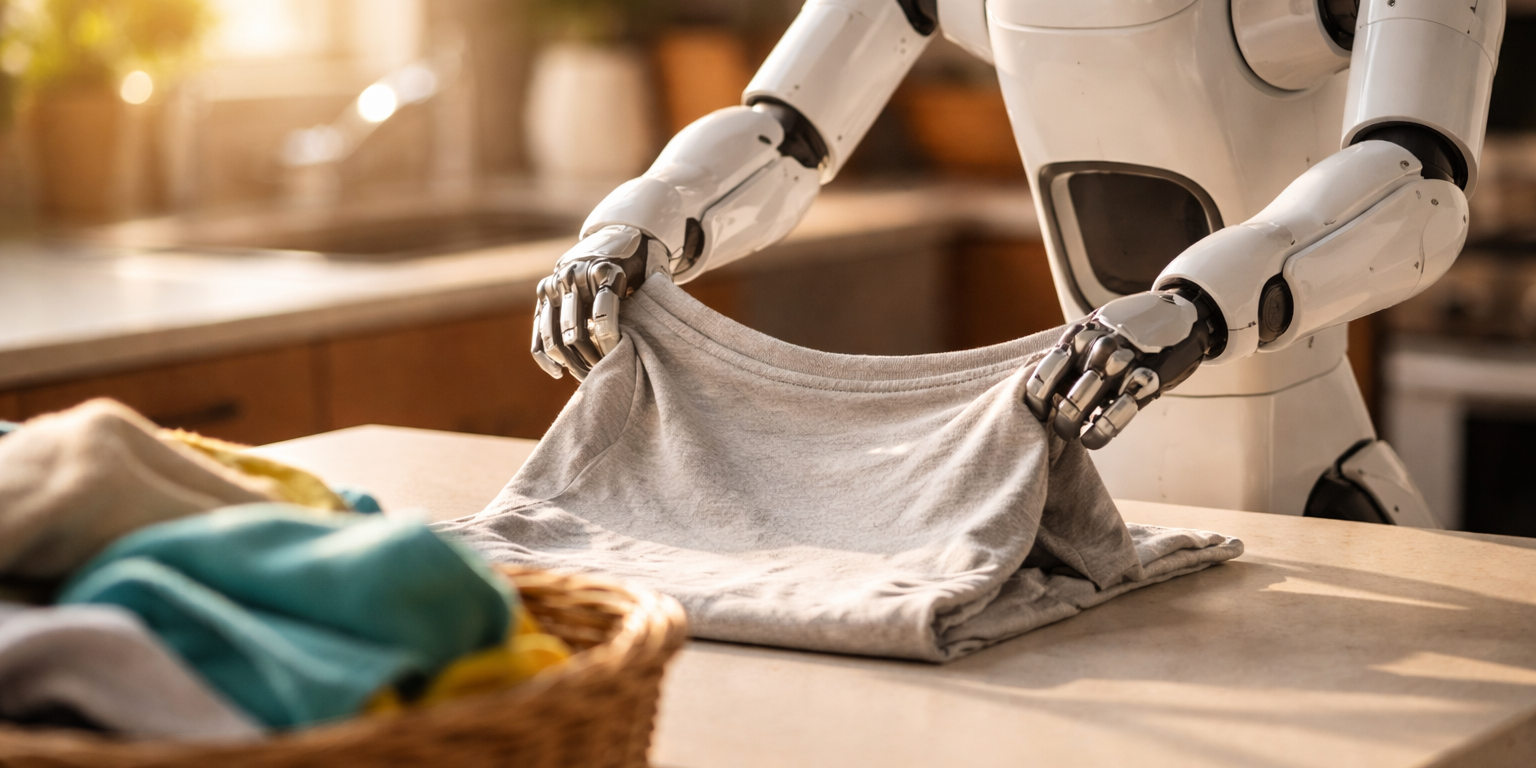
Weave Robotics will deliver its Isaac 1 laundry-folding robot to California customers this fall at a retail price of $8,000, making it one of the first manipulation-focused home robots to ship at a consumer-accessible price point. The Y Combinator-backed company enters a market where household robotics have largely been confined to vacuuming and mowing, with manipulation tasks remaining the domain of research labs and industrial settings. The $8,000 price tag positions Isaac 1 below the cost of a year's worth of weekly housekeeping services in major California metros, though it addresses only one household task.
Weave's timing reflects broader shifts in robotics economics. Component costs for servos, vision systems, and compute have dropped substantially over the past three years, while foundation models for robotic manipulation have matured from academic curiosities to deployable systems. Isaac 1 relies on those advances, though Weave has not disclosed whether the robot uses in-house trained models or licensed perception systems. The company emerged from Y Combinator's accelerator program, which has backed robotics companies including Zipline and Gecko Robotics, both of which targeted commercial rather than consumer applications. Consumer robotics companies face different scaling challenges: the tolerance for error is lower, the support burden higher, and the willingness to pay remains uncertain outside early adopter circles.
The California rollout strategy mirrors approaches taken by other hardware startups seeking to control initial deployment. Limiting shipments to one state allows Weave to manage service calls, gather usage data, and refine the product before expanding. It also concentrates early units in a region with high household incomes and demonstrated appetite for home automation products. The laundry folding problem itself is notoriously difficult. Fabric is deformable, items vary wildly in size and material, and the task requires dexterous manipulation across multiple steps: picking, unfolding, smoothing, and stacking. Previous attempts at commercial laundry-folding machines, including Foldimate and Laundroid, either never shipped or collapsed after limited runs. Laundroid's machine, introduced in Japan in 2018, cost approximately $16,000 and took 5 to 10 minutes per item before the company filed for bankruptcy. Weave's $8,000 price and fall shipping date will be tested against those precedents. The company has not released throughput specifications or detailed technical documentation on Isaac 1's capabilities.
The consumer robotics market has seen renewed investor attention after years of high-profile failures. Jibo, Anki, and Mayfield Robotics all shut down between 2018 and 2019, leaving the home robotics landscape dominated by single-function devices. But recent advances in AI-driven manipulation, coupled with component cost reductions, have revived investment. Companies including 1X Technologies, Sanctuary AI, and Figure AI have raised substantial capital for humanoid platforms, though those focus on commercial and industrial deployment rather than home use. Weave's consumer focus and sub-$10,000 price point differentiate it from those efforts. The company must now demonstrate that Isaac 1 can handle real-world laundry variability, maintain reliability over extended use, and deliver enough value to justify its cost. A household that does laundry twice weekly might fold 100 to 150 loads annually. At $8,000, Isaac 1 needs to perform reliably for multiple years to achieve cost parity with manual labor or outsourced services. Weave's post-shipment support model, warranty terms, and software update cadence will matter as much as the hardware itself.
What to Watch: Track Isaac 1 customer reviews and reported throughput figures when California shipments begin in fall 2026. Monitor whether Weave announces pricing or availability for additional states, or if the company raises a Series A to fund broader production. Watch for technical disclosures on Isaac 1's manipulation model, training dataset, and performance benchmarks, which Weave has not yet published. Observe whether other Y Combinator robotics companies follow with consumer-focused manipulation products or if Weave's early results steer capital back toward commercial applications.