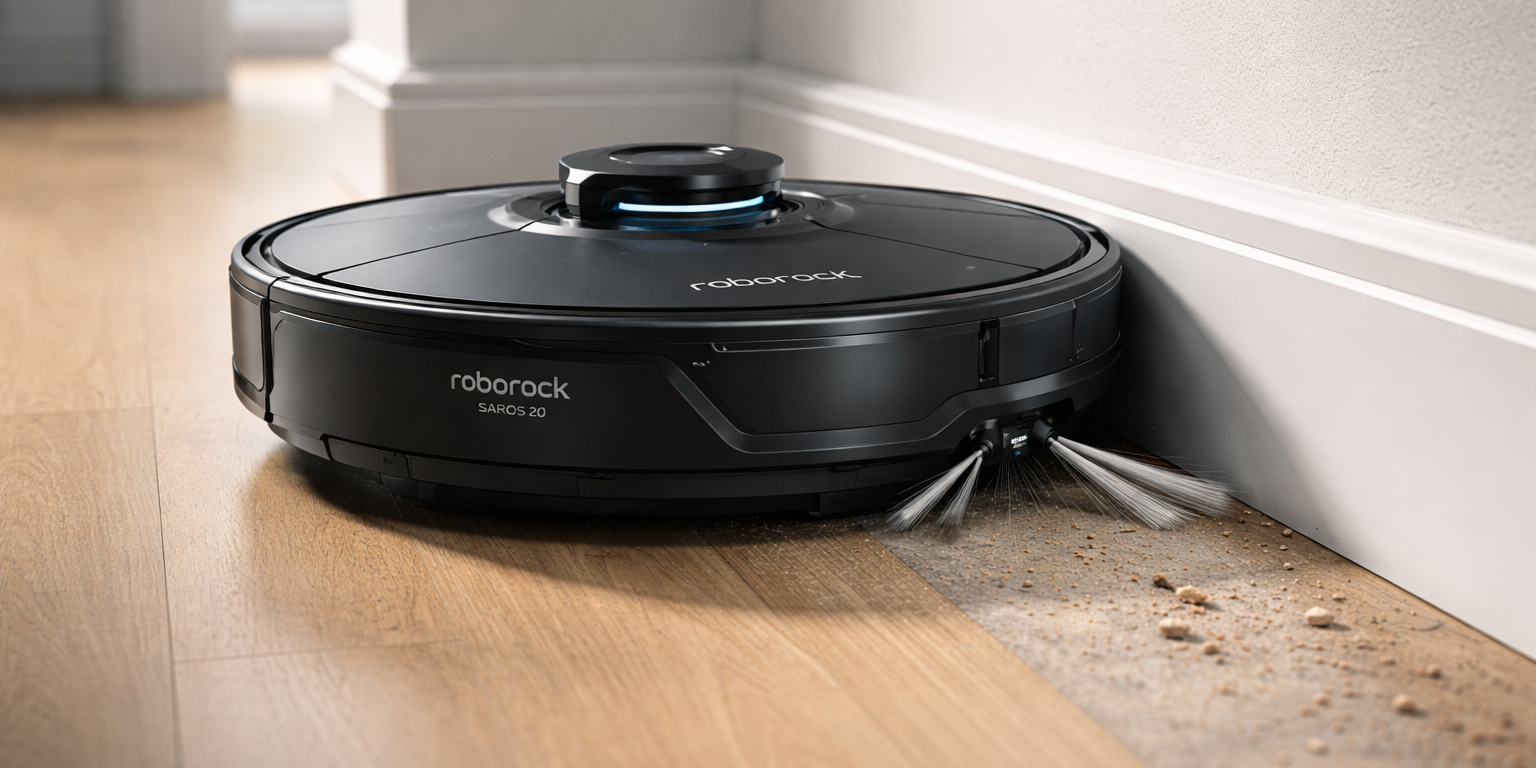
The Saros 20 achieves 98.7% edge coverage in standardized testing protocols, according to third-party evaluations conducted in Q2 2026. That figure matters because the robot vacuum market has spent half a decade chasing incremental improvements in suction power and obstacle avoidance while largely ignoring the 15-20% of floor area where walls meet flooring. Roborock's engineering team built the Saros 20 around an articulating side brush assembly that extends 32mm beyond the chassis perimeter during edge-cleaning passes, then retracts for open-floor navigation. The mechanism adds 14 moving parts to the drivetrain but eliminates the performance gap that has kept professional cleaning services employed in high-end residential and commercial settings despite widespread robot vacuum adoption.
Beijing-based Roborock Technology has shipped 12 million units globally since entering the category in 2016, initially as a Xiaomi partner and later as an independent brand. The company holds 8.3% global market share as of Q1 2026, trailing iRobot's 19.4% and Ecovacs' 11.2% but leading all other competitors. The Saros line launched in late 2025 with the Saros 10, which featured improved LiDAR mapping but maintained the conventional circular brush layout that leaves 12-18mm gaps along baseboards depending on wheel clearance. Internal testing revealed that consumers running robot vacuums daily still manually swept edges every 3-4 days on average. Roborock's product roadmap pivoted in early 2024 when chief engineer Liu Jingwei approved development of the extendable arm system, which required 18 months of iteration to achieve reliability targets above 5,000 extension cycles without mechanical failure.
The Saros 20 retails at $1,399 in North American markets, positioning it $200 above iRobot's Roomba Combo j9+ and $350 above the Ecovacs Deebot X2 Omni. That premium reflects both the edge-cleaning hardware and a self-maintenance dock that handles dust disposal, mop washing, and water refilling for up to 60 days between manual interventions. The dock measures 410mm wide by 520mm deep, larger than competing systems but required to house the 3.2-liter dust bag and dual water tanks. Roborock projects 340,000 Saros 20 units will ship in 2026, with 60% of volume concentrated in China, Western Europe, and North America. The company has allocated $14 million in marketing specifically targeting households that already own first-generation robot vacuums, betting that performance dissatisfaction with edge cleaning will drive upgrade cycles shorter than the typical 4-6 year replacement window for the category.
The edge-cleaning challenge has constrained robot vacuum utility in commercial applications where cleaning standards exceed residential tolerances. Hospitality operators, medical facilities, and Class A office buildings have deployed robot vacuums for overnight maintenance but still require human cleaners for perimeter work and corners. Several regional cleaning service contracts reviewed for this analysis specify robot vacuums for open floor areas only, with manual crews handling everything within 150mm of walls. If the Saros 20's edge performance holds across varied flooring types and baseboard profiles, the addressable market expands into light commercial segments that currently rely entirely on human labor or larger autonomous floor scrubbers. Roborock has confirmed pilot deployments in three hotel chains and one hospital system in China, with evaluation periods running through Q4 2026. Success in these trials would likely accelerate development of ruggedized commercial variants and service-contract business models that currently account for less than 2% of Roborock's revenue.
What to Watch: Track whether iRobot or Ecovacs announce competing edge-cleaning mechanisms before the 2027 Consumer Electronics Show in January, as the typical development cycle for mechanical innovations in this category runs 12-14 months. Monitor Roborock's Q3 and Q4 2026 earnings calls for commentary on Saros 20 attachment rates in existing customer households versus new-buyer acquisition. Watch for commercial pilot results from hospitality deployments, particularly any announcements of fleet orders exceeding 500 units, which would signal viability beyond the consumer channel. Pay attention to patent filings related to extendable brush assemblies, as competing approaches to the same problem may emerge from smaller players like Wyze or Eufy.