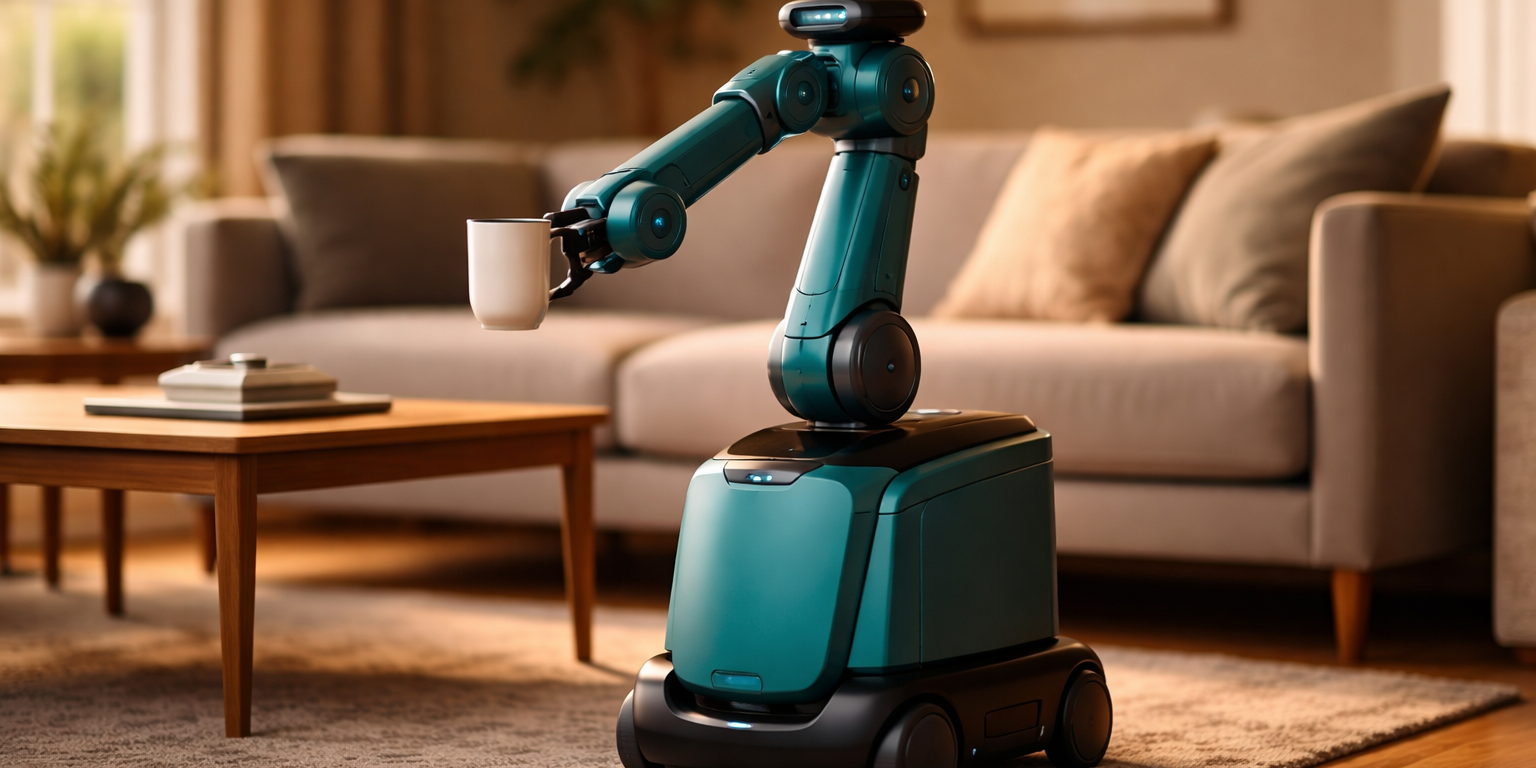
Weave Robotics has set a delivery window of fall 2026 for Isaac 1, a mobile manipulator designed for residential use and priced at $7,999. The San Francisco startup is assembling units locally and taking preorders now, positioning the robot as a general-purpose home platform rather than a single-task appliance. The company offers five distinct colorways, an unusual detail in a category where industrial white and black dominate. More significantly, Weave emphasizes on-device processing for privacy, a design choice that sets technical constraints but may prove commercially necessary given recent regulatory scrutiny of connected home devices.
The $7,999 price point places Isaac 1 well above established consumer robotics products but below early humanoid platforms. For context, Dyson launched its discontinued 360 Eye vacuum at $999, while Boston Dynamics declined to price Atlas for any commercial market. Figure AI and Apptronik have discussed humanoid pricing in the $25,000 to $50,000 range for initial industrial deployments. Weave is betting that a middle tier exists: households willing to pay more than appliance prices for a robot that can perform multiple tasks, but not ready to invest in full-scale humanoid hardware. The company has not disclosed manipulator specifications, degrees of freedom, or payload capacity, details that would clarify how Isaac 1 compares to research platforms like Stretch from Hello Robot or Toyota's HSR.
Weave claims Isaac 1 is "capable of far more than folding," a direct reference to laundry-folding robots that have attracted consumer attention but struggled with commercial viability. FoldiMate, which demonstrated a laundry-folding appliance at CES 2019, shut down after failing to ship. Seven Dreamers in Japan filed for bankruptcy in 2019 after its Laundroid folding machine, priced above $15,000, could not find a market. The pattern suggests that single-function home robots face a narrow path: the task must be frequent enough to justify the price and reliable enough to avoid becoming a novelty. Weave's multifunctional framing attempts to sidestep that trap, though the company has not published task demonstrations or benchmarks. The fall 2026 delivery window gives the team roughly three months from now to finalize production and logistics, assuming the announcement reflects current manufacturing timelines.
Local assembly in San Francisco carries cost implications but potentially simplifies iteration. Hardware startups that manufacture overseas often face months-long lead times for design changes, a constraint that slows response to early customer feedback. Anduril, Skydio, and other defense-adjacent robotics companies have kept production domestic despite higher labor costs, prioritizing speed and supply chain control. For a venture-backed consumer hardware company, the tradeoff depends on unit economics and how quickly Weave expects to reach scale. The company has not disclosed funding, team size, or production capacity. The five colorways suggest either confidence in volume or a modular design that allows for variation without retooling. Consumer electronics companies typically reserve multiple SKUs for products with proven demand; offering them at launch is either optimistic or strategic, signaling lifestyle positioning rather than pure utility.
The consumer robotics category has seen repeated false starts, with high-profile failures like Jibo, Kuri, and Anki's Vector. Each promised ambient intelligence and companionship; each underestimated the gap between demo and daily use. What has worked: task-specific robots with clear ROI. iRobot sold to Amazon for $1.7 billion on the strength of Roomba, a single-function device that justified its cost through saved time. Husqvarna's robotic mowers command premium prices in Europe by eliminating a weekly chore. Isaac 1 must either consolidate multiple chores into one platform or offer tasks with high enough value to justify an appliance-level price without appliance-level focus. Weave's privacy-first architecture may appeal to early adopters skeptical of cloud-connected cameras, but it limits the robot's ability to learn from aggregated data, a key advantage for companies like Tesla in autonomous vehicles. The company is choosing a harder technical path in exchange for a clearer marketing message.
What to Watch: Weave's fall 2026 shipment timeline means first customer units should arrive within the next 90 days. Look for unboxing videos and task performance benchmarks from early adopters, particularly around manipulation accuracy and failure modes. Monitor whether Weave discloses funding or production partnerships, which would signal scaling intent. Finally, track whether competitors like Matic or other well-funded home robotics startups adjust pricing or positioning in response to Isaac 1's multifunctional framing and domestic assembly messaging.