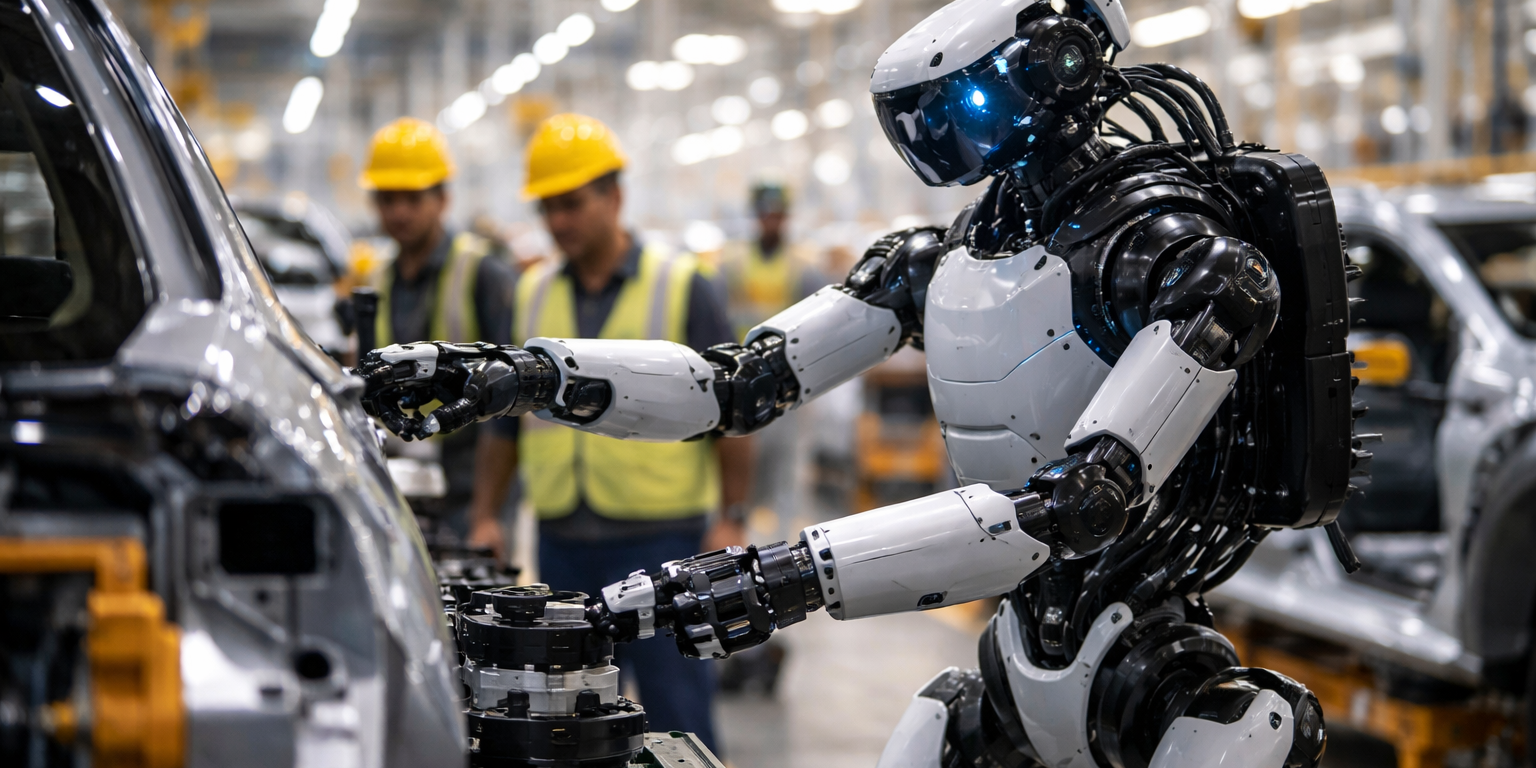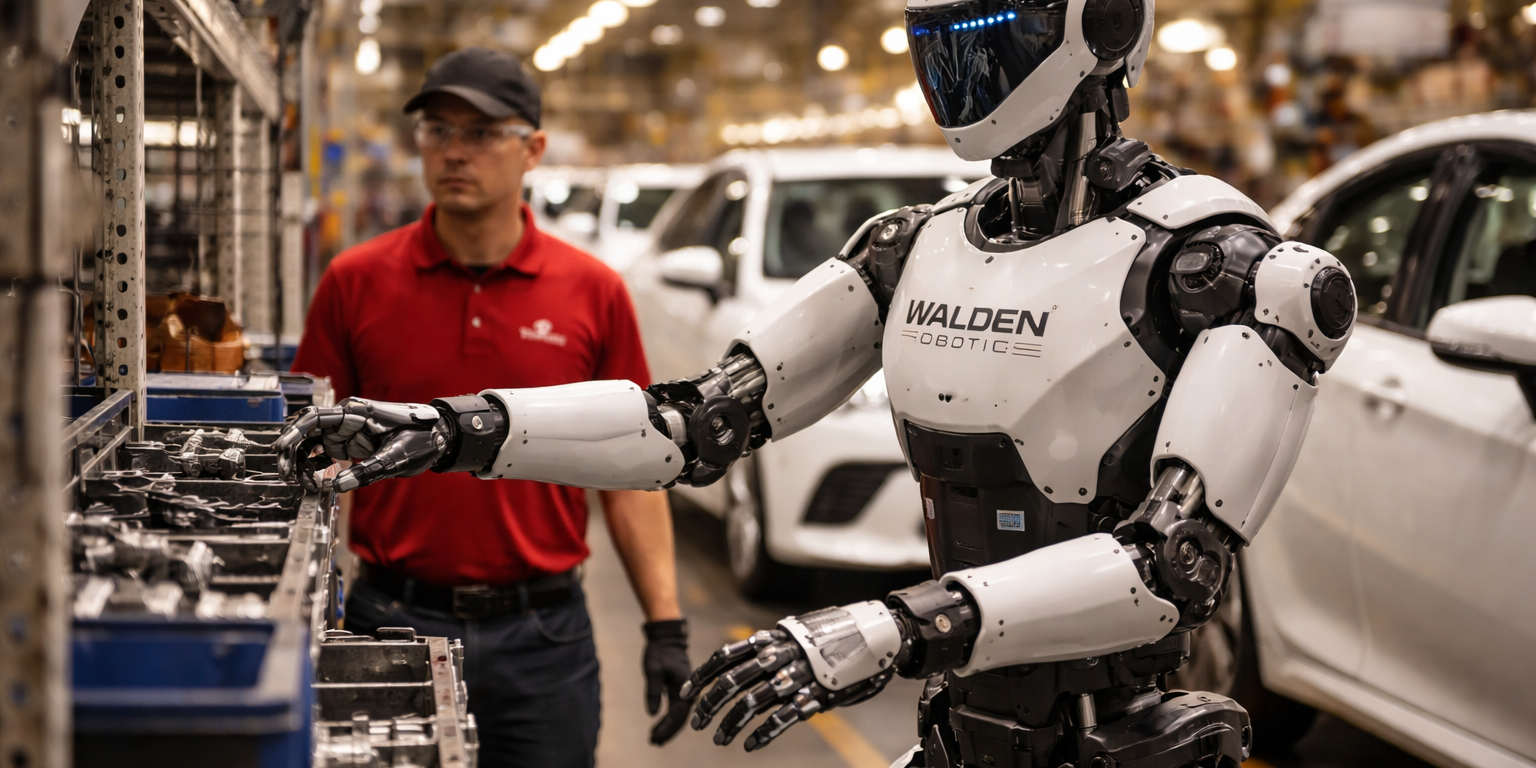
Toyota Motor Corporation will deploy Walden Robotics' humanoid platform across select North American manufacturing facilities starting in Q3 2026, according to both companies. The partnership represents a tactical shift for an automotive giant that has historically developed robotics capabilities in-house, and signals growing interest in practical humanoid applications after two years of hype-driven market turbulence. Walden, founded in early 2024 by former Boston Dynamics engineers Sarah Chen and Marcus Wolff, has avoided the funding frenzy that propelled competitors like Figure AI and 1X to billion-dollar valuations by focusing exclusively on industrial use cases with near-term ROI potential. Toyota declined to disclose financial terms but confirmed the partnership includes joint development rights and an option to license Walden's control architecture for internal projects. The initial deployment will focus on parts retrieval and quality inspection tasks in Toyota's Georgetown, Kentucky assembly plant, where the company manufactures the Camry sedan and RAV4 crossover.
The timing matters. Between mid-2023 and early 2025, venture capital poured approximately $4.2 billion into humanoid robotics startups, driven largely by demonstrations of bipedal mobility and dexterous manipulation that seemed to promise general-purpose robots within reach. Reality proved more complicated. Figure AI's commercial launch slipped twice. Agility Robotics' Digit faced integration challenges at Amazon fulfillment centers. Apptronik's Apollo drew skepticism over payload capacity claims. By late 2025, investors began demanding clearer paths to revenue, and several well-funded startups quietly pivoted toward more constrained problem sets. Walden emerged from that recalibration with a different thesis: humanoid form factors make sense for specific manufacturing contexts where existing automation fails, but only if the robots can be deployed and maintained without specialized robotics expertise. The company's platform uses standardized joint modules and a simplified programming interface designed for factory floor technicians, not research engineers. Chen has described the approach as "IKEA for industrial humanoids" in private investor meetings, though the company avoids that phrasing publicly.
Toyota's interest stems from persistent automation gaps in its manufacturing operations. While the company pioneered lean manufacturing and extensively automated body welding and painting, final assembly remains heavily manual. Tasks like routing wiring harnesses through tight spaces, inspecting interior trim alignment, and retrieving parts from mixed-bin storage resist traditional robotic solutions due to variability and spatial constraints. Humanoid robots, in theory, can navigate human-scaled work environments and manipulate objects designed for human hands without requiring infrastructure overhauls. Toyota has tested industrial robots from Universal Robots, ABB, and Fanuc in these contexts with limited success. The company also operates its own robotics research division, which developed the T-HR3 humanoid prototype in 2017 but never commercialized the platform. According to sources familiar with the partnership discussions, Toyota chose to work with Walden after observing the startup's demonstration at the Robotics Summit & Expo in Boston last May, where Walden's humanoid successfully performed a complex parts-matching task typically requiring three minutes of human labor in under ninety seconds, with 99.7 percent accuracy over fifty trials.
Walden's technical differentiation lies in its modular actuation system and what the company calls "task-specific kinematic optimization." Rather than designing a single humanoid configuration, Walden's platform allows facilities to adjust limb length, joint torque profiles, and end-effector mounting points based on specific task requirements. A humanoid configured for parts retrieval in a warehouse might have longer arms and different gripper mechanics than one handling quality inspection on an assembly line. The system runs a proprietary motion planning stack built on ROS 2 but abstracts most of the complexity behind a visual programming interface. Factory technicians define tasks by demonstrating them while wearing a motion capture suit, then the system generates and refines the robot's movement patterns through simulation before deployment. Walden claims this reduces programming time from weeks to hours compared to traditional industrial robot integration. The company has secured patents on its joint module design and the simulation-to-deployment pipeline, though Chen acknowledged in a recent interview with Robotics Business Review that competitors will likely replicate key innovations within eighteen to twenty-four months. Speed to market and manufacturing partnerships represent Walden's primary competitive moats.
What to Watch: Toyota plans to expand the Walden deployment to at least two additional North American plants by Q1 2027 if the Georgetown pilot meets performance targets. Walden is reportedly in advanced discussions with two other automotive manufacturers and a major aerospace contractor, with potential announcements expected before the end of 2026. The company will need to demonstrate sustained reliability and prove out its maintenance model, as humanoid robots operating in industrial environments have historically suffered from joint wear and sensor calibration drift that traditional automation avoids. Watch for competing modular humanoid platforms from established automation vendors like ABB and KUKA, both of which have research programs in this space but have not yet announced commercial products.