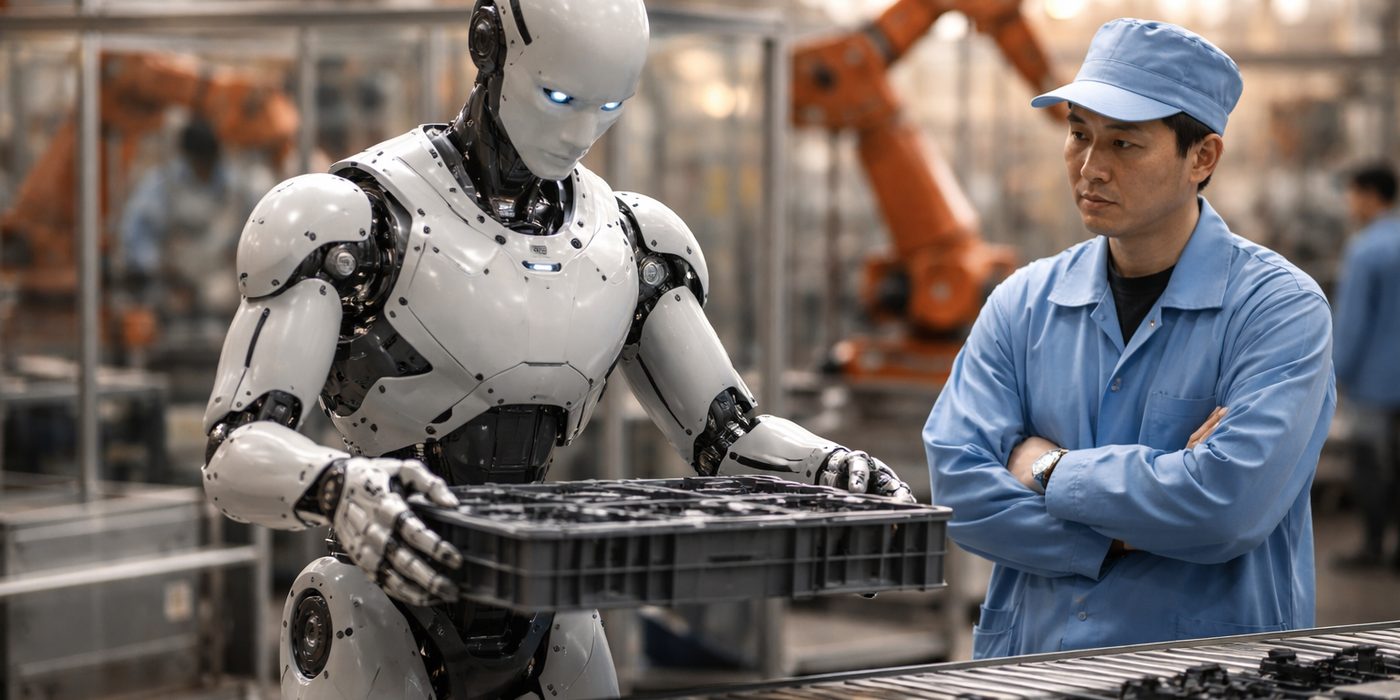
Somewhere between a cafe counter and a Korean assembly line, the humanoid robot industry is running an experiment it has not tried anywhere else: letting a rival nation's hardware prove itself on a market that is simultaneously spending heavily to replace it. UBTech, Unitree, AgiBot and Anyverse are all pursuing pilots in South Korea, according to reporting from The Gadgeteer, and the work has moved past the glass cases of trade shows. These are working trials, with robots handling real tasks in real facilities. For Chinese suppliers, Korea is an attractive proving ground. It is a wealthy, highly automated manufacturing economy with a shrinking labor pool and a proven appetite for robots.
The pitch is easy to understand and hard for operators to ignore. Chinese humanoid makers have spent the past two years driving unit prices down at a pace Western and Korean competitors have struggled to match, with Unitree's compact G1 and R1 platforms setting the reference point for what a capable bipedal machine should cost. That pricing pressure arrives in a country where factory managers face rising wages, an aging workforce and chronic difficulty filling night shifts. Cafe pilots serve a different purpose. A robot pouring drinks in a Seoul storefront is cheap marketing and a low-stakes way to gather uptime data before anyone commits to a production-floor contract.
Seoul, however, has no intention of watching from the sidelines. The Korean government has committed billions of dollars to domestic robotics and physical AI, and the logic is blunt: if imported humanoids set the standard, Korea risks repeating the experience of other industries where it became a high-volume buyer of someone else's core technology. Korea's conglomerates already hold serious positions in the supply chain, from actuators and reducers to batteries, displays and the semiconductors that anchor on-board compute. Hyundai-owned Boston Dynamics, Samsung's robotics push and LG's investments give the country anchors that few markets can match. The policy bet is that owning strategic components, and the software that controls them, matters more than owning the final chassis.
For engineers and investors, the useful signal sits underneath the headline. Hardware is converging fast. A humanoid that walks, grips and carries a tote is becoming a commodity faster than most forecasts assumed, which means differentiation is migrating toward manipulation quality, fleet software, safety certification and the data loop between deployment and model training. That is precisely where Korean policy is aiming its money, and where foreign pilots are quietly valuable. Every hour a Chinese robot logs in a Korean plant generates operational data, and the question of who retains that data, who certifies the machine and who services it will shape the commercial terms far more than sticker price. Procurement teams that treat these trials as simple price comparisons are underestimating what they are handing over.
The competitive picture is also less binary than the framing suggests. Korean manufacturers can buy Chinese bodies while building Korean brains, and several of the component categories that go into those bodies still run through Korean or allied suppliers. Security reviews, data-residency rules and the geopolitical temperature between Seoul and Beijing will determine how far any pilot can scale. A cafe trial faces almost no scrutiny. A humanoid inside a semiconductor or automotive facility faces a great deal. Expect the factory trials to be the real test, not for whether the robots can do the work, but for whether Korean buyers are willing to let them stay.
What to Watch Track whether any of the four vendors converts a pilot into a named, paid production contract at a Korean manufacturer, since announced trials are cheap and signed purchase orders are not. Watch Korean government funding disbursements and any new humanoid-specific procurement rules through the first quarter of 2027, particularly around data handling and security certification for foreign-made robots. Follow Unitree's pricing moves on its G1 and R1 lines, because further cuts would sharpen the squeeze on domestic entrants. Finally, monitor announcements from Hyundai, Samsung and LG on in-house humanoid timelines, which will show how quickly Korea's own champions plan to close the gap.