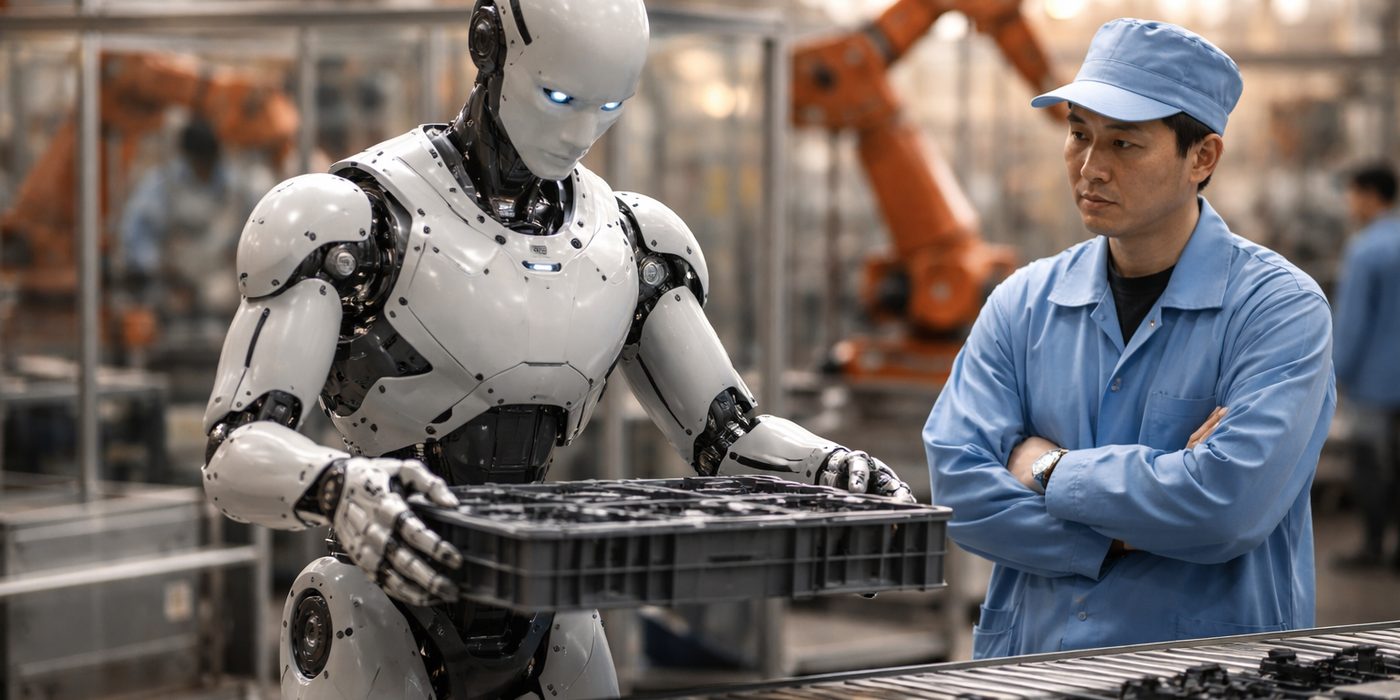
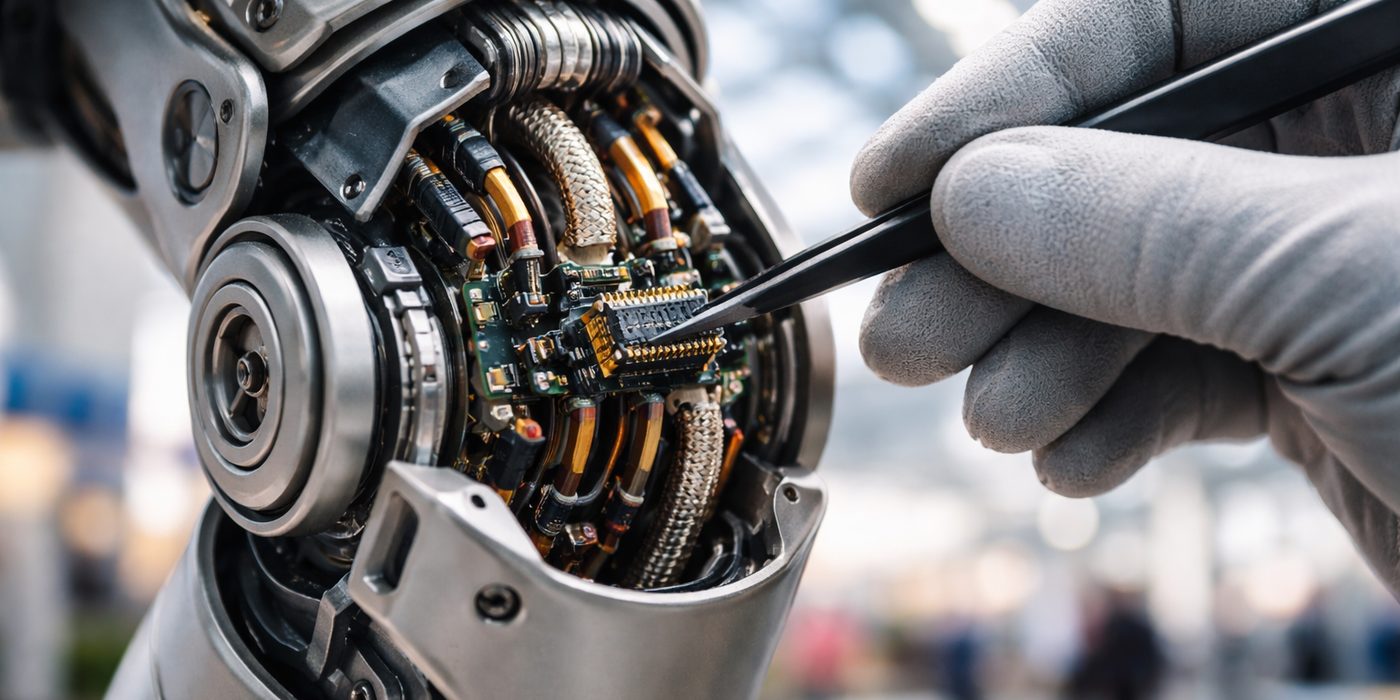
A humanoid robot's knee joint may flex tens of thousands of times in a single day of warehouse work, and every one of those cycles stresses the connector sitting behind it. That is the problem Samtec intends to put front and center when it exhibits at electronica 2026 in Munich, where the Indiana-based interconnect maker will show high-cycle connectors, high-density board-to-board arrays, and ruggedized I/O products. The company is grouping the display around three markets: defence, aerospace, and humanoid robotics. The first two are familiar territory for a supplier with decades of mil-aero qualification work. The third is newer, and its inclusion tells you where Samtec sees volume coming from.
The logic is straightforward once you open up a humanoid. A bipedal platform packs dozens of actuators, a dense sensor suite, and one or more compute modules into a torso and limbs that were never designed as electronics enclosures. Signals and power must cross joints that rotate, twist, and take impact loads. Conventional board-level connectors are built for a few hundred mating cycles and a static life inside a chassis. Robotics demands something different: connectors that tolerate vibration, shock, repeated flexing, and tight packaging envelopes, while moving high-speed data from vision sensors and tactile arrays back to the processing core. Samtec's high-density array families and its rugged, sealed offerings are positioned to address precisely that mix of constraints.
The defence and aerospace angle is not a side show; it is the credential that makes the robotics pitch credible. Qualification regimes for those sectors, covering thermal cycling, shock, vibration, and long-term reliability, give suppliers a body of test data that humanoid builders can lean on instead of repeating years of validation themselves. Many robotics startups have discovered the hard way that a connector that passes bench testing can fail in the field after weeks of real motion. A supplier that already ships into airframes and ground vehicles can shorten that learning curve. Samtec has long sold high-speed and high-density interconnect into these markets, and electronica gives it a European stage to show the same product lineage to robot makers.
Munich is also a calculated choice of venue. Europe has a growing humanoid and mobile manipulation ecosystem, and electronica draws the component buyers, power-electronics specialists, and embedded-systems engineers who make the unglamorous sourcing decisions behind a robot's bill of materials. For investors, that is the useful lens. Humanoid valuations tend to track demos and model benchmarks, but production economics hinge on parts like connectors, harnesses, and slip-ring alternatives that determine mean time between failures and service cost. As makers target production runs in the thousands rather than dozens, the reliability of every board-to-board and wire-to-board link multiplies across the fleet. A single weak interconnect design, replicated across thousands of units, becomes a warranty problem measured in real money. Suppliers that can offer qualified, catalog-available parts with engineering support stand to capture design wins early, before platforms lock in their architectures.
The sharper observation is about leverage. Humanoid makers are racing to differentiate on actuators, batteries, and AI, which leaves interconnect as a layer where almost nobody wants to innovate yet everybody depends on the result. That creates an opening for established suppliers to become de facto reference-design partners, much as they did in data centers and automotive. If Samtec can get its parts specified into a handful of leading humanoid platforms, it gains visibility into the next generation of designs and a voice in how joint-crossing signal paths are standardized. The company's willingness to market to robotics alongside defence also hints at a broader pattern: components proven in harsh, low-volume aerospace programs are being repurposed for what many expect to become a high-volume robotics market.
What to Watch Track which humanoid makers appear in Samtec's electronica 2026 booth materials and partner announcements over the coming weeks, since named design wins would confirm the robotics push has traction beyond marketing. Watch for competing connector suppliers, including TE Connectivity, Amphenol, and Molex, to answer with their own humanoid-specific product launches or reference designs before year-end. Pay attention to whether any humanoid manufacturer publishes cycle-life or field-failure data for joint connectors, which would turn an invisible component into a measurable benchmark. Finally, follow electronica 2026 session programming on robotics and power electronics for signs that interconnect standards for joint-crossing signals are starting to emerge.