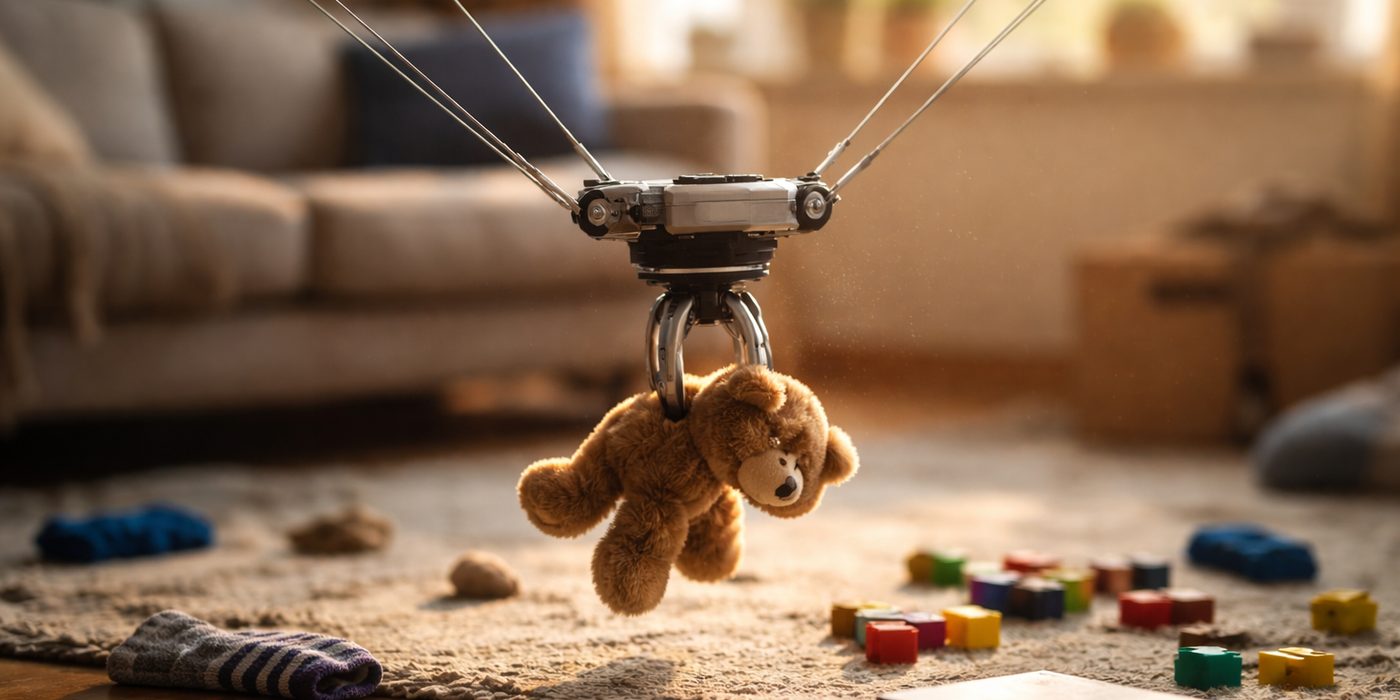
Eight hundred dollars buys almost nothing in robotics. It will not get you a serious industrial gripper, a decent lidar, or a month of cloud inference for a fleet. Neufangled Robotics is asking $795 for something different: Stringman, a cable-driven robot that spans an entire room and picks up the clutter on the floor. IEEE Spectrum flagged it in its Video Friday roundup, where the editors called the form factor novel and underrated, and the product is now available to order. The machine does not walk, roll, or balance. It hangs. Cables anchored at points around the room's perimeter carry a lightweight end effector through three-dimensional space, reeling it in and out to reach any spot the lines can cover.
Cable-driven parallel robots are not new. Researchers have studied them for decades, and the same basic geometry moves cameras above stadium fields and positions payloads in large telescope arrays. The appeal is simple physics. Winches and thin cables are cheap, light, and scale to enormous workspaces without the cost curve that punishes rigid arms as they grow. A rigid manipulator that could reach across a living room would need massive links, powerful joints, and a base heavy enough to resist tipping. A cable system trades all that for tension and software. The trade-off is that every cable must stay taut and unobstructed, which makes calibration, collision avoidance, and anchor placement the real engineering problems. Stringman's bet is that those problems have finally become tractable at consumer prices.
That bet looks sharper when set against the rest of the household robotics market in 2026. The industry's loudest capital is flowing toward general-purpose humanoids, machines designed on the premise that homes are built for human bodies and so robots should have them. Those platforms carry price tags in the tens of thousands of dollars, and their makers are still working through reliability, safety certification, and battery life before any serious in-home volume. Stringman sidesteps the premise. Rather than adapting a robot to an environment designed for people, it adapts the environment to the robot, accepting a one-time installation in exchange for a workspace the device covers without ever navigating a stair, a doorway, or a pet. The result is a narrow tool aimed at one chore, floor-level tidying, rather than an aspiration toward doing everything.
For engineers, the interesting questions sit in the details Neufangled has to get right. Cable robots live or die on workspace geometry: the shape of the room, the placement of the anchor points, and whether furniture creates dead zones where lines cannot pass. Grasping unstructured household objects from above, with a lightweight end effector that cannot exert much force, is a perception and manipulation challenge that has humbled far better-funded teams. There is also the human factor. A robot that strings lines across a living room must be safe around children and animals, which means tension limits, fault detection, and graceful failure all matter as much as the pick-and-place success rate. How Neufangled handles those edge cases will determine whether Stringman is a product or a curiosity.
The broader implication is about where value accrues in home automation. The humanoid thesis assumes the hard, expensive part is the body, and that general intelligence will eventually fill it. Stringman suggests a competing view: that task-specific mechanisms paired with modern vision and planning software can deliver real utility years earlier and at a fraction of the cost. Investors weighing nine-figure bets on bipedal platforms now have a data point at the opposite end of the spectrum, a device priced like a mid-range gaming console. If buyers install it and keep using it, the lesson will be that household robots may arrive as many small, odd machines before they arrive as one universal one. If they do not, the humanoid camp gets a useful argument that cheap and narrow does not stick.
What to Watch
Watch for the first independent teardown and long-term user reports on Stringman, which will show whether the $795 price holds up against real installation effort and grasp reliability in cluttered rooms. Track whether Neufangled Robotics discloses shipment volumes or a pre-order backlog in the coming weeks, since unit counts at this price are the clearest early signal of consumer appetite. Keep an eye on CoRL 2026, running 9-12 November in Austin, for academic work on cable-driven manipulation and household grasping that could validate or challenge the approach. Finally, follow Humanoids 2026, scheduled for 6-9 December in Santa Clara, where the humanoid camp's cost and capability claims will be on display and invite direct comparison.