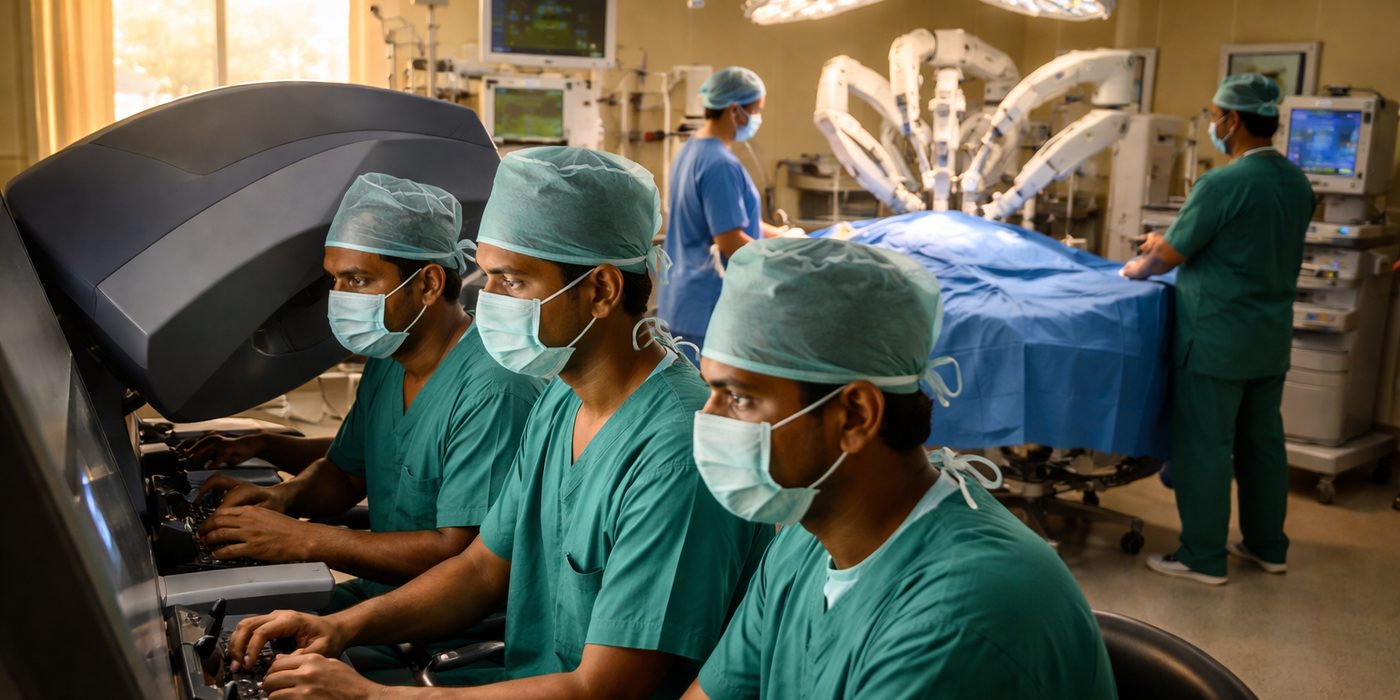
The first robot to operate inside a human eye was a research curiosity that took years to reach patients. Its creators have now left that lineage behind. On October 29, 2026, VisioSurgical Solutions (VSS) emerged in Lausanne, Switzerland, with a founding team that includes the engineers behind the first retinal surgery robot, and a stated mission to develop a compact surgical platform for retina surgeons worldwide. The company announced its launch and the start of development in the same breath. No product exists yet. What exists is a thesis: that the barrier to robotic retinal surgery was never whether a machine could do it, but whether a hospital could afford the space, the capital, and the disruption of installing one.
That thesis rests on an uncomfortable fact about the field. Retinal surgery sits near the hard limit of what human hands can do. Surgeons work through ports barely a fraction of a millimeter wide, manipulating membranes on the retina that are measured in microns, while contending with physiological tremor that no amount of training eliminates. Robotics should be a natural fit, and for more than a decade researchers have said so. Early systems proved the concept, with prototypes and first-in-human work demonstrating that a robotic arm could steady an instrument inside the eye better than a hand could. But proving a concept and building a business around it are different engineering problems, and the second has proven stubborn.
The obstacle is mostly economic and spatial rather than technical. Retinal procedures are high-volume and relatively short, often performed in ambulatory surgery centers where operating-room real estate is tight and capital budgets are tighter. A large, multi-arm platform of the kind that defined soft-tissue robotics in the abdomen does not translate to a procedure where the surgeon already sits at the patient's head with a microscope and a footswitch. Every added cart, tower, or console competes for floor space and for the surgeon's workflow. VSS appears to have absorbed that lesson. The company's emphasis on a compact form factor is a direct answer to why earlier retinal systems stayed confined to academic centers and clinical studies rather than spreading into routine practice.
For investors and engineers watching medical robotics, the launch is notable less for what VSS has built than for who is building it. Founding teams with a first-of-its-kind system behind them carry something rare in this sector: hard-won knowledge of regulatory pathways, clinical trial design, and the failure modes that only surface when a robot meets a real patient. That experience is expensive to acquire and cannot be hired off a job board. It also shapes the risk profile. A team that has already shipped one generation of hardware knows which assumptions about haptics, instrument exchange, and surgeon ergonomics collapse under clinical use. The Swiss setting adds its own advantage, placing the company inside one of Europe's densest clusters of precision engineering, microtechnology, and medical-device talent, with EPFL's robotics and microengineering ecosystem a short distance away.
The broader implication reaches past ophthalmology. Medical robotics has spent years chasing larger platforms and broader indications, and the commercial results have been uneven outside a few dominant franchises. VSS represents a different strategy: narrow the anatomy, shrink the footprint, and win a single specialty where precision demand is extreme and incumbent automation is nearly absent. If a compact retinal robot can clear regulatory review and fit into an existing surgical suite without redesigning it, it would validate a playbook that other microsurgical fields, from otology to neurosurgery, could follow. If it cannot, the episode will reinforce the view that eye surgery is a technology looking for a market. The company has been explicit that development is only beginning, which means the evidence that matters, including prototype performance, clinical partnerships, and regulatory strategy, is still ahead.
What to Watch
The first signal will be funding: VSS has not disclosed its backers or round size, and a named lead investor or seed figure would indicate how seriously capital markets rate the compact-robot thesis. Watch for announcements of clinical or academic partnerships in Switzerland and across Europe over the coming weeks, since early surgeon collaborators will shape both the design and the regulatory path. Track whether VSS names a target regulatory route, whether CE marking under the EU Medical Device Regulation or an FDA submission, and any timeline it attaches to a first prototype. Finally, keep an eye on competing retinal and microsurgical robotics programs for any pricing or footprint disclosures, because the compact-versus-capable debate will be settled by hospital purchasing decisions, not press releases.