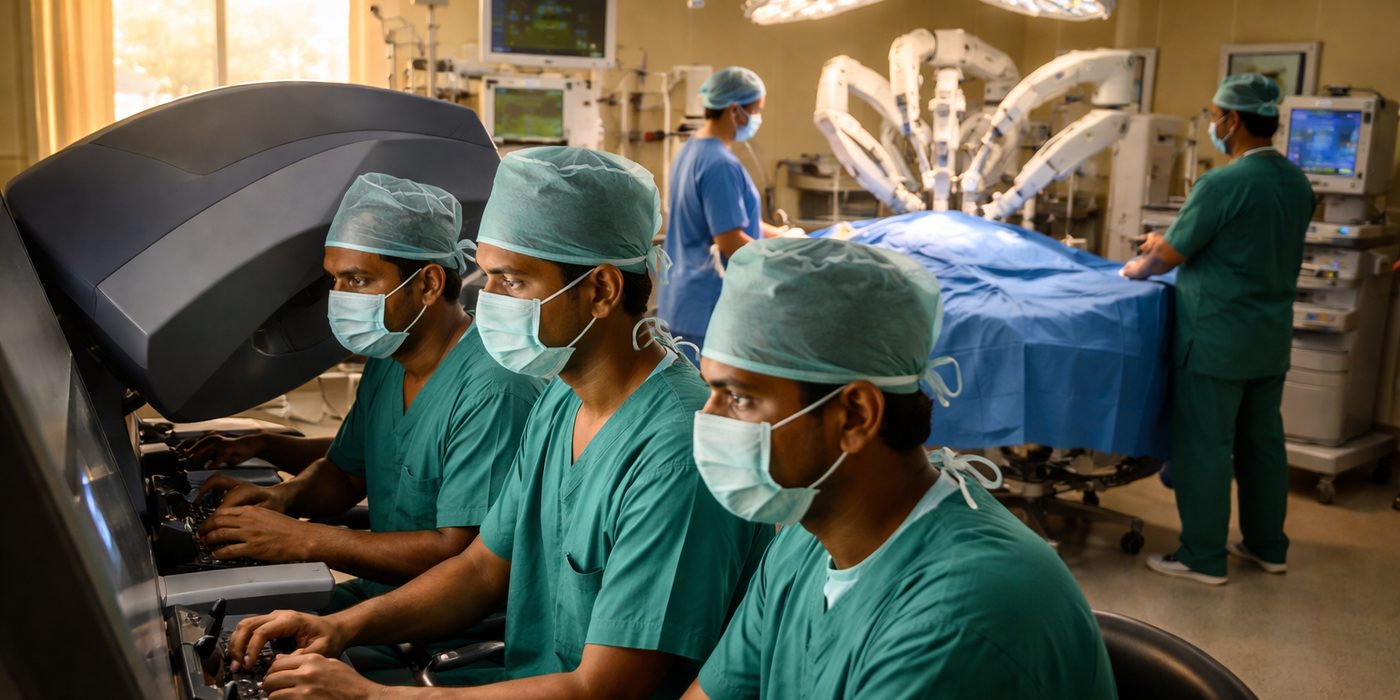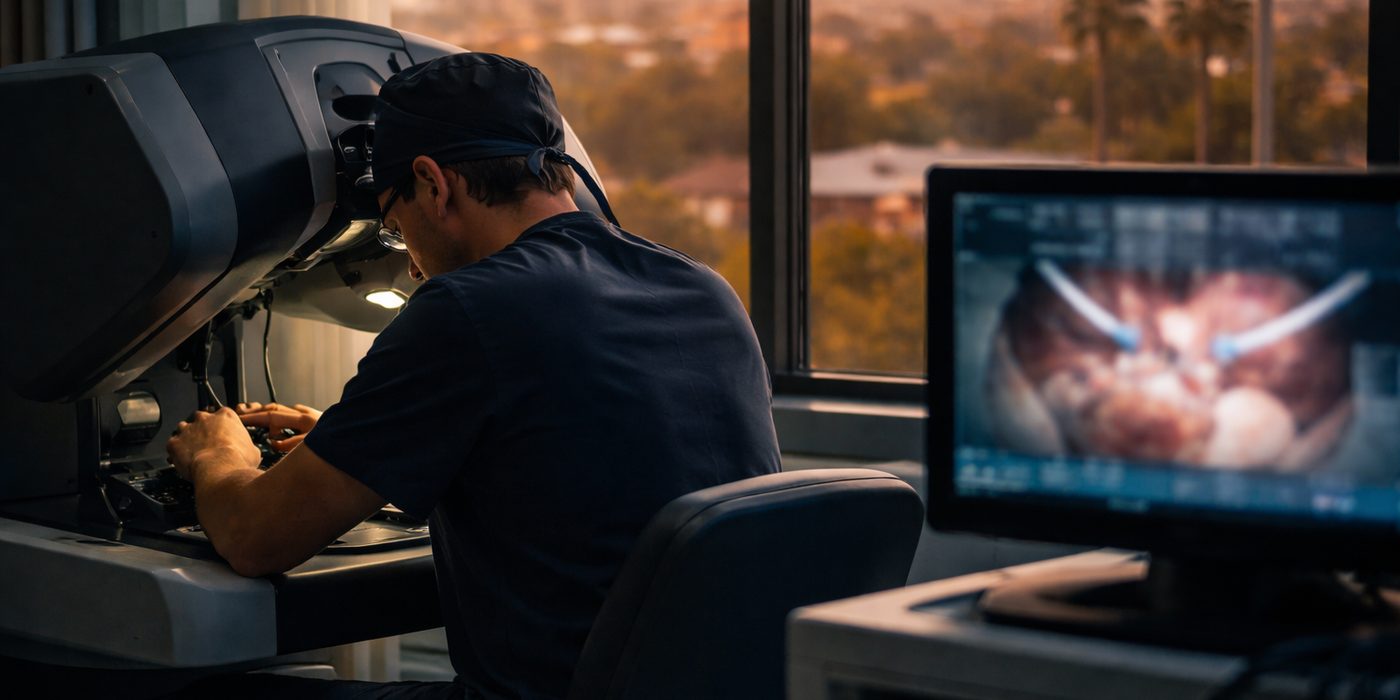
Thirty-five miles is not an impressive distance by the standards of telesurgery stunts. Surgeons have operated across oceans in trials dating back to the 2001 Lindbergh operation, when a team in New York removed a gallbladder from a patient in Strasbourg, France. What makes the Florida procedure notable is how ordinary the geography is. Dr. Vipul Patel, founder and medical director of the Global Robotics Institute at AdventHealth Celebration, sat at a console in one Florida hospital while a patient lay on an operating table in another, roughly the distance between downtown Orlando and its farther suburbs. That is a commuter's distance, and it is exactly the scale at which a health system might actually use the technology.
The case for telesurgery has always been about access rather than spectacle. Surgical expertise is concentrated in a handful of academic and high-volume centers, while patients who need complex robotic procedures, such as prostatectomies, are scattered across community hospitals that may perform too few cases to build or retain that skill. Patel is a natural figure to anchor the effort. His institute sits inside one of the largest nonprofit health systems in the United States, and robotic urologic surgery is the discipline where the console-and-arm architecture has been most thoroughly proven. A system that lets one high-volume surgeon extend his hands to a second site changes how a hospital network can think about staffing, referral patterns, and capital allocation.
The engineering burden in a procedure like this falls on the network, not the manipulator. Surgeons tolerate only a narrow window of delay between a hand movement and the instrument response before fine tissue work becomes unsafe, and that tolerance shrinks further when the tissue involved is delicate. Over a dedicated fiber path of 35 miles, propagation delay is a rounding error; the harder problems are jitter, packet loss, and failover. A dropped connection mid-dissection is a patient-safety event, so these systems depend on redundant links, local fail-safe behavior at the patient-side cart, and a bedside team capable of converting to conventional or standard robotic surgery on short notice. Those safeguards, more than the arms themselves, determine whether a hospital's risk committee will sign off.
For the robotics industry, the milestone lands in a market that has been waiting for regulators and payers to catch up with the hardware. The installed base of surgical robots numbers in the thousands, but nearly all of them operate with the surgeon in the same room as the patient, which makes telesurgery an unproven revenue line rather than a feature on a spec sheet. Vendors face a strategic choice. They can treat remote operation as a software and connectivity layer added to existing platforms, or they can design new systems around it from the start. Either path pulls networking vendors, cybersecurity firms, and telecom carriers into the surgical supply chain in ways that traditional robot makers have never had to manage. The surgeon's console becomes, in effect, an endpoint on a critical medical network, with all the authentication, encryption, and audit requirements that implies.
The next questions are commercial and legal rather than technical. Who is liable when a remote surgeon and a local bedside team disagree? How do state licensing rules apply when a surgeon operates on a patient across an institutional boundary, even within one state? Will insurers reimburse a remote procedure at the same rate as an in-person one, or discount it? Until those answers firm up, telesurgery will remain a supervised, case-by-case capability at well-resourced systems like AdventHealth, not a service a community hospital can simply purchase. The Florida case gives the industry something it has lacked: a domestic, short-range, clinically ordinary example that regulators and hospital boards can evaluate without the exotic framing of a transoceanic record.
What to Watch
Track whether AdventHealth discloses patient outcomes, case counts, or conversion-to-conventional rates from the Global Robotics Institute through the end of 2026, since a single procedure establishes feasibility but not safety. Watch for FDA clearance language from surgical robot makers that explicitly covers remote operation, which would be the clearest signal that a commercial product is moving from trial to market. Follow telecom partnerships and dedicated-network announcements from carriers courting health systems, as connectivity contracts will show where the real money in telesurgery lands. Finally, monitor Medicare and private-payer coverage guidance in the coming quarters, because reimbursement policy, not hardware capability, will decide how fast hospitals adopt.