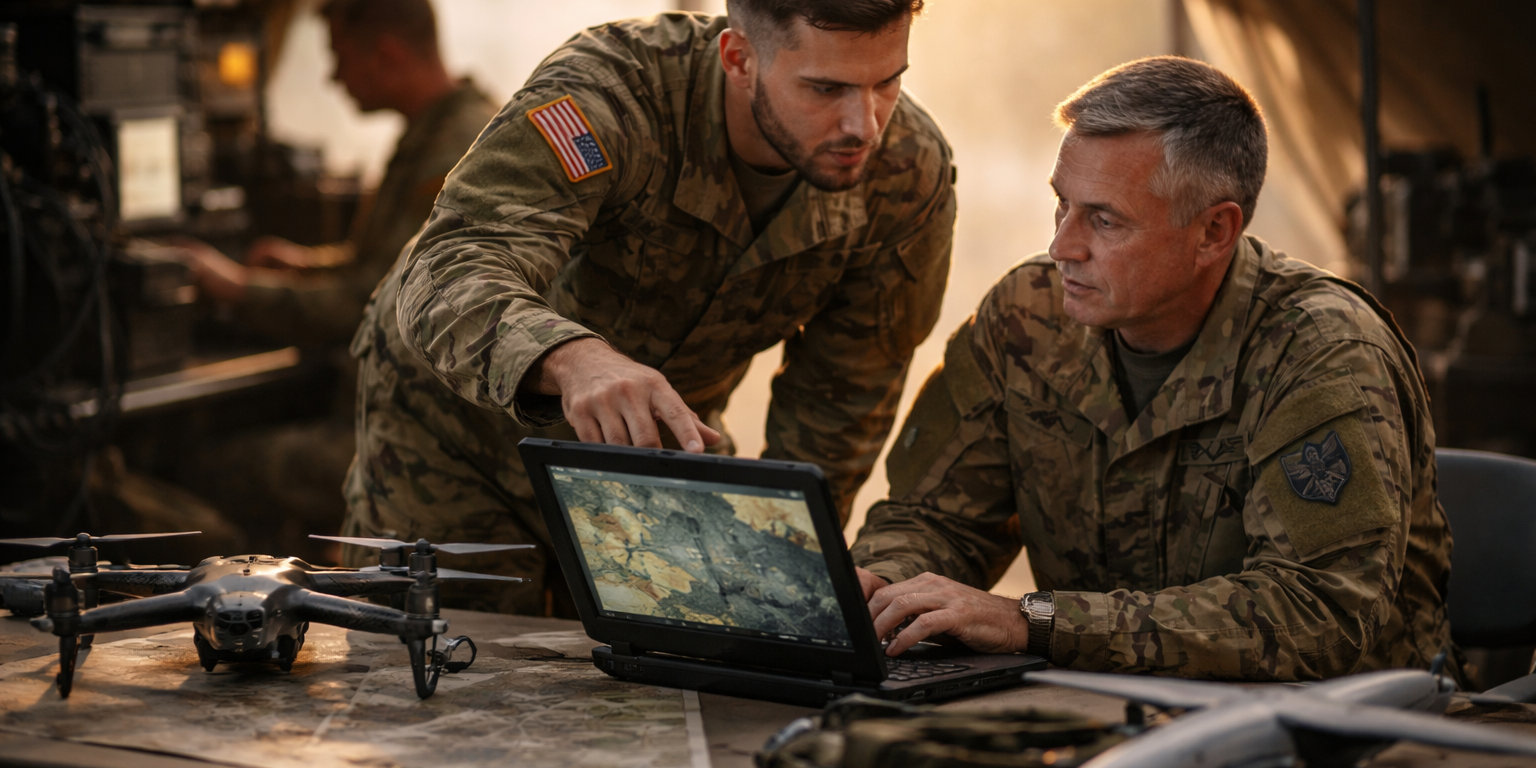
The U.S. Army now has a job whose entire purpose is telling commanders what to do with their robots. The service has created a robotics technician position, a specialist role built around autonomous and unmanned systems, with a mandate that goes beyond flying or maintaining drones. These soldiers are meant to function as staff-level advisers, translating the capabilities and limits of autonomous platforms into operational decisions. It is a small organizational change with outsized implications. For years, drone expertise in Army formations has been informal: a lieutenant who happened to be good with quadcopters, a sergeant who learned on the fly. That era is ending, and the shift from improvisation to institution is the real story.
The move follows a pattern that has been building since the war in Ukraine rewrote assumptions about low-cost aerial systems. Both sides there have fielded drones by the hundreds of thousands, adapting hardware and tactics in weeks rather than procurement cycles. Army leadership took note. Over the past two years the service has pushed to field attritable systems at the company and platoon level, expanded drone training at installations across the country, and set ambitious targets for the volume of small unmanned aircraft in its inventory. What it lacked was a career path. A soldier who masters electronic warfare, autonomy stacks, and mission planning for unmanned platforms had no formal home in the personnel system, which meant that expertise was easily lost to reassignment, attrition, or the simple churn of unit rotations.
The technician role addresses that gap directly. Based on the service's description, the position combines technical depth with advisory responsibility. These soldiers will understand how autonomous systems behave under contested conditions, including degraded communications, GPS denial, and electronic attack, and will counsel commanders on tradeoffs. Should a swarm be committed now or held back? Is a given platform suited to reconnaissance, strike, or logistics in this terrain? Which systems can operate without a persistent data link, and which will fail the moment the spectrum gets crowded? That judgment is precisely what separates a unit that uses drones from one that fights with them. Embedding it in a trained, credentialed specialist gives commanders a consistent source of advice rather than whatever the nearest enthusiast happens to know.
For the robotics industry, the practical consequences ripple outward. A formal occupational specialty implies a standardized curriculum, and standardized curricula tend to favor standardized equipment. Vendors whose platforms are open, modular, and easy to integrate into training pipelines stand to benefit; those selling closed, proprietary systems that require bespoke instruction may find themselves at a disadvantage. The role also creates a new kind of customer voice. Technicians who return to their units after schooling will form opinions about what works, and those opinions will feed back into requirements, field feedback, and eventually procurement. Companies like Anduril, AeroVironment, Skydio, and the growing field of smaller attritable-drone makers will want to understand how these specialists are trained and what they are taught to prioritize. Autonomy software providers face a similar calculus, since an adviser who must explain a system's behavior to a commander favors tools that are interpretable and predictable.
There is also a workforce angle that investors should not overlook. Skilled operators and technicians for autonomous systems are scarce, and the commercial sector competes for the same people. By building a dedicated career field, the Army is making a bet that it can recruit and retain talent that might otherwise drift to defense contractors or civilian drone operators. If that bet pays off, it strengthens the pipeline of experienced personnel who understand autonomy at an operational level, a population that eventually feeds back into industry. If it fails, the service will keep losing its best drone people to higher-paying employers, and the technician role will exist mostly on paper. The retention numbers will matter more than the announcement.
The broader signal is that autonomy is being treated as a permanent warfighting discipline rather than a passing experiment. Establishing a job code is bureaucratic, unglamorous work, and it is exactly the kind of work that indicates a capability is here to stay. Programs get cancelled; occupational specialties tend to endure. For engineers building the next generation of unmanned systems, the lesson is that the human interface, meaning the training, doctrine, and advisory layer wrapped around the machine, is becoming as strategically important as the machine itself.
What to Watch
Track the Army's published training plans and course announcements through the remainder of 2026, particularly any named schoolhouse or installation designated to host the technician pipeline, since that will reveal which vendors' equipment shapes the curriculum. Watch for follow-on solicitations from the Army's drone and counter-drone program offices that reference the new role, a sign that requirements are being written around it. Monitor first-cohort size and recruiting goals, which will indicate how aggressively the service intends to scale. Finally, keep an eye on FY2027 budget language and congressional marks for line items tied to unmanned-systems training, which will show whether funding follows the new job title.