
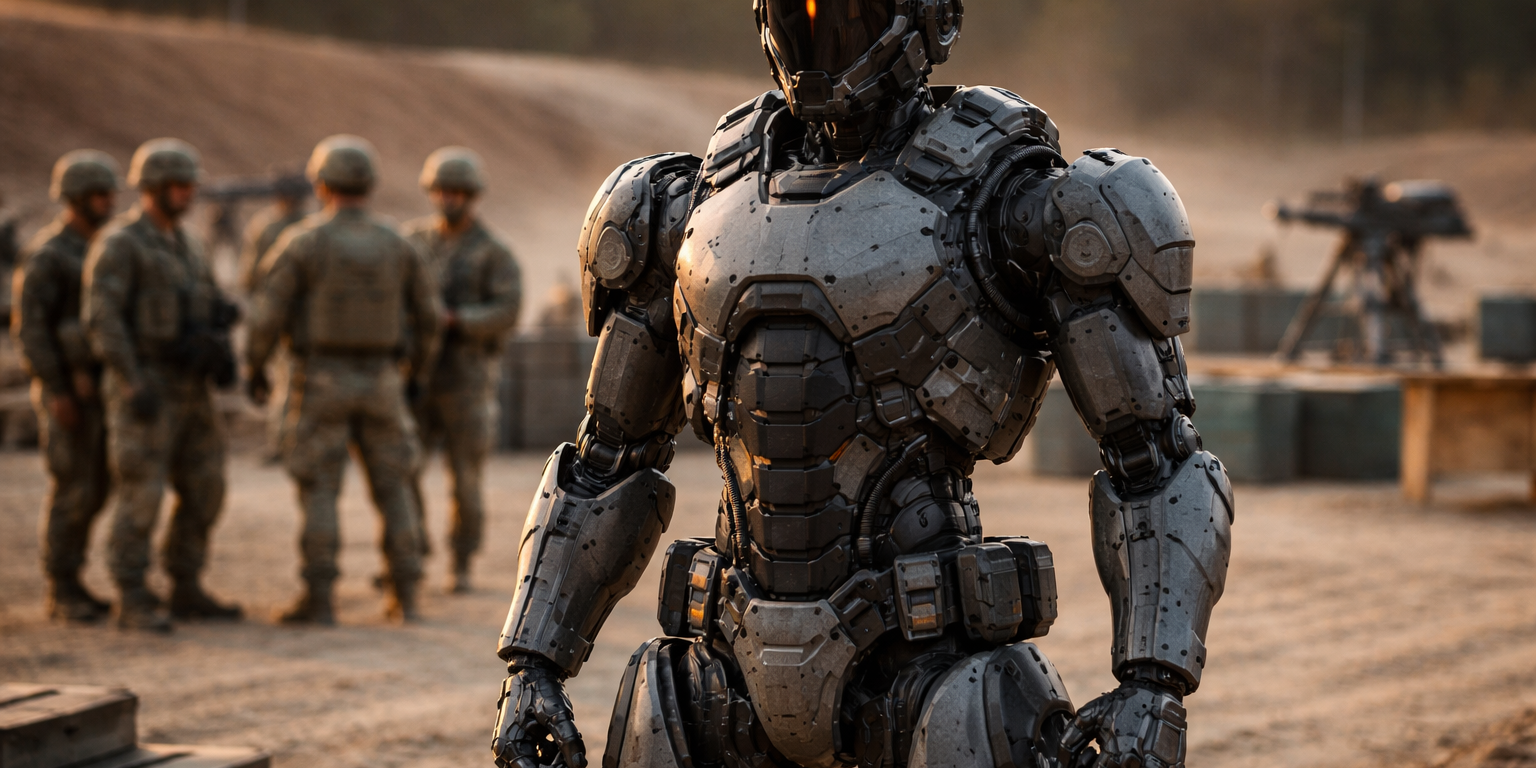
The Army Research Laboratory awarded a contract to a coalition of defense contractors and robotics firms to develop a humanoid robot hardened for combat operations, marking the first military-funded bipedal platform designed from the ground up with ballistic protection integrated into its frame. The system, designated the Advanced Ground Mobility Autonomous Platform, will incorporate ceramic composite armor panels rated to defeat 7.62mm rounds across critical actuator housings and the torso-mounted compute stack. Program managers expect prototype trials at Aberdeen Proving Ground in Maryland beginning in the fourth quarter of 2027, with operational assessments following in 2028 if initial testing validates mobility performance under armor load.
Humanoid robots have proliferated in logistics and manufacturing over the past three years, but those platforms prioritize cost and payload efficiency over survivability. Boston Dynamics, Figure, Agility Robotics, and others ship systems built around aluminum frames and carbon fiber shells. The Army requirement reverses those priorities entirely. Total system weight climbs to 180 kilograms versus the 60-to-80 kilogram range typical of commercial humanoids, but the platform must still traverse uneven terrain, navigate doorways sized for humans, and manipulate standard military equipment without modification. Engineers are compensating with upgraded actuators delivering 40 percent more torque at the hip and knee joints compared to civilian designs, along with a hybrid power system pairing lithium-ion batteries with a compact diesel generator to extend operational endurance beyond eight hours.
The rationale centers on reducing casualty rates in high-risk tasks where human presence remains necessary but dangerous. Explosive ordnance disposal, building clearing in urban combat, and forward observation missions all require manipulation capabilities and environmental adaptability that wheeled or tracked robots struggle to deliver. Previous attempts to field semi-autonomous ground vehicles in these roles have faltered on stairwells, narrow corridors, and complex manipulation tasks like opening doors or moving debris. A bipedal form factor addresses those gaps, but earlier research platforms lacked the durability to survive small arms fire or shrapnel. Army testers destroyed four legged robots and two tracked systems during live-fire exercises at Fort Benning between 2023 and 2025, prompting the shift to armored humanoid architectures. The program also incorporates lessons from Ukrainian and Israeli combat robotics deployments, where lighter commercial drones and ground vehicles have proven effective for reconnaissance but vulnerable when operating within direct line of sight of enemy positions.
The development timeline reflects both urgency and technical risk. Contractors must deliver three prototype units by September 2027, then survive a 90-day evaluation period including live-fire testing, obstacle courses designed to simulate Mosul-style urban terrain, and extended field trials in desert and forested environments. The Army is requiring autonomous navigation and manipulation for defined tasks—opening doors, ascending stairs, retrieving objects—but retains human oversight for all weapon-related decisions. No armament integration is planned for the initial prototypes, though mounting points compatible with standard Picatinny rails are specified in the design. That decision keeps the program focused on mobility and survivability while sidestepping immediate questions about autonomous weapon employment that have stalled previous initiatives. Program officials note that even without weapons, a ballistic-rated humanoid capable of carrying 30 kilograms of sensors or equipment into contested areas could replace human scouts in reconnaissance missions where detection often proves fatal. The Marine Corps has expressed interest in a marinized variant for ship boarding and facility security missions, though no formal joint program has been established.
Broader implications ripple through the defense robotics sector. Competitors who spent the last five years optimizing for warehouse environments now face a new archetype where survivability trumps unit economics. The Army program could validate design principles—armored actuation, redundant power systems, hardened compute modules—that reshape commercial development roadmaps if contractors decide the dual-use potential justifies the engineering investment. Alternatively, the military and civilian humanoid markets may diverge entirely, with defense platforms becoming specialized tools produced in limited quantities while mass-market systems continue pursuing cost reduction. Either outcome clarifies a question the industry has skirted: whether humanoid robots will remain general-purpose machines or splinter into domain-specific variants optimized for radically different operating requirements.
What to Watch: Aberdeen Proving Ground will host the first ballistic testing phase in late 2027; expect detailed performance data on armor integration and mobility trade-offs to emerge from those trials. Monitor whether Boeing, Lockheed Martin, or Northrop Grumman announce partnerships with commercial humanoid manufacturers, signaling movement toward dual-use platforms. The Marine Corps is expected to release a formal requirements document for shipboard humanoid systems in early 2027, which could expand the addressable market significantly.