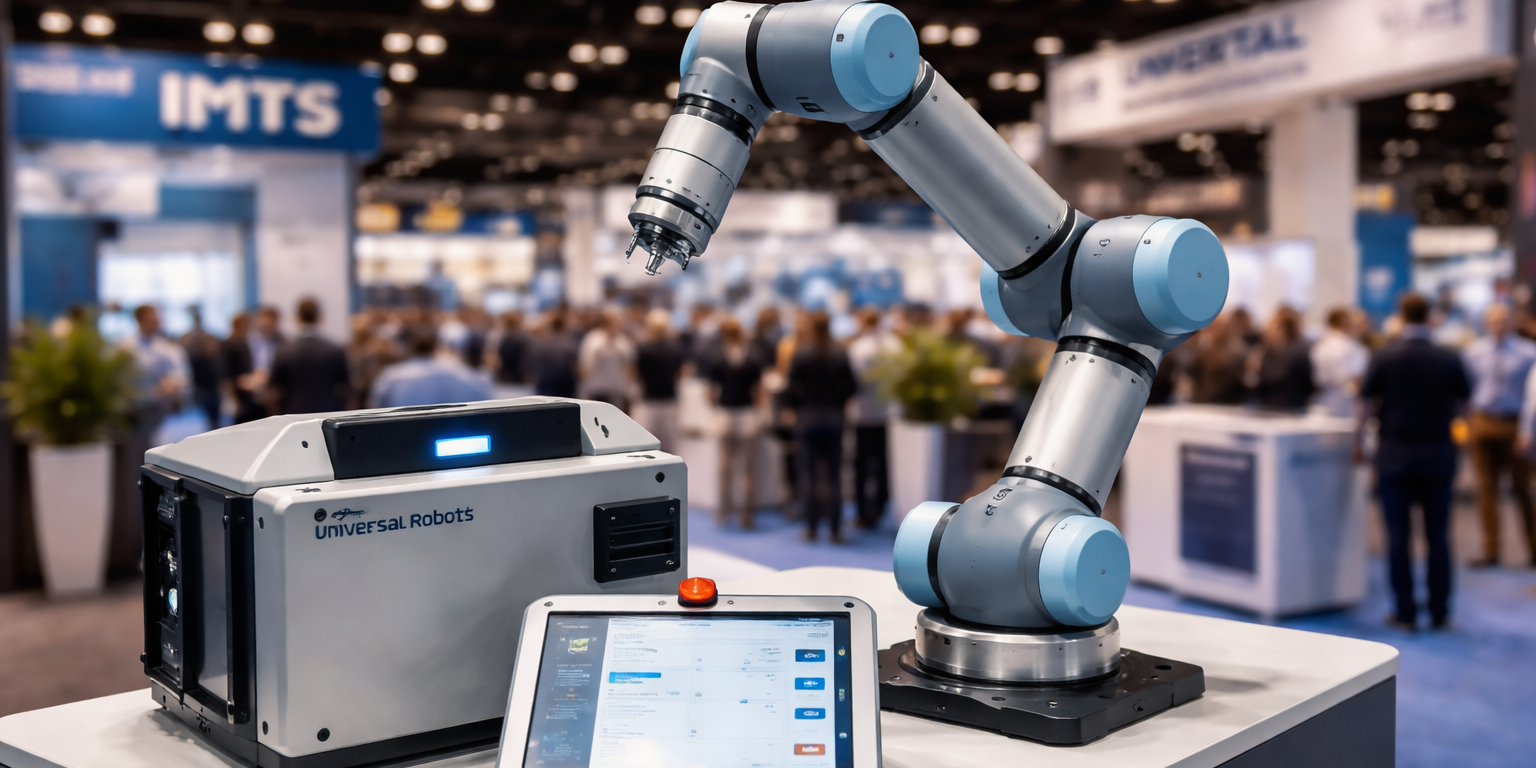
Universal Robots brought its Gen 7 platform to the IMTS tradeshow floor in Chicago on September 14, marking the first complete architectural overhaul of its cobot line in four years. The platform pairs reengineered robot arms with a redesigned control box, teach pendant, and tool flange, but the real change sits in the software layer: the company intends to bridge the gap between AI research prototypes and production-floor deployments, a transition that has consistently stalled in industrial robotics despite significant academic progress.
The Odense, Denmark-based company, operating as a division of Teradyne Robotics since the 2015 acquisition, built its business on accessibility and ease of deployment rather than raw performance. That strategy delivered market leadership: Universal Robots holds an estimated 40 percent share of the collaborative robot segment, a category it effectively created when it shipped its first UR5 arm in 2008. The Gen 7 platform does not abandon that positioning. Instead, it attempts to layer intelligence onto familiar hardware without requiring integrators to rebuild their workflows or retrain operators. Whether that balance proves technically feasible remains the central question, particularly given the computational demands of vision-based manipulation and real-time path planning.
The platform's control architecture handles sensor fusion and model inference locally rather than relying on cloud connectivity, a design choice that matters in facilities where network reliability remains inconsistent or where latency constraints rule out remote processing. Universal Robots has not disclosed processor specifications, but the control box dimensions suggest thermal and power budgets consistent with embedded GPU or NPU configurations rather than discrete accelerator cards. Tool flange redesigns accommodate higher-bandwidth data connections for vision systems and force-torque sensors, addressing a bottleneck that limited previous-generation cobots to relatively simple pick-and-place tasks. The teach pendant, historically a point of differentiation for Universal Robots, now includes interfaces for annotating training data and monitoring model behavior, tasks that previously required separate software environments and export workflows.
Several factors converge to explain the timing of this release. First, the physical AI research community has generated dozens of manipulation policies trained on diverse datasets, but translating those models from simulation or laboratory settings into industrial use cases has proven difficult. Sim-to-real transfer remains brittle, and the data distributions encountered in actual production environments diverge sharply from those in benchmarking datasets. Second, integrators and end users have grown increasingly sophisticated in their expectations: simple repeatability no longer suffices when competitors deploy adaptive systems capable of handling part variation, orientation uncertainty, and bin-picking scenarios. Third, the competitive landscape has intensified. ABB, Fanuc, and Yaskawa all field AI-enabled offerings, while newer entrants like Covariant and Dexterity focus explicitly on learned manipulation. Universal Robots cannot afford to cede ground in intelligence while defending its position in ease of use.
The company did not announce pricing for Gen 7 hardware at the IMTS unveiling, nor did it specify availability timelines for individual robot models within the new platform. That omission suggests either ongoing supply chain negotiations or uncertainty about production ramp schedules. Universal Robots typically stages product launches across multiple quarters, beginning with higher-payload models before expanding to lighter-duty variants. The Gen 7 platform likely follows that pattern, with initial shipments concentrated among strategic accounts and integration partners rather than broad availability. Software capabilities will almost certainly evolve faster than hardware, a dynamic that introduces its own complications: customers purchasing Gen 7 arms in late 2026 may find themselves running materially different firmware than early adopters, creating version fragmentation and support burdens.
Industry analysts often describe collaborative robotics as a mature market, but deployment density remains surprisingly low outside automotive and electronics assembly. Millions of manufacturing tasks still rely on manual labor not because automation is technically infeasible but because programming and integration costs exceed labor savings over realistic payback periods. Universal Robots built its reputation by lowering those barriers, but incremental improvements in teach pendants and safety systems no longer move the needle. Physical AI represents a different approach: rather than simplifying programming, eliminate it entirely by training models on demonstration data. The Gen 7 platform tests whether that vision can escape the laboratory without sacrificing the reliability and determinism that industrial operators demand.
What to Watch: Universal Robots will likely announce pricing and detailed specifications for individual Gen 7 models before the end of Q4 2026, with initial customer shipments targeted for early 2027. ABB and Fanuc responses to the Gen 7 platform should clarify whether incumbent cobot manufacturers view physical AI as a core capability or a niche feature. Integration partners, particularly those specializing in automotive and consumer goods, will signal market receptivity through their willingness to certify Gen 7 hardware for production deployments rather than pilot projects.