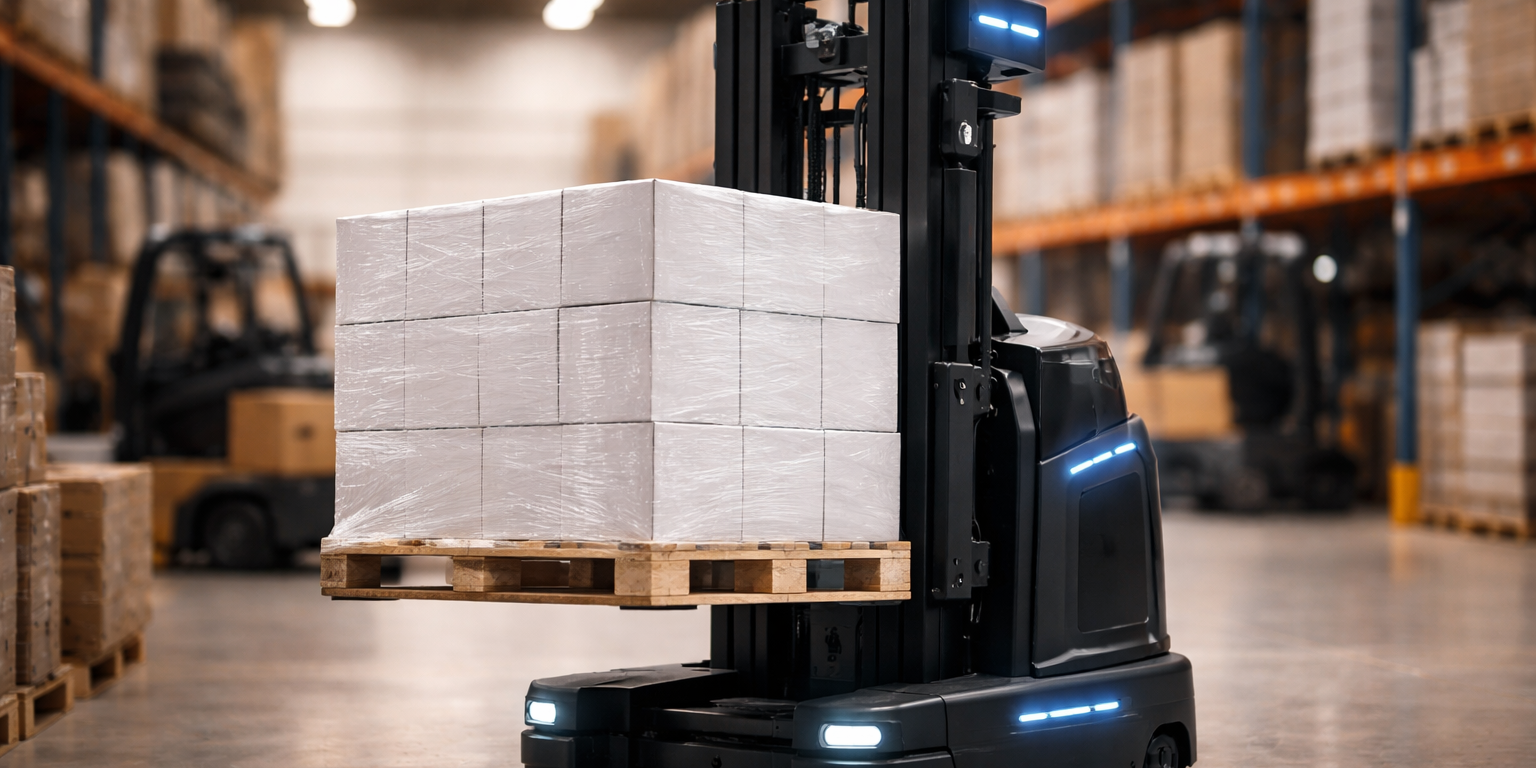
The MP2000 autonomous forklift from Pudu Robotics handles loads up to 2,000 kilograms, a payload threshold that positions the machine between light-duty automated guided vehicles and heavy industrial forklifts. Pudu announced the system in August 2026, marking the Shenzhen-based company's most aggressive move yet into warehouse automation after years focused on delivery robots for restaurants and hotels. The MP2000 uses what Pudu describes as an AI-native architecture, though the company has not disclosed whether this refers to onboard vision processing, cloud-connected route optimization, or both. Payload capacity matters in industrial robotics because it determines addressable use cases. A 2,000 kg limit covers most pallet handling in electronics assembly, pharmaceuticals, and e-commerce fulfillment, but excludes heavier applications in automotive parts distribution or bulk materials.
Pudu built its reputation on more than 80,000 service robots deployed across hospitality and healthcare, primarily in China and Southeast Asia. Those systems navigate crowded dining rooms and hospital corridors, avoiding unpredictable human movement. Warehouse environments present different challenges: tighter tolerances, higher throughput demands, and integration with existing warehouse management systems. The MP2000 must compete with autonomous forklifts from Balyo, which has over 4,000 units deployed in Europe; Toyota Material Handling, which began offering automated forklifts in 2024; and Seegrid, a Pittsburgh-based company with substantial market share in North American distribution centers. Each of these competitors has spent years refining fleet coordination software and building service networks that industrial customers require. Pudu's challenge is not just the robot hardware but the surrounding ecosystem of support, software integration, and proven uptime metrics that logistics managers demand before committing capital.
Complex warehouse environments, as Pudu describes its target application, typically means facilities with narrow aisles, mixed traffic of human-operated equipment and autonomous systems, and variable lighting conditions. Autonomous forklifts in such settings rely on multiple sensor modalities. LiDAR provides spatial mapping, cameras enable optical recognition of pallet types and rack locations, and inertial measurement units maintain positional accuracy during acceleration and braking. The MP2000's AI-native design likely refers to perception algorithms that adapt to changing warehouse layouts without manual reprogramming, a capability that reduces deployment time. Standard AGVs using magnetic tape or reflective markers can take weeks to install and reconfigure when warehouse layouts change. Vision-based systems, by contrast, can remap environments in days. The trade-off is cost. Vision systems require more computational power and sophisticated software, which typically adds $15,000 to $25,000 to the base unit price compared to guided vehicles. Industrial customers will weigh this against the flexibility gained.
Pudu's entry into autonomous forklifts reflects broader industry consolidation around mobile manipulation. Service robot manufacturers are leveraging proven navigation stacks to address industrial use cases, while traditional material handling companies are adding autonomy to existing product lines. Fetch Robotics, acquired by Zebra Technologies in 2021 for $290 million, demonstrated that service robot expertise translates to warehouse applications. Locus Robotics has deployed over 20,000 autonomous mobile robots in fulfillment centers, focusing on collaborative picking rather than heavy payload transport. The MP2000 occupies a middle ground: heavier payloads than AMRs, but in facilities requiring the adaptability of vision-based navigation. Pricing and deployment timelines will determine market reception. If Pudu can deliver the MP2000 at a cost comparable to guided forklifts while offering faster reconfiguration, it may find traction among third-party logistics providers who manage multiple client facilities with varying layouts. If the system requires extensive customization or prolonged integration cycles, it will struggle against incumbents with established service networks and proven mean time between failures data.
What to Watch: Monitor Pudu's first disclosed customer deployments of the MP2000, particularly any partnerships with multinational logistics providers or automotive suppliers. Track whether Pudu announces integration partnerships with warehouse management system vendors like Manhattan Associates or Blue Yonder, which would accelerate enterprise adoption. Watch for pricing disclosure, especially whether Pudu undercuts or matches the $80,000 to $120,000 range typical for autonomous forklifts in the 2,000 kg class. Competitor responses from Balyo and Toyota Material Handling may indicate how seriously incumbents view Pudu's industrial ambitions.