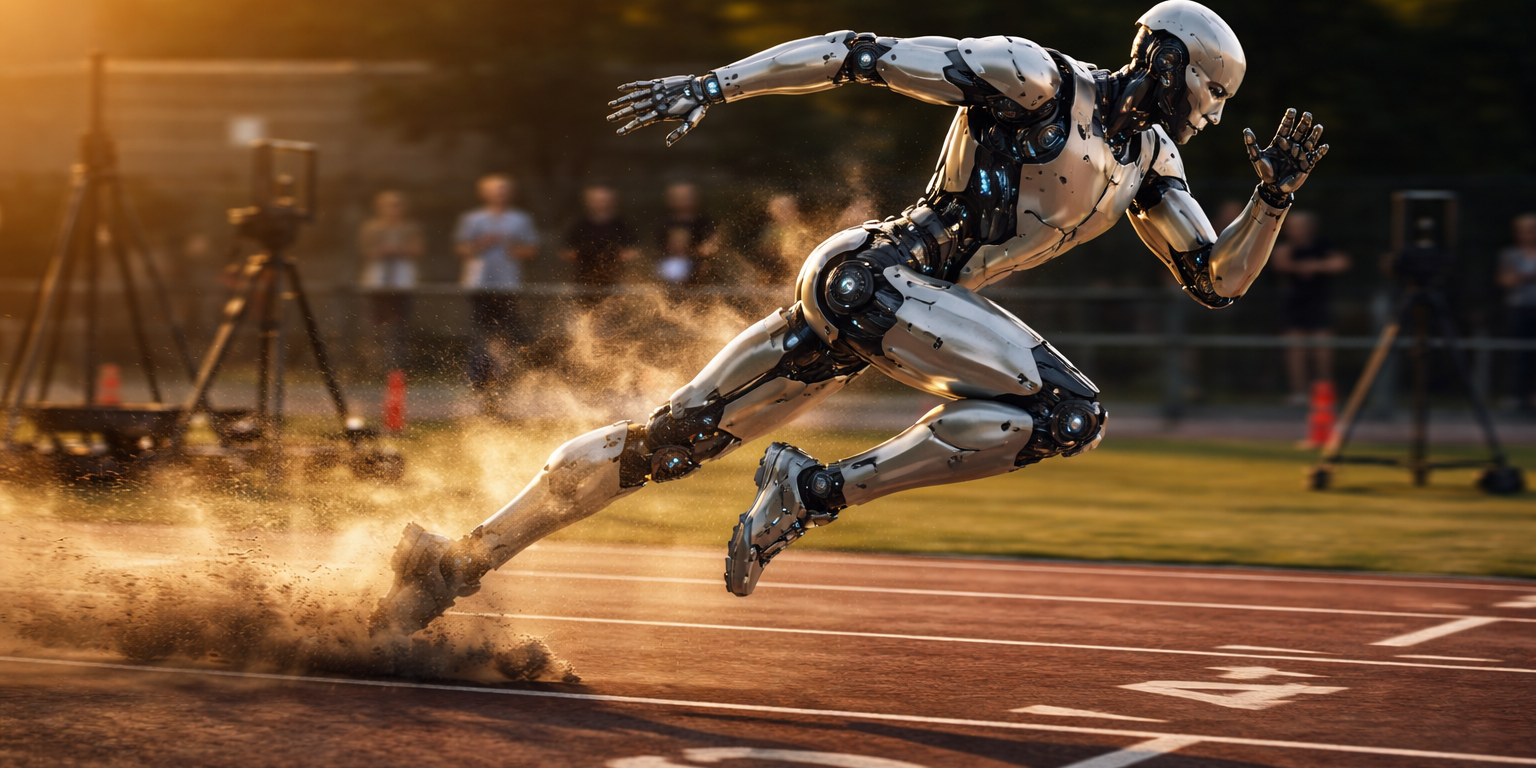
A humanoid robot sprinting at 12.66 meters per second would cover 100 meters in under eight seconds. Unitree Robotics claims its newest platform achieves exactly that velocity, a figure that would eclipse every publicly documented bipedal robot speed by a significant margin. The Chinese manufacturer released video footage and headline specifications for the machine it calls Superman, including a stated two-meter vertical jump from a standing position, but stopped short of disclosing the testing methodology, surface conditions, or whether the robot carried any payload during the trials. Boston Dynamics' Atlas has demonstrated running gaits approaching 5.5 meters per second in controlled environments. Agility Robotics' Digit operates at walking speeds below 2 meters per second during warehouse deployments. If Unitree's figures hold under scrutiny, the performance gap represents not an incremental improvement but a categorical leap in dynamic bipedal locomotion.
Unitree entered the humanoid development race later than several Western competitors but has accelerated its release cadence over the past eighteen months. The company gained attention in mid-2025 with the G1 humanoid, priced at $16,000 in its base configuration and aimed squarely at research institutions and early commercial adopters. That platform emphasized affordability and modularity over raw performance, with actuator torque density and payload capacity trailing machines from Figure AI and Tesla. Superman appears to represent a different design philosophy entirely. The published specifications suggest a machine optimized for speed and agility rather than load-bearing industrial tasks, though Unitree has not clarified whether Superman shares core components with the G1 or constitutes an entirely separate development effort. The company's Hangzhou headquarters houses both consumer-focused quadruped production lines and a humanoid research division, but it has not disclosed how resources are allocated between product families or whether Superman will transition from prototype to commercial availability.
The lack of published test protocols complicates any attempt to benchmark Superman against existing platforms. Peak instantaneous velocity differs substantially from sustained running speed, and manufacturers have historically measured these figures under varying conditions. Sprint duration, acceleration profile, battery consumption at maximum speed, and thermal management under load all determine whether a laboratory demonstration translates to operational capability. A two-meter vertical jump, if achieved from a true standing start without a preparatory crouch or countermovement, would require explosive power output far exceeding current commercial actuators. Unitree has not specified the actuation technology in Superman, whether the platform uses the quasi-direct-drive motors common in the G1 or employs hydraulic or pneumatic systems capable of the power density such performance implies. The company's history in quadruped development—the Go1 and B2 models both use electric actuators—suggests a preference for electromechanical designs, but scaling those architectures to humanoid-scale explosive movements remains an open engineering challenge across the industry.
Superman arrives as several major humanoid programs approach inflection points in 2026 and 2027. Figure AI has deployed small pilot fleets at BMW and other manufacturing partners, collecting operational data that will inform the next hardware iteration expected in early 2027. Tesla continues testing Optimus Gen 2 units in its own factories, with Elon Musk projecting limited external sales beginning sometime after mid-2026, though the company has missed similar timelines repeatedly. Sanctuary AI's Phoenix platform entered Canadian retail warehouse trials in late 2025, focusing on manipulation tasks rather than high-speed navigation. Apptronik's Apollo targets NASA and Department of Defense applications, where payload capacity and reliability matter more than sprint speed. Within China, several state-backed research institutes and private ventures including UBTECH and Fourier Intelligence are developing humanoids for industrial and service roles, creating a domestic competitive landscape that may explain Unitree's emphasis on performance specifications that generate headlines and differentiate the platform in a crowded field. The Chinese government has identified robotics as a strategic priority under its Made in China 2025 industrial policy, directing capital toward companies that demonstrate technical leadership in key subsystems.
The robotics investment community has poured more than $2.3 billion into humanoid ventures since January 2025, according to Pitchbook data, with valuations increasingly tied to hardware demonstrations rather than purely software or AI capabilities. Unitree remains privately held and has not disclosed recent funding rounds, though the company's ability to iterate rapidly on hardware suggests either strong revenue from its quadruped product lines or access to capital that has not appeared in public filings. Superman's performance claims, if substantiated through independent testing, could position Unitree for a significant financing round or partnership announcements as the company scales beyond research prototypes. Conversely, if the specifications prove difficult to reproduce outside controlled demonstrations, the gap between marketing materials and deliverable products could undermine the company's credibility with industrial customers who prioritize reliability over peak performance.
What to Watch: Unitree has not announced a timeline for independent verification or published detailed specifications, but competitors and research institutions will likely attempt to replicate the speed and jump metrics using their own platforms over the next quarter. Figure AI and Boston Dynamics both have sufficient actuator technology and control systems to approach these benchmarks if they prioritize locomotion performance in upcoming hardware revisions. Third-party testing facilities, particularly those affiliated with IEEE or the robotics departments at Carnegie Mellon, MIT, and ETH Zurich, may request access to Superman for controlled trials that would either validate or contextualize Unitree's claims. Watch for announcements regarding commercial availability, unit pricing, and whether the platform targets research buyers or attempts to compete directly with industrial humanoids from Agility and Figure in warehouse or manufacturing deployments.