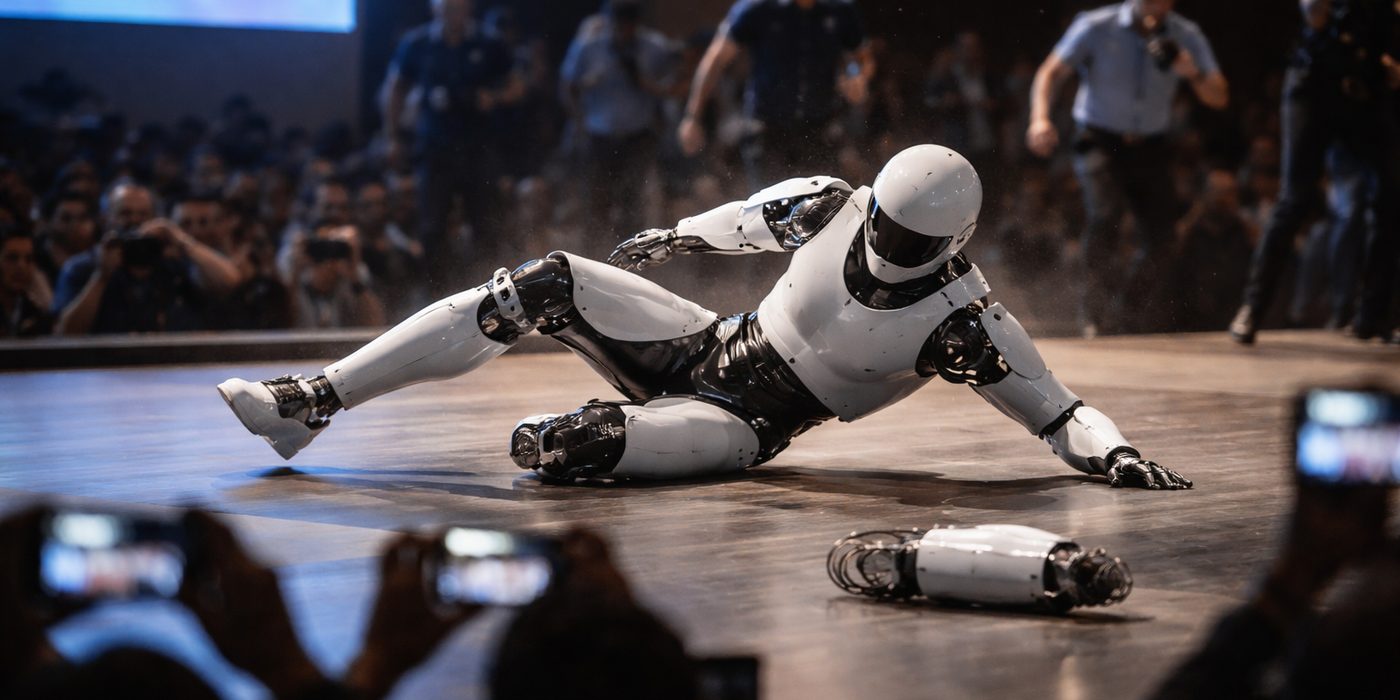
A humanoid robot that had existed publicly for less than 24 hours lost part of its leg in front of a live audience in Hangzhou last Thursday. Unitree Robotics' H2-X was midway through a side flip at the 2026 World Physical AI Conference and Unitree Robotics Partner Ecosystem Conference when it failed to stick the landing. The machine tipped sideways, and one of its mechanical lower legs came away from the chassis. Clips of the moment spread quickly across Chinese and international social platforms. The demonstration was meant to prove the platform's dynamic range. It ended up documenting, with unusual clarity, exactly where that range runs out.
Unitree has built its reputation on spectacle that works. The Hangzhou-based company became a fixture of humanoid highlight reels by landing backflips, running choreographed kung fu sequences, and performing on national television, all while undercutting Western rivals on price. That track record is what makes the H2-X stumble notable rather than routine. Flips are the sport's most punishing stress test, because the landing concentrates the machine's entire mass and angular momentum into a fraction of a second on a few joints. A side flip is arguably harder than a backflip for a bipedal frame, since lateral stability margins in the ankle and hip are narrower than fore-aft ones. Falls during such maneuvers are common in development labs. They are rarely staged for an audience.
The detail that should hold an engineer's attention is not the fall but the separation. Humanoids tip over constantly in testing, and a well-designed robot is expected to absorb a sideways collapse without shedding hardware. A lower leg detaching suggests the load path from the impact traveled into a mechanical interface, whether a fastener, a coupling, or a structural joint, that gave way before the surrounding components did. Whether that was a deliberate sacrificial design, a manufacturing flaw, or an overload beyond specification is not clear from public footage. Unitree's actuators are known for high torque density, and pushing that capability into dynamic landings leaves little slack in the mechanical chain that has to survive the result.
For the wider industry, the episode lands at an awkward moment. Humanoid makers are courting factory operators, logistics firms, and investors who want evidence of reliability, not just athleticism, and the gap between those two qualities is where deployments are won or lost. A robot that can flip is impressive; a robot that can fall without breaking is deployable. Buyers evaluating humanoids for warehouse or assembly work care far more about mean time between failures and repair cost than about acrobatics. Competitors in the United States and China will read the Hangzhou footage as a reminder that dynamic showmanship carries real reputational risk, and that the same stage that generates headlines can also generate liabilities.
What to Watch
First, any technical post-mortem from Unitree, particularly an explanation of which component failed and whether the H2-X's lower-leg interface will be revised before shipments begin. Second, whether the company repeats flip demonstrations at upcoming events or quietly pulls them from the repertoire, which would signal how much margin it believes the design has. Third, pricing and delivery timing for the H2-X, since early customer commitments will reveal whether the incident dented confidence among the partners attending the Hangzhou ecosystem conference. Finally, track how rival humanoid makers frame durability in their own marketing through the end of 2026, as reliability metrics increasingly displace acrobatics as the competitive talking point.