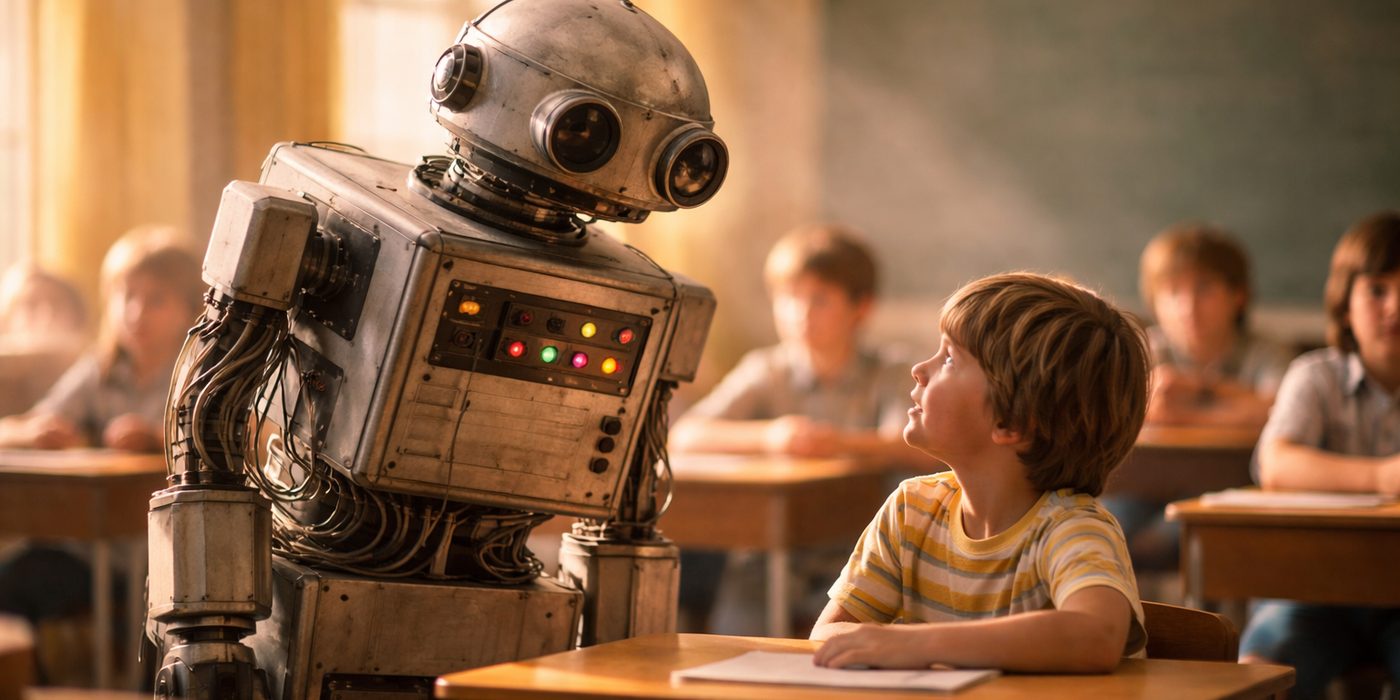
Thirty students, one robot, and a memory capacity measured in kilobytes. That was LEACHIM, the classroom teacher built in the 1970s by Michael Freeman, a Massachusetts educator who wanted to prove a machine could deliver individualized instruction. The robot, short for Learning Environment Teaching Machine, reportedly stood about the height of a small adult, rolled through a classroom on wheels, and addressed each child by name. It stored the curriculum, test history, and even the personal details of every student in its roster, then adjusted its questions accordingly. Digitimes has now revisited the machine in an interview, and the timing is pointed. The humanoid sector is flush with capital, crowded with prototypes, and short on proof that any of them can hold down a job.
What made LEACHIM work was not mobility or dexterity but constraint. Freeman's design did one thing: it taught. Its hardware was modest even by the standards of its day, tethered to a mainframe-class computer that handled the heavy lifting while the humanoid shell served as the interface. The robot could speak in a synthesized voice, listen for answers, and log results against each student's profile. It could not fold laundry or climb stairs. That narrowness is precisely what the Digitimes piece highlights, and it lands in an industry where the dominant sales pitch is the opposite. Companies from Tesla to Figure AI to Agility Robotics have framed their machines as general-purpose labor, a promise that has so far outrun measurable deployments.
The contrast is instructive for anyone underwriting humanoid programs in 2026. LEACHIM's value rested on a tight loop between data and behavior: it knew who it was talking to, remembered what that student had struggled with, and changed its approach. Strip away the wheels and the plastic torso, and what remains is a personalization engine wrapped in a friendly form factor. Modern humanoid developers are rediscovering the same logic. The form factor draws attention and fits human-built spaces, but the commercial case increasingly depends on software that adapts to specific environments, tasks, and people. A warehouse robot that learns one facility's pick patterns is closer in spirit to LEACHIM than to the all-purpose android of investor decks.
For the industry, the machine also carries a quieter warning about demonstration versus deployment. LEACHIM was a working prototype, tested in a real classroom, but it never scaled into a product line. The economics of the era, with computing costly and bulky, made replication impractical. Today's constraint is reversed: compute is cheap, actuators and batteries are the bottleneck, and the cost of a humanoid still runs well into the tens of thousands of dollars even from aggressive Chinese entrants. The lesson for 2026 is that technical feasibility has never been the hard part of humanoid history. Finding a task where the robot's total cost, reliability, and acceptance by the people around it add up to a durable business is what has repeatedly stalled the field, from the 1970s to now.
What to Watch
Track whether humanoid vendors begin publishing task-specific uptime and cost-per-hour figures over the next 90 days, rather than demo reels; Agility Robotics' Digit deployments and Figure AI's commercial pilots are the clearest places to look. Watch the education and eldercare segments, where interaction and personalization matter more than payload, and where few humanoid makers have yet made a serious commercial push. Pay attention to how investors respond at Q4 2026 funding rounds: any term sheet that ties valuation to narrow, verifiable deployments instead of general-purpose claims would confirm the shift LEACHIM's story implies. Finally, monitor whether any developer revives the classroom or tutoring use case with modern language models, the one area where Freeman's 1970s concept and today's AI are most directly aligned.