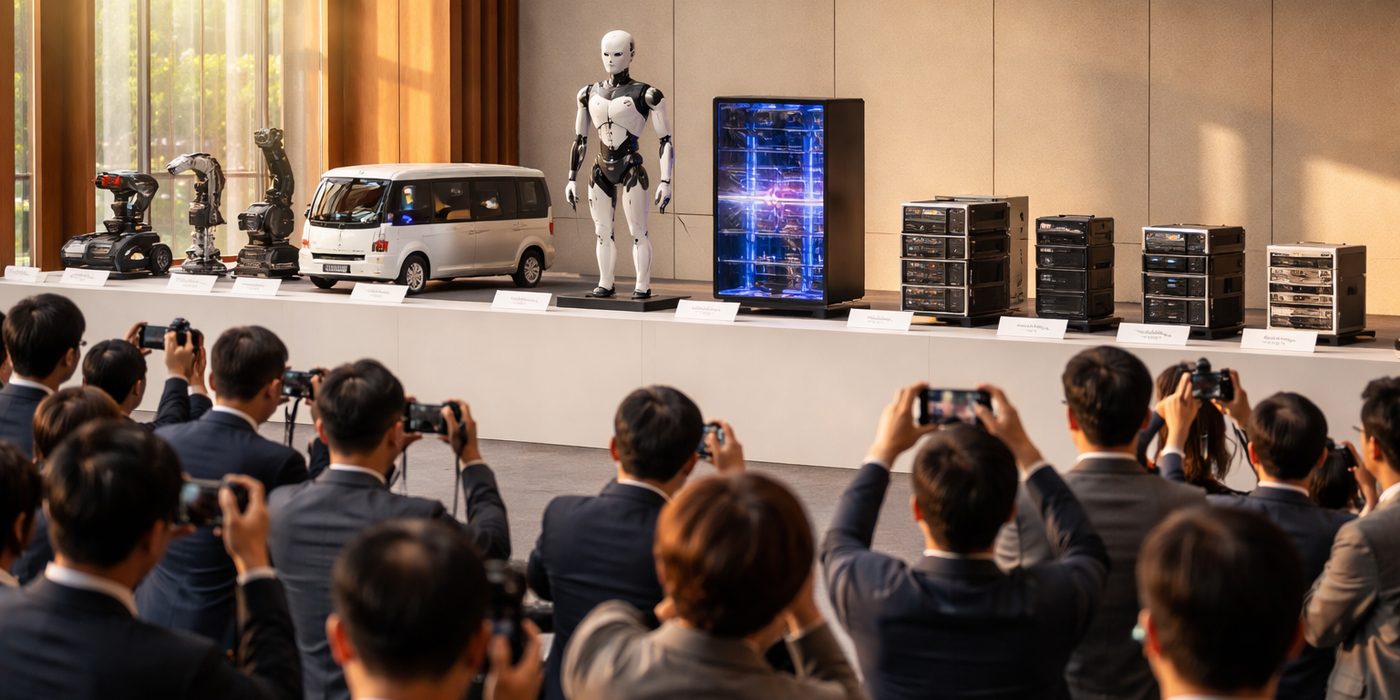
Only a handful of the nine winners at FIX 2026 were selling something with legs. That is the detail worth sitting with. When the show's organizers gathered the honorees for a press conference in Daegu, South Korea, humanoid robotics shared the podium with autonomous vehicles, industrial AI, cybersecurity, and data center cooling. Nine companies in all were recognized for innovation. The awards, covered by Ubergizmo, are not a ranking of humanoid maturity, and the source material offers limited detail on individual specifications or funding. But the composition of the winners' circle is a data point in itself: the market no longer treats a walking robot as the whole product.
The breadth makes sense once you look at how Korean industry has organized itself around what Seoul calls physical AI. Daegu sits in the heart of a manufacturing region with deep ties to automotive supply chains, machine tools, and the mobility sector, which gives an event like FIX a natural audience of buyers rather than spectators. Humanoid developers in the country have spent the past two years moving from stage demonstrations toward pilot work in factories and logistics centers. Autonomous vehicle firms face a parallel transition, from road-test mileage to commercial permits. Both groups arrive at the same bottleneck: the software has to be trustworthy, and the compute has to be housed somewhere.
That is where the less glamorous categories on the winners list earn their place. Industrial AI is the layer that turns a fleet of robots from a collection of expensive demonstrations into a system that schedules work, predicts failures, and reports yield. Cybersecurity has moved from afterthought to procurement requirement, since a humanoid operating on a factory floor is a networked actuator with arms, and any buyer's security team knows it. Data center cooling, the most surprising entry for a robotics audience, addresses a physical constraint that grows with every increase in model size. Training and serving the foundation models behind embodied AI generates heat on a scale that conventional air cooling struggles to handle, and liquid and immersion approaches are becoming a standard conversation.
For engineers and investors, the useful reading is structural rather than promotional. Awards at regional trade shows are an imperfect signal: they reward demonstration quality and press-room appeal, and they say little about unit economics, mean time between failures, or order backlogs. Treat them as a map of where attention is flowing, not as validation of any one platform. The practical takeaway is that the humanoid category is being pulled into a broader industrial stack, and the companies positioned to capture value may include the ones that never build a robot at all. Supply-chain players in cooling, security, and fleet intelligence sell into every humanoid program at once, which insulates them from the winner-take-most dynamics that haunt the robot makers themselves. Anyone sizing the opportunity should model the whole stack, not just the chassis.
What to Watch
Track whether any of the nine FIX 2026 honorees convert recognition into named pilot customers or disclosed production orders over the next 90 days; announcements tied to Korean automotive and logistics buyers would be the most credible signal. Watch for follow-on disclosures from the humanoid winners on deployment counts and uptime, since specifications alone do not distinguish serious programs from showpieces. Monitor data center cooling and robotics cybersecurity vendors for partnership news with humanoid makers, which would confirm that infrastructure is being bundled into embodied AI offerings. Finally, watch the autonomous vehicle winners for permit or commercial-service milestones in Korea before the end of 2026, as those timelines will indicate how quickly physical AI is moving from showcase to revenue.