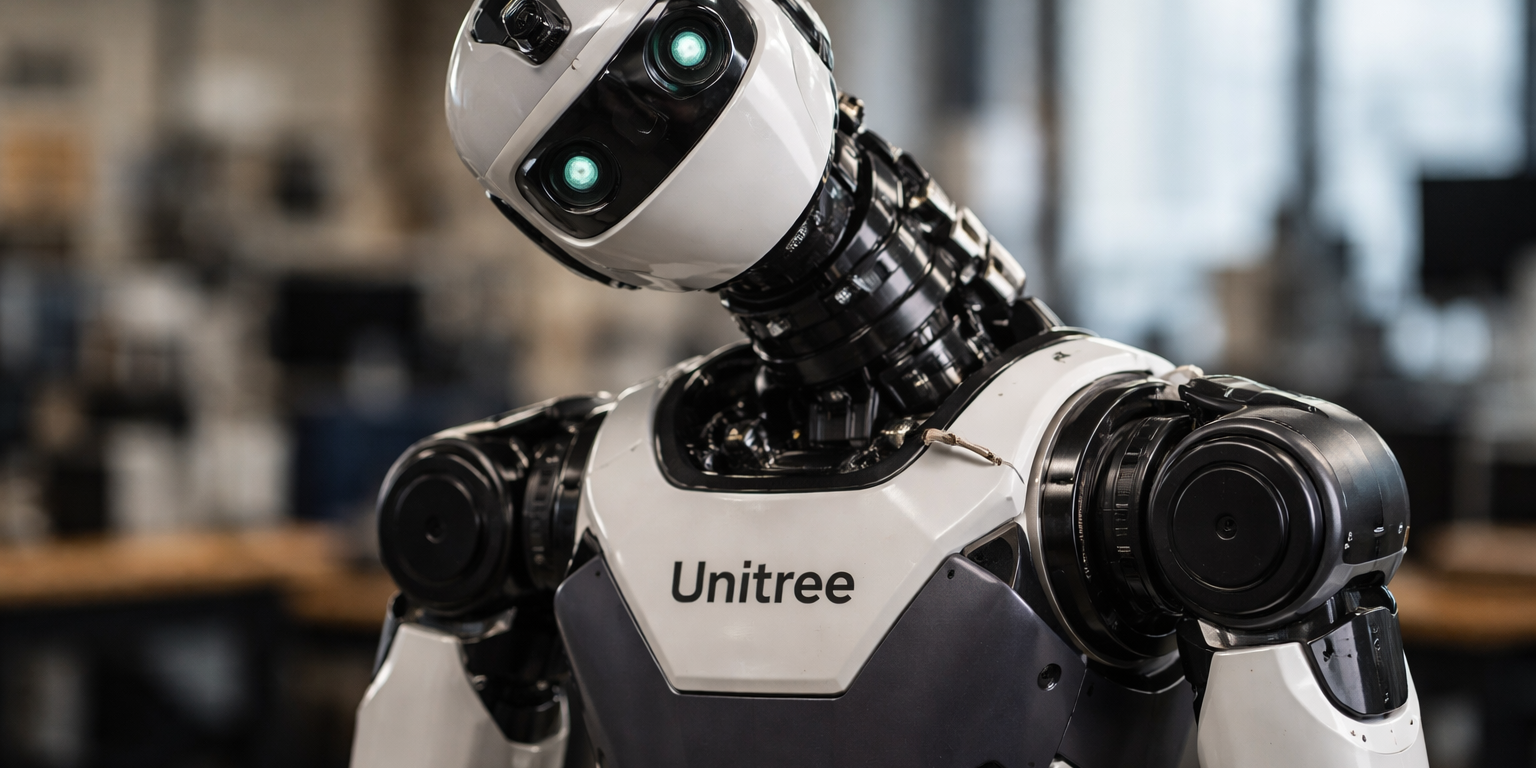

The H2 Plus from Unitree Robotics arrived with Nvidia backing and immediately fractured assumptions about vertical integration in humanoid development. Engineers and investors across China's robotics sector are now asking a question that transcends one product launch: when a humanoid robot ships with third-party AI infrastructure, who actually controls the machine? Unitree built the body. Nvidia supplies computational architecture and likely foundational models. Neither company has clarified where one domain ends and the other begins, and that ambiguity is forcing the industry to confront control layer ownership before the first units ship at scale.
Unitree has established itself as a hardware specialist, moving from quadruped platforms like the Go2 into bipedal form factors with aggressive pricing. The H2 Plus represents a bet that hardware expertise alone justifies market position, even when the intelligence running atop that hardware originates elsewhere. Nvidia, meanwhile, has positioned its Jetson modules and Isaac simulation platform as infrastructure for robotics broadly, not tied to proprietary hardware. The collaboration should be straightforward: Unitree handles mechanical design, actuation, and power systems while Nvidia provides compute and AI frameworks. But humanoid robotics resists clean separation. Perception, planning, and motor control blur together. A walking gait relies on real-time sensor fusion and predictive models as much as servo response curves. When those models come from Nvidia and the servos from Unitree, accountability fractures. If the robot falls, who owns the failure? If it navigates autonomously through a warehouse, who certifies the safety? The H2 Plus partnership forces those questions into the open without offering answers.
China's robotics industry has watched Western players pursue different models. Figure AI and Tesla build end-to-end, controlling hardware, AI training, and deployment context. Boston Dynamics licenses hardware to research institutions but retains tight software control. Agility Robotics ships Digit with defined APIs, allowing customer software within boundaries. Unitree's approach with Nvidia suggests a fourth path: modularity across the stack, accepting that no single company will own humanoid intelligence or embodiment outright. That model scales faster in theory. Hardware manufacturers can focus on cost reduction and mechanical reliability. AI providers can iterate on foundation models without waiting for hardware cycles. Developers gain access to capable platforms without building from silicon up. But modularity introduces dependencies. Unitree relies on Nvidia's roadmap for compute performance gains. Nvidia relies on hardware partners to reach deployment environments where its models improve. Neither can move unilaterally, and neither can claim full autonomy over the end product.
The debate in China reflects broader industry fragmentation. Humanoid development has attracted automotive companies, AI labs, defense contractors, and logistics operators, each with different risk tolerances and control preferences. Automotive sees humanoids as extensions of autonomous vehicle problems, favoring integrated stacks where perception and actuation share training data. AI labs view humanoids as embodied reasoning challenges, prioritizing model architecture over hardware specifics. Defense applications demand sovereign control over every subsystem, rejecting dependencies on foreign suppliers. Logistics operators want commodity hardware with swappable software, minimizing vendor lock-in. Unitree and Nvidia are navigating these conflicting demands without a clear industry standard to guide them. The H2 Plus may succeed as a product, but its structure—joint ownership of critical control layers—exposes a question the industry has deferred: what does autonomy mean when the body and brain come from separate companies, possibly separate nations, with distinct incentives and oversight regimes?
What to Watch: Unitree's next disclosure on H2 Plus pricing and availability will clarify whether modularity translates to cost advantage over integrated rivals like Fourier Intelligence or Tesla. Nvidia's GTC 2025 keynote in March should detail Isaac updates and whether the company intends to certify hardware partners or remain platform-agnostic. Any announcement from China's Ministry of Industry and Information Technology regarding AI sovereignty in robotics will signal regulatory pressure on partnerships like Unitree-Nvidia. Finally, track whether Figure AI or Agility Robotics responds by opening their software stacks, a move that would validate Unitree's modular approach or expose its weaknesses.