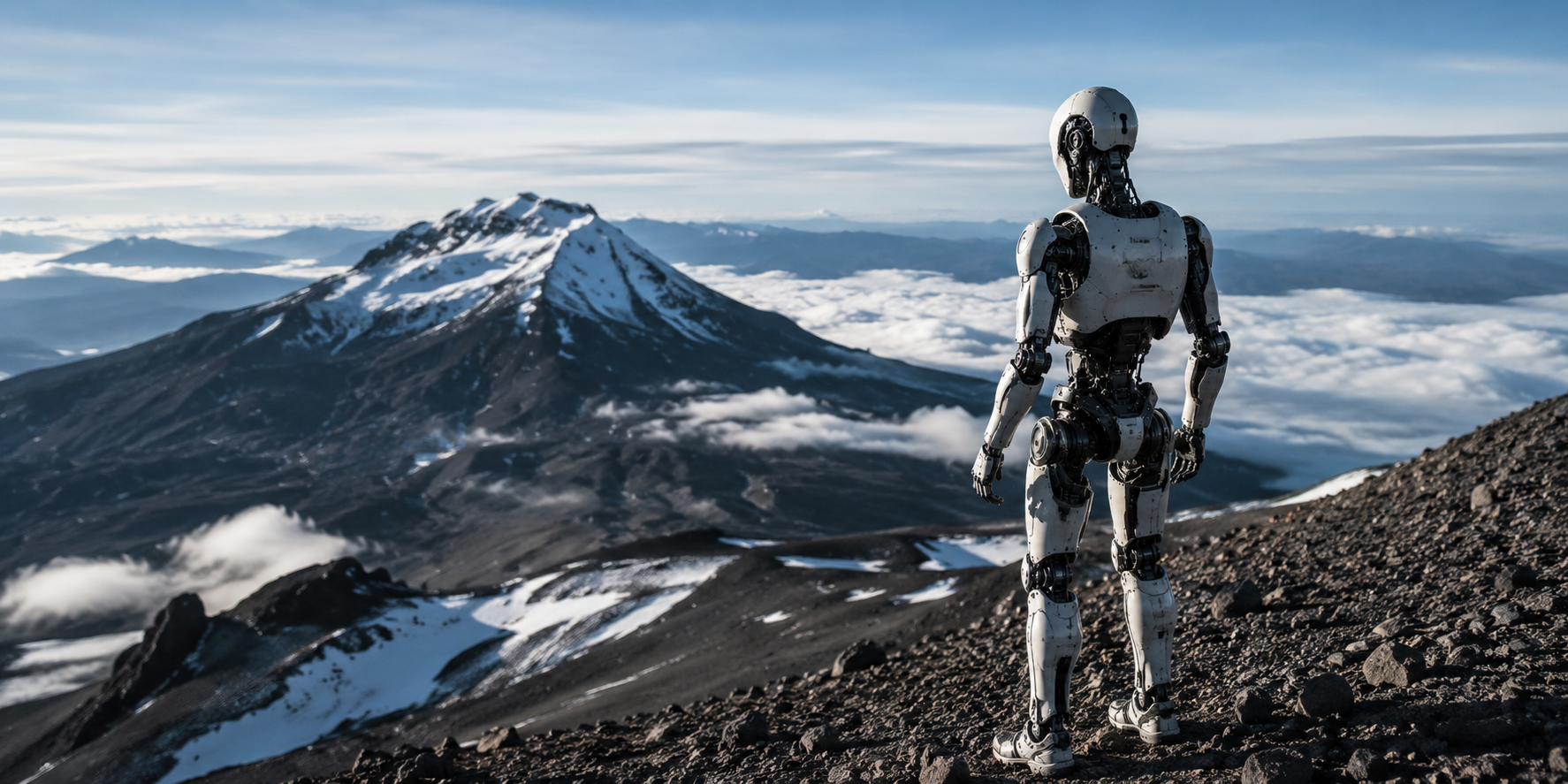
A Unitree G1 humanoid designated Pemba reached the 6,310-meter summit of Ecuador's Chimborazo volcano last month, establishing the first documented instance of a bipedal robot operating autonomously at that altitude. The modified platform carried environmental sensors throughout the ascent, transmitting atmospheric data and terrain imaging in real time while navigating loose volcanic scree and sustained winds exceeding 60 kilometers per hour. The test run positions legged robots as viable alternatives to wheeled rovers and drones for scientific monitoring in terrain where traditional ground vehicles fail and flight regulations or thin air ground aerial platforms.
Chimborazo presents a useful stress case for robotics validation. While not the tallest peak by elevation above sea level, its position on the equatorial bulge places its summit farther from Earth's center than any other point on the planet's surface. The volcano's upper slopes combine low atmospheric pressure—roughly 46 percent of sea level—with temperature swings from 15 degrees Celsius in sunlight to minus 20 in shadow, conditions that challenge thermal management systems and expose weaknesses in actuator sealing. The Unitree team modified the standard G1 chassis with upgraded joint seals, additional battery capacity, and reinforced ankle actuators rated for uneven load distribution across rocky substrates. Those modifications added roughly 3 kilograms to the platform's base weight of 47 kilograms, a trade-off that extended operational endurance from the G1's standard 2-hour runtime to approximately 4.5 hours under load.
Unitree has shipped more than 1,400 G1 units since the model's commercial release in June 2024, primarily to research institutions and systems integrators building custom applications. The platform's appeal rests on its $16,000 price point—roughly one-fifth the cost of Boston Dynamics' Atlas research platform—and an open SDK that allows teams to bypass proprietary middleware. Field deployments to date have concentrated on warehouse automation and urban delivery trials, where flat surfaces and predictable obstacles simplify path planning. High-altitude testing opens a different design space. Environmental monitoring networks in the Andes, Himalayas, and Antarctic Dry Valleys currently rely on stationary sensor arrays that require helicopter placement or mountaineering teams for installation and maintenance. A robot that walks to remote sites, collects multi-day datasets, and returns to a charging station could reduce the cost per data point by an order of magnitude while increasing spatial resolution.
The Chimborazo test feeds into a broader push toward extreme-environment autonomy. Pemba's sister unit, a G1 configured with ice traction feet and a secondary lithium-polymer battery pack optimized for subzero discharge, is scheduled for an Everest Base Camp trial in April 2026, with a potential summit attempt planned for the 2026 climbing season if the base camp shakedown validates cold-weather performance. That timeline tracks with similar efforts in Japan, where Kawasaki's Kaleido humanoid completed winter trials on Mount Fuji's lower slopes in February, and in Norway, where a team from the Norwegian University of Science and Technology deployed a modified ANYmal quadruped to 2,100 meters in Jotunheimen National Park. Each project approaches the same constraint: as altitude increases, both battery energy density and electric motor efficiency degrade, forcing engineers to choose between payload capacity and operational duration. Unitree's answer involves segmented mission profiles—short autonomous excursions from a semi-permanent charging hub rather than single long-duration climbs—which aligns with scientific use cases where repeated sampling matters more than speed.
What to Watch: Unitree's planned Everest Base Camp deployment in April 2026 will test the G1 platform at 5,364 meters with sustained subzero exposure, providing the first apples-to-apples comparison against Kawasaki's Kaleido data from Fuji. Monitor whether Boston Dynamics enters the high-altitude testing arena with a next-generation Atlas variant, as the company has historically used challenging terrain to showcase new capabilities ahead of broader commercial releases. Track publication of sensor data from the Chimborazo ascent, particularly joint torque telemetry and thermal performance logs, which will inform actuator design choices for the next generation of outdoor humanoids.