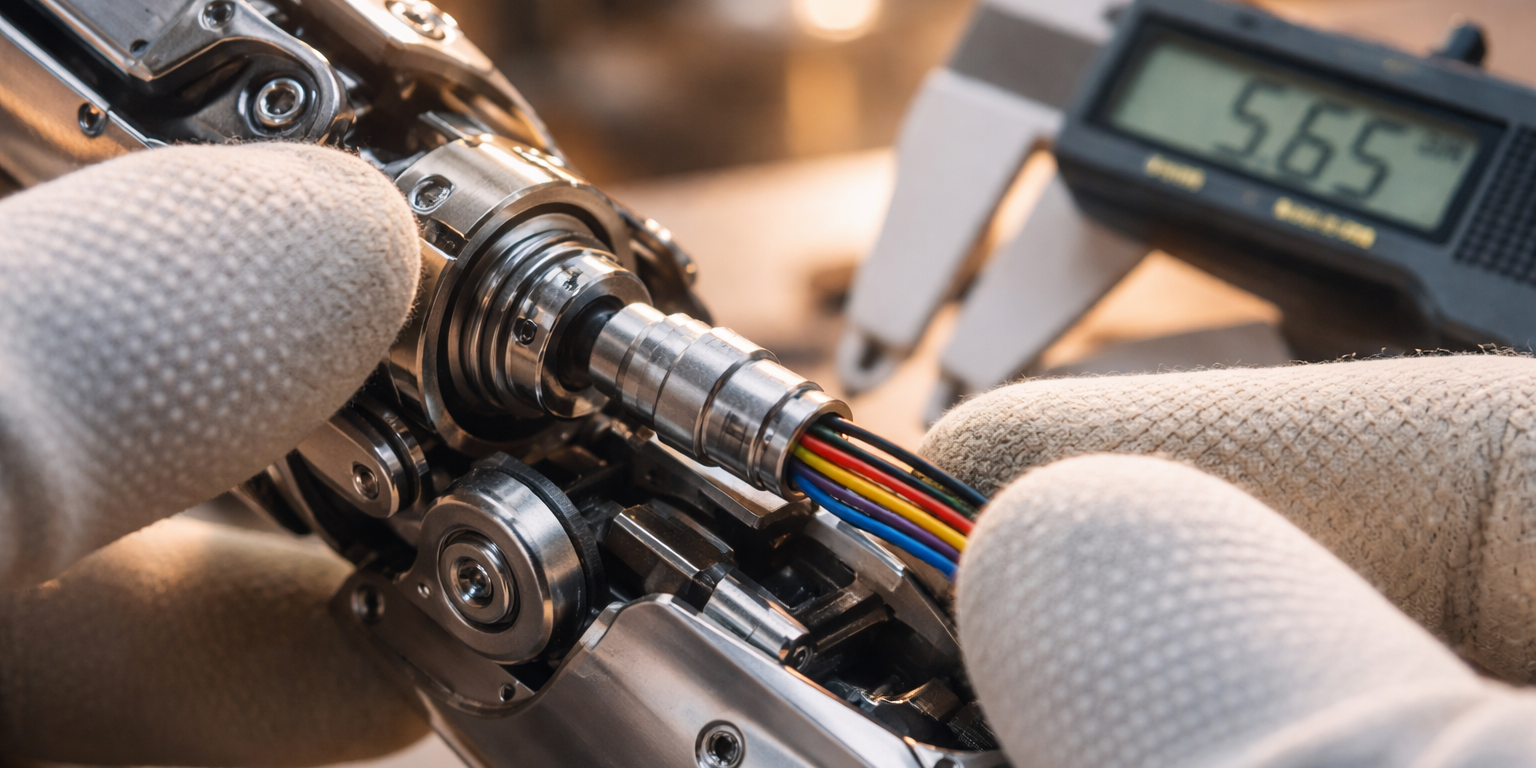
Routing cables through the rotating joints of a humanoid robot has been one of the industry's most mundane yet persistent engineering headaches, and Molex believes it has a solution that cuts the required clearance nearly in half. The company's new MiniMix hybrid connector passes through openings as small as 5.65 millimeters while carrying both 15-amp power delivery and high-speed data lines, a combination the Lisle, Illinois-based interconnect manufacturer says requires up to 50 percent less routing area than alternative designs currently on the market. For engineers building humanoid platforms where every millimeter of shoulder, elbow, and hip diameter translates directly to actuator torque requirements and overall system mass, the space savings carry immediate implications for both performance and production economics.
The announcement arrives as multiple robotics companies push humanoid platforms from prototype labs toward volume manufacturing, a transition that has exposed the limitations of connectors originally designed for industrial automation or consumer electronics. Tesla's Optimus team, for instance, has publicly discussed the challenges of cable management in anthropomorphic designs, where dozens of power and signal lines must route through compact rotational assemblies without binding or creating torque disturbances. Figure AI, Agility Robotics, and Apptronik have faced similar constraints. Molex developed the MiniMix line specifically for these applications, targeting not just the technical specifications but the assembly processes required to build hundreds or thousands of units per month rather than hand-assembled prototypes. The company reports working directly with unnamed humanoid developers to validate the connector's durability through millions of joint articulation cycles, a testing regimen that reflects the industry's growing focus on field reliability rather than laboratory demonstrations.
The MiniMix family features what Molex calls a hybrid architecture, integrating power contacts rated for 15 amps continuous current with high-speed signal pairs in a single mated connection. Previous-generation solutions typically required separate connectors for power and data, consuming more routing volume and introducing additional potential failure points. The power specification targets the brushless DC motors and harmonic drive actuators common in humanoid limbs, while the data channels handle encoder feedback, motor controller commands, and sensor telemetry at speeds sufficient for closed-loop control rates above 1 kilohertz. Molex has not disclosed the exact signal bandwidth, but engineering samples shown to early-access customers reportedly support differential pairs operating in the hundreds of megabits per second range. The mechanical design uses a push-pull latching mechanism intended for robotic assembly, eliminating the threaded couplings or bayonet locks that require human hand strength and dexterity. Assembly line integration was a design requirement from the outset, according to company materials, reflecting the reality that humanoid production volumes will demand automated connector installation rather than technician labor.
Beyond the headline dimensions, Molex has designed the MiniMix for what it terms harsh operational environments, including the vibration, temperature swings, and contamination exposure typical of logistics warehouses and light manufacturing facilities where most commercial humanoids are expected to deploy initially. The connector housings use a polymer blend selected for resistance to hydraulic fluids, cleaning solvents, and the particulate matter found in fulfillment centers. Gold-plated contacts address the durability concerns raised by early humanoid operators who reported contact degradation after repeated mating cycles during maintenance procedures. The company claims a minimum mating cycle life of 5,000 insertions, substantially higher than the 500-1,000 cycle ratings common in consumer-grade connectors but still below the 10,000-plus cycles specified for certain military and aerospace applications. That middle ground reflects the expected maintenance intervals for commercial humanoids, where joint actuator modules may be swapped quarterly or semi-annually rather than daily.
The MiniMix introduction positions Molex to capture a supply chain node that could scale rapidly if humanoid production forecasts materialize. Analysts at Interact Analysis project humanoid manufacturing volumes could reach 50,000 units annually by 2028, up from an estimated 2,000 units across all manufacturers in 2025. Each humanoid requires 20 to 40 hybrid connectors depending on design complexity, creating a potential market for one to two million connectors per year within two production cycles. Molex competes in this space against TE Connectivity, Hirose Electric, and a cohort of Chinese manufacturers including Jonhon and Yonggui Electric, the latter two having supplied connectors for several Shenzhen-based humanoid startups. Pricing details remain under NDA for volume customers, but industry sources suggest hybrid connectors in this class typically command $8 to $15 per unit in production quantities, implying a total addressable market in the tens of millions of dollars as the sector matures. Molex has established dedicated manufacturing capacity for the MiniMix line at facilities in Singapore and Ireland, with the ability to add lines in Mexico and China if demand projections hold.
What to Watch: Molex plans to showcase the MiniMix connectors at the International Conference on Humanoid Robots in November 2026, where the company is expected to announce design wins with at least two named humanoid manufacturers. Watch for adoption announcements from Agility Robotics and Apptronik, both of which have publicly discussed supply chain partnerships ahead of their planned production ramps in mid-2027. Volume shipments are scheduled to begin in Q4 2026 according to company guidance, making the next 90 days critical for finalizing customer qualifications and assembly process validation.