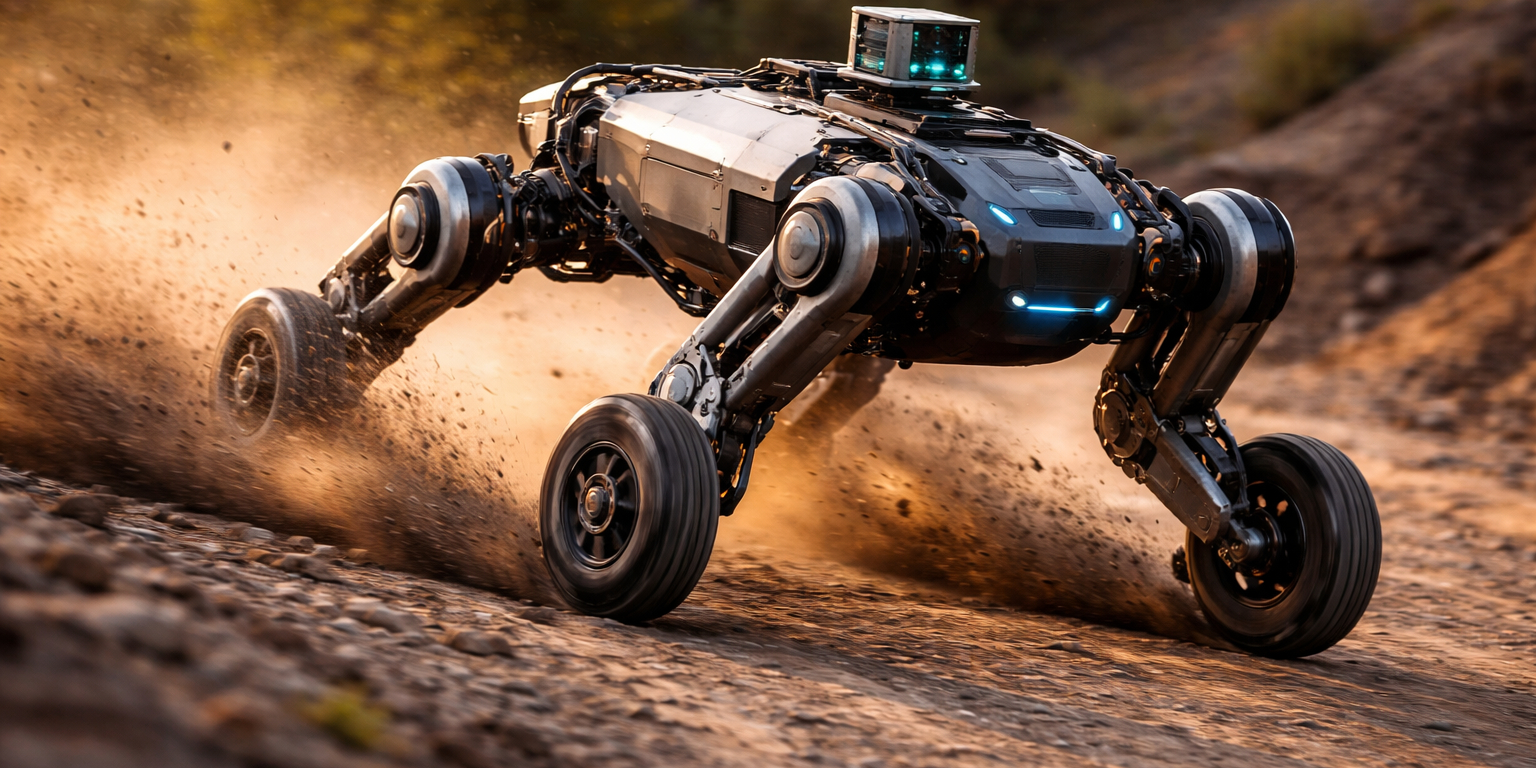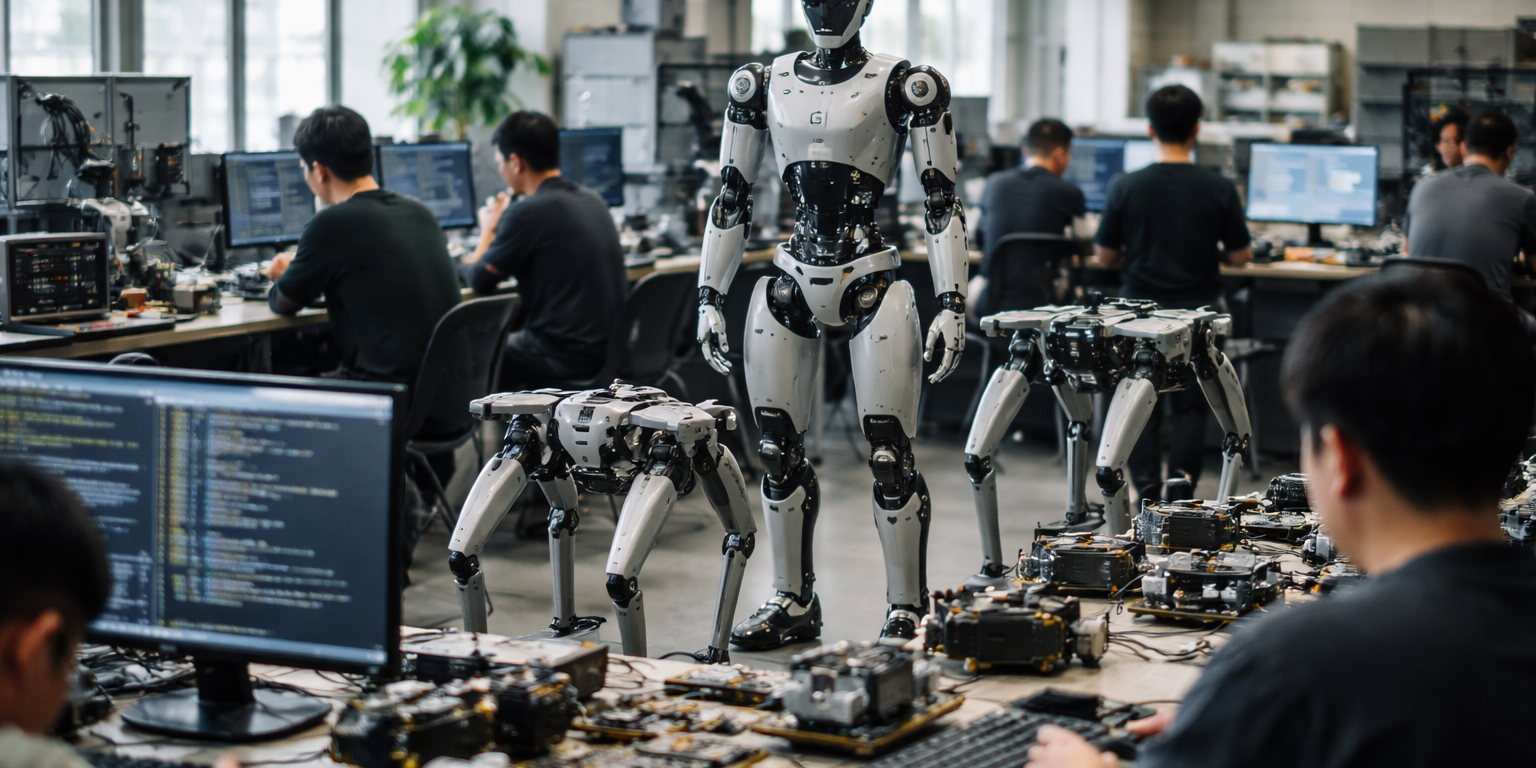
Unitree confirmed plans to expand development of what it terms core embodied AI technologies, a move that signals the company's intent to own critical layers of its robotics stack rather than rely on third-party suppliers. The announcement came August 7 from the company's Hangzhou headquarters, where CEO Wang Xingxing outlined priorities spanning large embodied AI models, reinforcement learning frameworks, self-developed components, and high-performance actuators. Wang did not specify budget allocations or headcount targets, but industry analysts tracking Chinese humanoid robotics firms say Unitree currently employs roughly 300 engineers split between hardware and software divisions. The company operates two primary product lines: quadruped robots derived from its Go series and the G1 humanoid platform introduced in mid-2024 at a $16,000 base price. That price point matters. Unitree entered the humanoid market positioned below Boston Dynamics Atlas research units but above hobbyist-grade systems, targeting university robotics labs, research institutions, and corporate R&D teams willing to trade some refinement for accessibility.
Embodied AI refers to intelligence systems that learn through physical interaction with environments rather than purely digital datasets. For robotics manufacturers, the distinction is critical. Large language models trained on text corpora can generate human-like responses but struggle to grasp spatial reasoning, force dynamics, or object permanence. Embodied models learn by doing: grasping objects of varying weight and compliance, navigating uneven terrain, reacting to unexpected obstacles. Unitree's focus on reinforcement learning, a subset of machine learning where agents improve through trial and error, suggests the company is building training infrastructure to let robots learn tasks without exhaustive human demonstration. Tesla's Optimus team uses a similar approach, logging millions of hours of simulated manipulation before deploying learned behaviors to physical hardware. The technical challenge lies in transferring skills from simulation to reality, a gap researchers call the sim-to-real problem. Companies that solve it efficiently gain speed advantages in deploying new capabilities.
Actuators represent the other half of Unitree's stated priority. These electromechanical components convert electrical signals into physical motion, and their performance dictates a robot's speed, precision, and load capacity. Most humanoid developers source actuators from specialized suppliers like Harmonic Drive, Nabtesco, or newer entrants such as Elephant Robotics. Unitree already manufactures its own actuators for quadruped models, giving it integration advantages and margin control. Extending that capability to humanoid platforms makes strategic sense, especially as actuator demand surges. Industry data from the International Federation of Robotics indicates global shipments of collaborative and humanoid robots could exceed 80,000 units annually by 2028, up from roughly 12,000 in 2024. Each humanoid requires 20 to 40 actuators depending on design complexity. Supply chain control becomes a competitive moat. Unitree's vertical integration strategy mirrors approaches taken by Agility Robotics, which designs custom actuators for its Digit warehouse robot, and Boston Dynamics, which engineers hydraulic and electric actuation systems in-house.
The announcement arrives as Chinese robotics firms face intensifying scrutiny over export restrictions and technology transfer concerns. The U.S. Commerce Department added several Chinese AI companies to its Entity List in late 2025, citing national security grounds related to autonomous systems development. While Unitree has not appeared on such lists, the regulatory environment shapes strategic decisions. Building proprietary AI and actuation technologies reduces dependence on U.S. semiconductor toolchains and software frameworks, insulating the company from potential supply disruptions. It also positions Unitree to serve domestic Chinese demand, which the China Robot Industry Alliance projects will grow at a 37 percent compound annual rate through 2030. Government subsidies for robotics R&D, particularly in Zhejiang Province where Unitree is based, provide capital access that Western startups often lack. Embodied AI development requires extensive compute infrastructure. Training reinforcement learning models can consume thousands of GPU-hours per task. Firms that cannot secure funding or subsidized access to compute clusters face meaningful disadvantages. Unitree's ability to sustain parallel development across AI models, learning frameworks, and hardware components suggests access to such resources.
The broader humanoid market remains fragmented. Figure AI raised $675 million in March 2024 at a $2.6 billion valuation, positioning its Figure 02 model for logistics and manufacturing applications. Agility Robotics deploys Digit units at Amazon facilities for tote handling. 1X Technologies targets consumer markets with NEO, a bipedal home assistant. Unitree occupies a distinct niche: affordable platforms for researchers and developers who need humanoid hardware but lack enterprise budgets. That positioning creates volume opportunities if embodied AI matures faster than hardware costs decline. A $16,000 robot running sophisticated learning algorithms becomes viable for mid-tier universities, manufacturing R&D labs, and logistics firms piloting automation. Unitree's challenge lies in execution. Embodied AI remains an emerging discipline with few proven playbooks. Companies must balance research exploration with product commercialization, a tension that has delayed timelines for competitors including Tesla, which has repeatedly pushed back Optimus deployment targets.
What to Watch: Track whether Unitree announces partnerships with Chinese cloud compute providers such as Alibaba Cloud or Huawei Cloud, which would signal scaling of its embodied AI training infrastructure. Monitor G1 pricing and specification updates, particularly actuator torque ratings and degrees of freedom, as indicators of in-house component integration. Watch for academic publications or conference presentations from Unitree research teams at venues like ICRA or CoRL, which would reveal technical approaches to sim-to-real transfer and reinforcement learning architectures. Finally, observe whether U.S. or European research institutions continue purchasing G1 units despite geopolitical tensions, a proxy for the platform's technical credibility independent of trade policy.