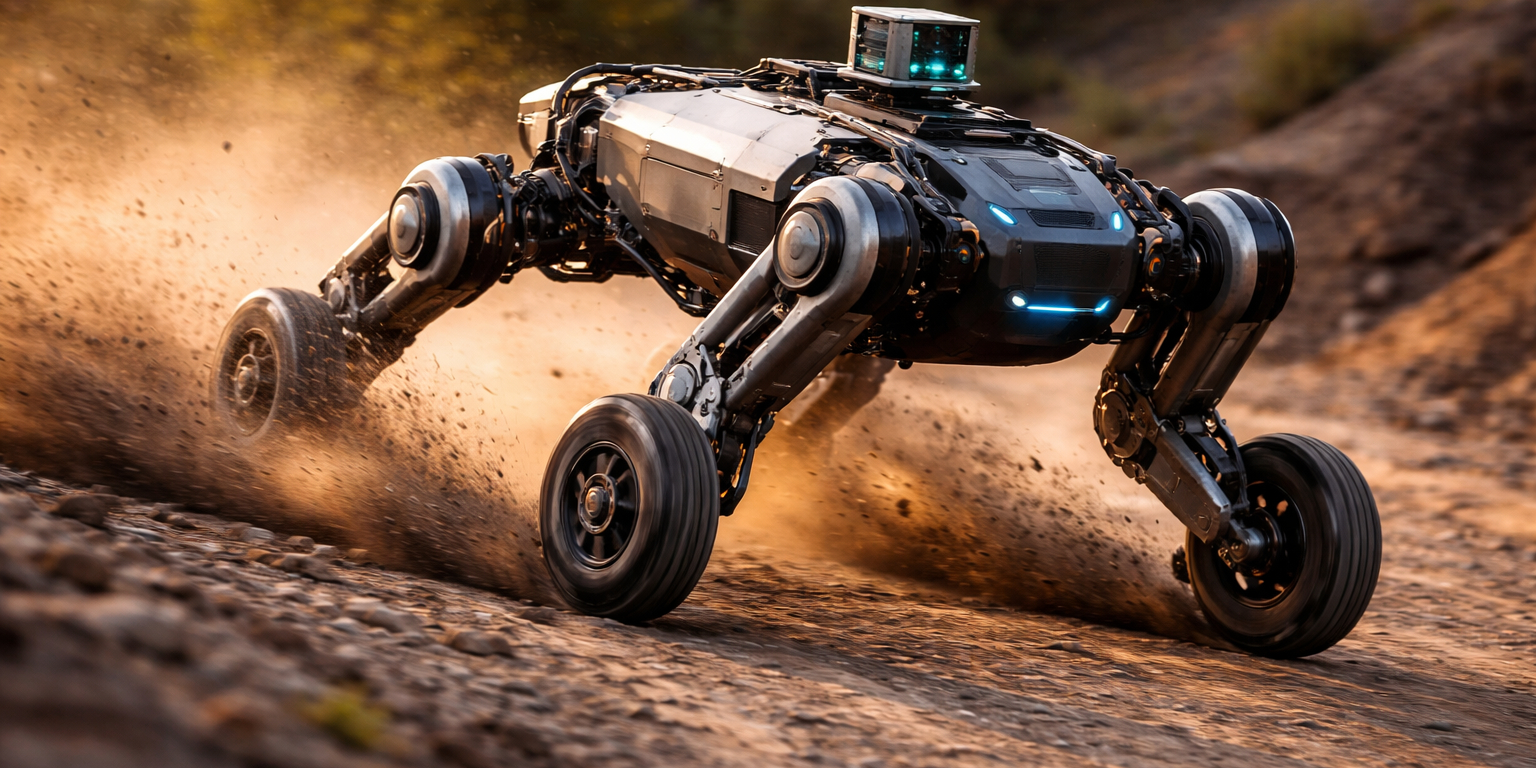
A demonstration video of Unitree Robotics' AS2-W quadruped navigating obstacles, recovering from simulated falls, and executing synchronized movements has accumulated more than 40 million views across social platforms in the past ten days, igniting debate about both the technical achievement and its implications. The Hangzhou-based company, which shipped over 10,000 units of its previous-generation Go2 quadruped in 2025, engineered the AS2-W with wheeled legs that enable it to reach speeds of 18 meters per second while maintaining balance on uneven terrain. Engineers responding to the video have focused on the robot's apparent mastery of terrain prediction and real-time weight distribution. Casual observers fixated on something else entirely: the machine looked disturbingly alive.
Unitree positioned the AS2-W as a successor to its wheel-leg hybrid models introduced in late 2024, when the company began exploring applications beyond its core academic and hobbyist customer base. The system integrates proprietary brushless motors rated at 300 Newton-meters of torque per joint, paired with a custom sensor suite that includes LIDAR, stereo depth cameras, and inertial measurement units refreshing positional data at 1,000 Hz. That hardware stack enables the robot to autonomously navigate GPS-denied environments, a requirement for search-and-rescue operations in collapsed structures or underground facilities where Unitree sees immediate commercial traction. The company has not disclosed AS2-W pricing but indicated it will remain below the $16,000 list price of its B2 industrial quadruped, suggesting positioning for volume deployment rather than niche research projects. China's Ministry of Emergency Management contracted for pilot deployments of Unitree quadrupeds at twelve provincial disaster response centers in early 2026, though those units appear to be earlier-generation B2 models rather than the wheeled AS2-W configuration.
The polarized response to Unitree's demonstration reflects a broader tension as legged robots transition from laboratory curiosities to field-deployable tools. Boston Dynamics faced similar scrutiny when videos of its Atlas humanoid performing parkour routines generated millions of views but also prompted questions about military applications and workforce displacement. Unitree's engineering team, led by co-founder Wang Xingxing, designed the AS2-W specifically for cargo transport in complex terrain, where wheeled vehicles fail and tracked platforms damage surfaces. A single unit can haul 80 kilograms across terrain gradients up to 35 degrees, making it viable for construction site logistics, agricultural monitoring on hillside vineyards, and perimeter security at industrial facilities. None of those applications typically generate viral social media attention. What captured the public imagination was footage of the robot sprinting up a steep embankment, tumbling deliberately, then righting itself within 1.2 seconds. That recovery sequence required coordinating twelve actuators simultaneously while recalculating the center of mass based on sensor fusion data, a task that pushes the limits of onboard computing with Unitree's custom edge AI chip running at 15 watts.
Commercial interest in autonomous quadrupeds has intensified as battery energy density improvements extend operational runtime beyond four hours, crossing the threshold where deployment economics begin favoring robotics over human labor for specific tasks. ANYbotics, the Swiss industrial inspection robotics company, reported 220% year-over-year growth in deployments at oil and gas facilities in 2025. Ghost Robotics, based in Philadelphia, secured a $140 million contract extension with the U.S. Air Force for its Vision 60 quadruped used in perimeter patrol applications at installations across seven countries. Unitree occupies a different market segment, targeting price-sensitive customers in logistics and agriculture where the company's vertical integration in motor and controller manufacturing enables aggressive pricing. The AS2-W uses the same actuator architecture as Unitree's $1,600 G1 humanoid, allowing the company to amortize development costs across product lines. Industry analysts at Interact Analysis estimate Unitree manufactured between 14,000 and 17,000 robotic systems in 2025, making it among the highest-volume producers of dynamic legged robots globally, though the firm's revenue remains a fraction of incumbents like ABB or KUKA that focus on traditional industrial arms.
What to Watch: Unitree is expected to announce AS2-W commercial availability and regional distribution partnerships before the end of August 2026, with initial deliveries likely targeting Asian markets where regulatory frameworks for autonomous mobile robots are more permissive. The company's next-generation G1 humanoid, priced at $16,000, faces potential competition from Figure AI's Figure 02 and Tesla's Optimus Gen 3, both anticipated to reach pilot customers in late 2026. Monitor whether Unitree pursues U.S. market expansion through a domestic manufacturing partner, as Chinese robotics exports face increasing tariff and national security scrutiny. The broader quadruped market will see product launches from Deep Robotics and LimX Dynamics, both Hangzhou-based competitors, in Q4 2026.