Unichem, a tier-two automotive supplier based in Michigan with annual revenues exceeding $840 million, has acquired Loomia, the Brooklyn-based developer of soft-circuit sensing fabrics, in a transaction that marks one of the first significant consolidations in the emerging humanoid tactile sensing market. Financial terms were not disclosed, but the deal transfers ownership of Loomia's manufacturing processes, intellectual property portfolio covering flexible electrode arrays, and its 34-person engineering team to Unichem's sensing division. The move reflects a strategic bet that humanoid robots will require automotive-scale production volumes for tactile sensors within three to five years, a timeline that assumes commercial deployments accelerate beyond the pilot projects currently underway at Figure AI, Apptronik, and others.
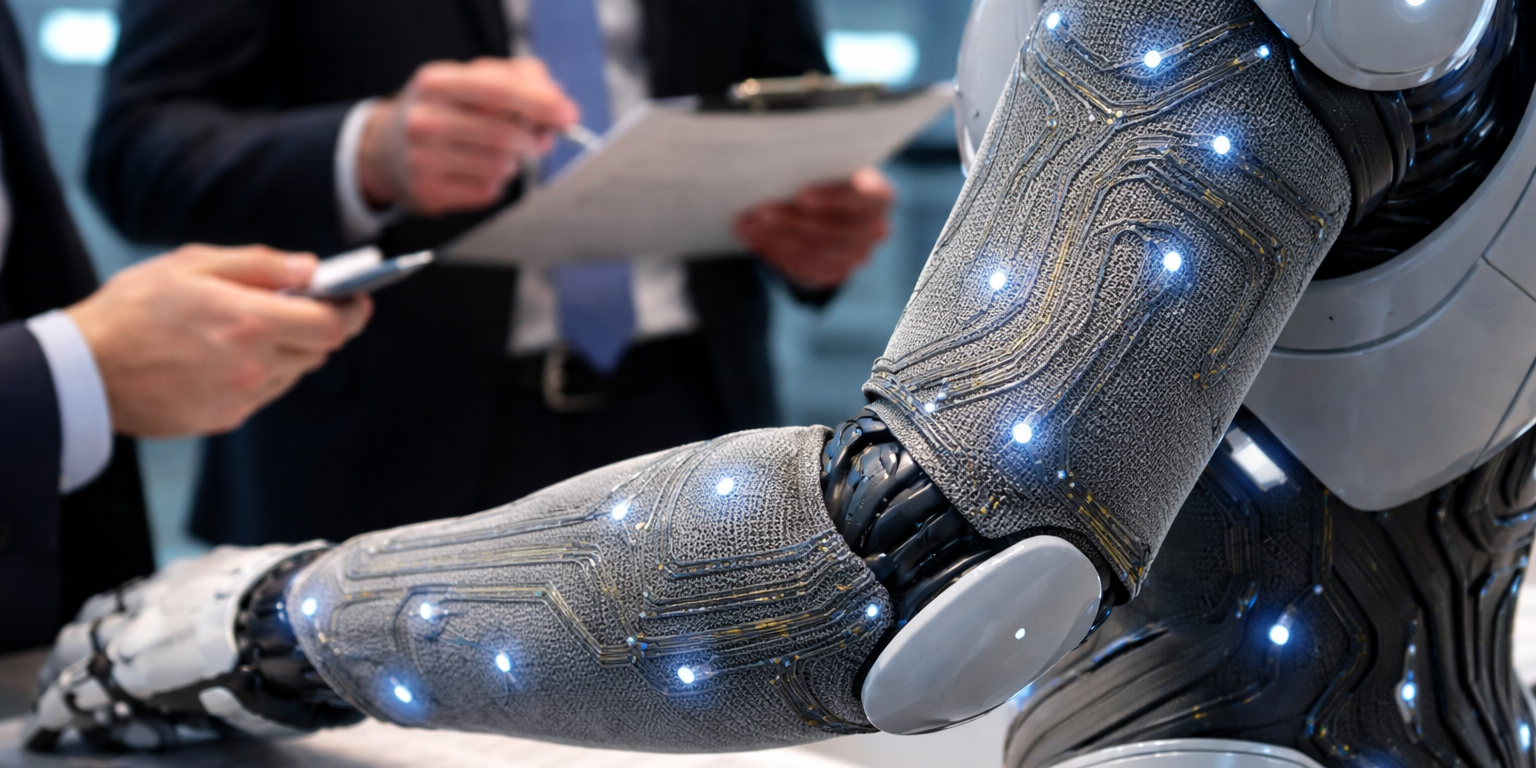
Loomia's core technology involves depositing conductive traces onto flexible substrates, typically textile or thin polymer sheets, to create pressure-sensitive and strain-sensitive circuits that can conform to curved surfaces. The company emerged from a fashion-tech background, initially developing heated jackets and illuminated garments, before pivoting to industrial sensing applications in 2023. That pivot came as humanoid developers began publicly discussing the challenge of providing robots with distributed tactile feedback across large surface areas like torsos, upper arms, and thighs, where traditional rigid sensor arrays prove impractical. Unichem's interest stems from its existing contracts supplying force-sensing resistors and pressure mats for automotive seating and airbag systems, markets where per-unit costs must stay below fifty cents and failure rates below ten parts per million. The robotics opportunity demands similar economics. A single humanoid could require between eight and fifteen square feet of sensor coverage, depending on design, meaning even modest production runs of ten thousand units annually would consume hundreds of thousands of square feet of sensing material.
R&Y, a separate automotive supplier specializing in polymer extrusion and injection molding, announced a partnership with the combined Unichem-Loomia operation to co-develop overmolding techniques that integrate Loomia's circuits into protective housings. R&Y operates seven facilities across North America and has worked with Tesla, Rivian, and General Motors on battery enclosures and structural components. The three-way collaboration aims to deliver a product that meets IP67 ingress protection standards while maintaining tactile sensitivity sufficient to detect contact forces below one newton, the threshold generally considered necessary for safe human-robot interaction. Current humanoid prototypes typically use either no tactile sensing beyond wrist-mounted force-torque sensors, or employ small patches of research-grade sensor skin that cost upwards of $400 per square foot and require careful handling. Scaling that approach to full-body coverage would add $30,000 or more to a robot's bill of materials, an untenable figure when manufacturers are targeting all-in costs around $50,000 for commercial viability. Unichem executives believe automotive manufacturing processes can reduce tactile skin costs to under $20 per square foot at volumes above fifty thousand units annually.
The broader context includes parallel efforts by several sensor manufacturers and materials companies to crack the humanoid skin problem. Tekscan, a subsidiary of Noraxon since 2024, offers thin-film force sensors primarily for medical and research applications but has reportedly engaged with at least two humanoid manufacturers on custom integrations. SynTouch, which developed the BioTac sensor used in academic robotics labs for over a decade, spun out a manufacturing-focused subsidiary in early 2026 to pursue commercial robot applications. And in China, several Shenzhen-based electronics manufacturers have begun offering low-cost capacitive sensing films marketed explicitly for robot skin, though independent testing suggests reliability and calibration consistency remain problematic. Unichem's advantage lies not in novel sensing physics but in process control, supply chain integration, and experience navigating automotive qualification standards that increasingly overlap with industrial robotics requirements. The company already operates clean rooms for sensor fabrication, automated testing rigs capable of running millions of actuation cycles, and vendor relationships with DuPont, 3M, and other materials suppliers that could provide the substrate films and conductive inks at scale.
What to Watch: Unichem and R&Y plan to demonstrate prototype sensor panels at the International Manufacturing Technology Show in Chicago during the second week of September 2026, where humanoid developers including Agility Robotics and Sanctuary AI are expected to attend. Monitor whether any humanoid manufacturer announces design-in commitments for Unichem's technology before year-end, which would signal confidence in commercial readiness. Also track patent filings from the combined entity related to strain-isolation techniques, which remain a critical unsolved problem when sensors must flex repeatedly without drift. Finally, observe whether other automotive suppliers follow Unichem's lead by acquiring robotics sensing startups, a pattern that would confirm consolidation in the tactile sensing supply chain is underway.