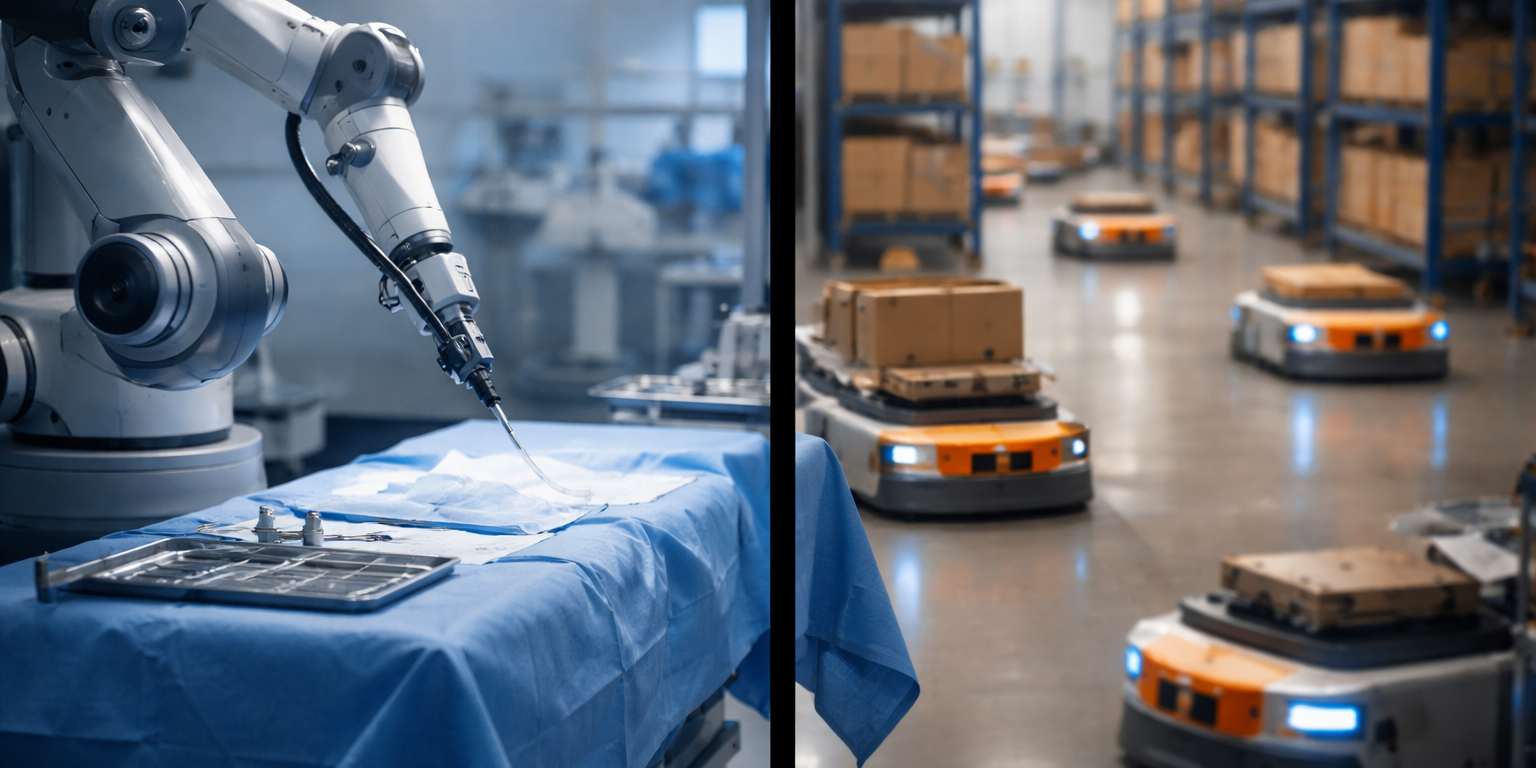
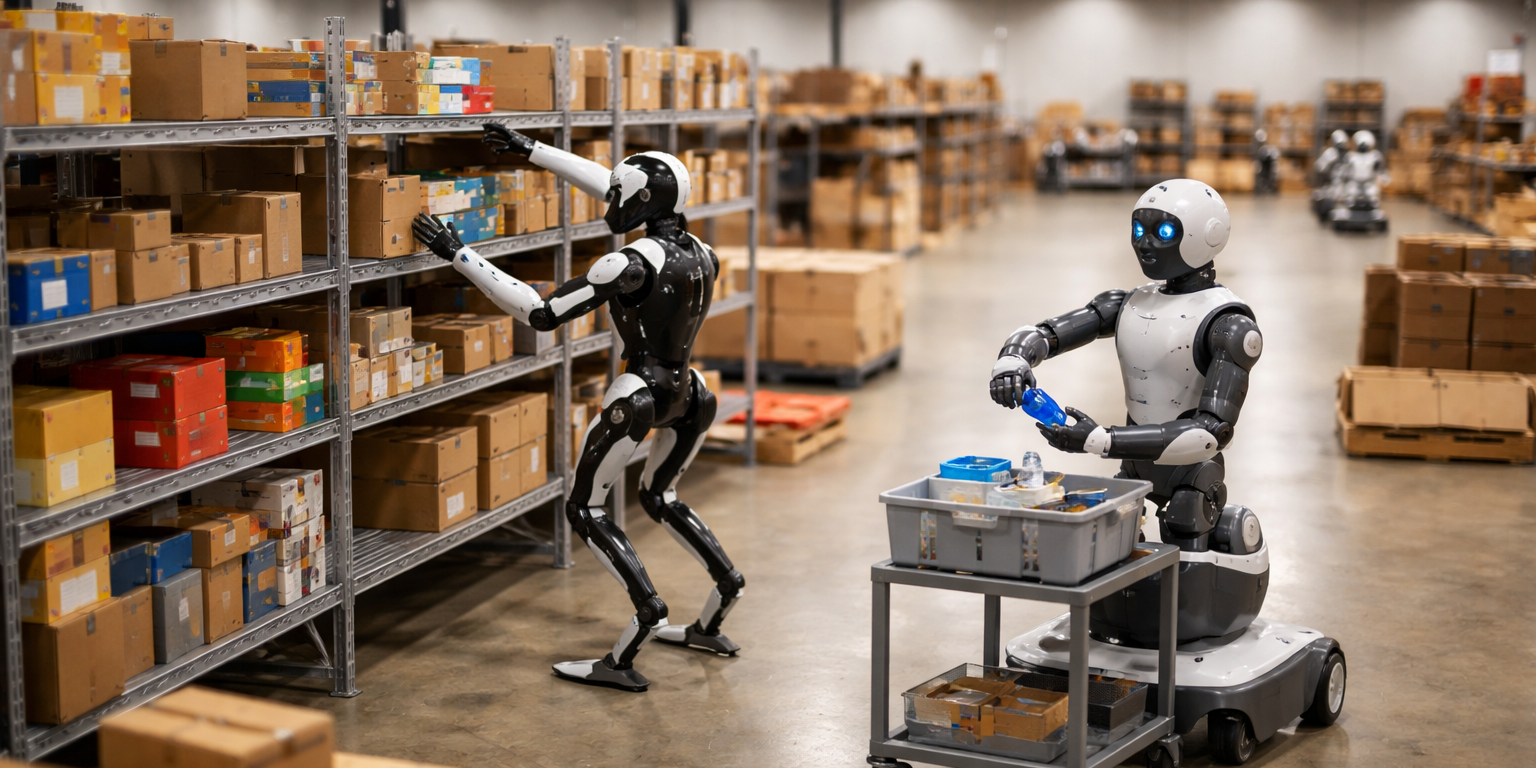
Tutor Intelligence shipped its second-generation warehouse robots in late August 2026, betting that foundation models trained in centralized facilities will solve the customization problem that has plagued industrial robotics deployments for decades. The Santa Clara-based company developed what it calls a robot classroom, a 15,000-square-foot training facility where Cassie picking robots and Sonny mobile manipulators learn tasks before reaching customer warehouses. Chief Executive Officer Anisha Nagarajan, formerly a robotics lead at Amazon, says the approach reduced average deployment time at pilot sites from six weeks to nine days. The foundation models underlying both platforms represent a departure from the task-specific programming that still dominates warehouse automation, where each new SKU or shelf configuration typically requires engineering time and system downtime.
Tutor Intelligence emerged from stealth in March 2024 with $42 million in Series A funding led by Khosla Ventures, followed by a $45 million Series B in November 2025 from Sequoia Capital and Lux Capital. The company has deployed first-generation systems at four logistics facilities operated by two undisclosed retailers and one third-party logistics provider. Nagarajan founded the company in late 2022 after leading the team that developed Amazon's Sparrow robotic arm, which uses computer vision and suction grippers to handle individual products. She brought seven engineers from that project to Tutor Intelligence, including former Kiva Systems veterans who worked on Amazon's mobile robot platforms. The decision to build foundation models rather than task-specific controllers stems from lessons learned at Amazon, where Nagarajan's team spent months tuning systems for new warehouse layouts. Sonny, the mobile manipulator, stands 5.2 feet tall with a seven-degree-of-freedom arm and can handle items up to 35 pounds. Cassie focuses on piece-picking operations, using a parallel gripper system and depth cameras to identify and grasp products from storage bins. Both robots share the same base foundation model, which Tutor Intelligence trains on synthetic data generated from 3D scans of common warehouse items and real-world teleoperation data collected in the classroom facility.
The classroom concept involves running dozens of robots through standardized picking, placing, and navigation tasks across mock warehouse environments that replicate common shelf configurations, bin sizes, and product categories. Tutor Intelligence built five distinct warehouse layouts within the training facility, each representing a different operational model: e-commerce fulfillment, retail replenishment, returns processing, crossdocking, and cold storage. Robots cycle through these environments continuously, with human operators providing corrections when the systems fail. That teleoperation data feeds back into the foundation model through a reinforcement learning pipeline. Nagarajan says the company has logged more than 2.3 million manipulation attempts and 18,000 hours of navigation data since the classroom opened in February 2025. The second-generation robots incorporate hardware changes based on field deployments, including upgraded motors in Sonny's shoulder joint and a redesigned gripper on Cassie that handles deformable packaging more reliably. Both platforms now run inference on Nvidia Jetson Orin modules, up from the Xavier chips in first-generation units. The foundation models themselves have grown from 340 million parameters in early 2025 to 1.2 billion parameters in the current release, trained on a cluster of 128 H100 GPUs.
Industry observers note that Tutor Intelligence enters a warehouse robotics market projected to reach $41 billion by 2028, according to ABI Research, with established players including Locus Robotics, which has deployed more than 31,000 mobile robots, and Boston Dynamics, whose Stretch robot now operates in more than 70 facilities. Covariant, another foundation model-focused robotics startup, raised $75 million in July 2026 and partners with ABB Robotics on AI-powered picking systems. The competitive landscape has intensified as companies race to demonstrate that large-scale machine learning can overcome the brittleness that has limited warehouse robot capabilities to relatively narrow task domains. Tutor Intelligence's classroom approach differs from competitors who train models directly in customer facilities or rely primarily on simulation. Nagarajan argues that centralized training allows tighter control over data quality and faster iteration, though it requires significant upfront capital investment. The company's facility lease and training infrastructure represent roughly $12 million in fixed costs. Pricing for Tutor Intelligence's systems starts at $4,200 per robot per month on three-year contracts, with the foundation model updates included. That positions the offering between pure robot-as-a-service providers like Locus, which typically charge per pick or per unit, and capital equipment sales from traditional automation vendors. The company currently employs 94 people, including 52 engineers split between hardware, software, and machine learning teams.
What to Watch: Tutor Intelligence plans to open a second classroom facility in Rotterdam by February 2027 to serve European customers and collect training data on different product types common in that market. The company is negotiating deployments with two top-ten global retailers for pilot projects starting in Q1 2027. Watch for announcements around expanded gripper capabilities, particularly for soft goods and polybag handling, which Nagarajan identified as the most common failure mode in current deployments. Competitors including Covariant and Dexterity are expected to release updated foundation models before year-end, setting up direct performance comparisons on standard warehouse benchmarks.