
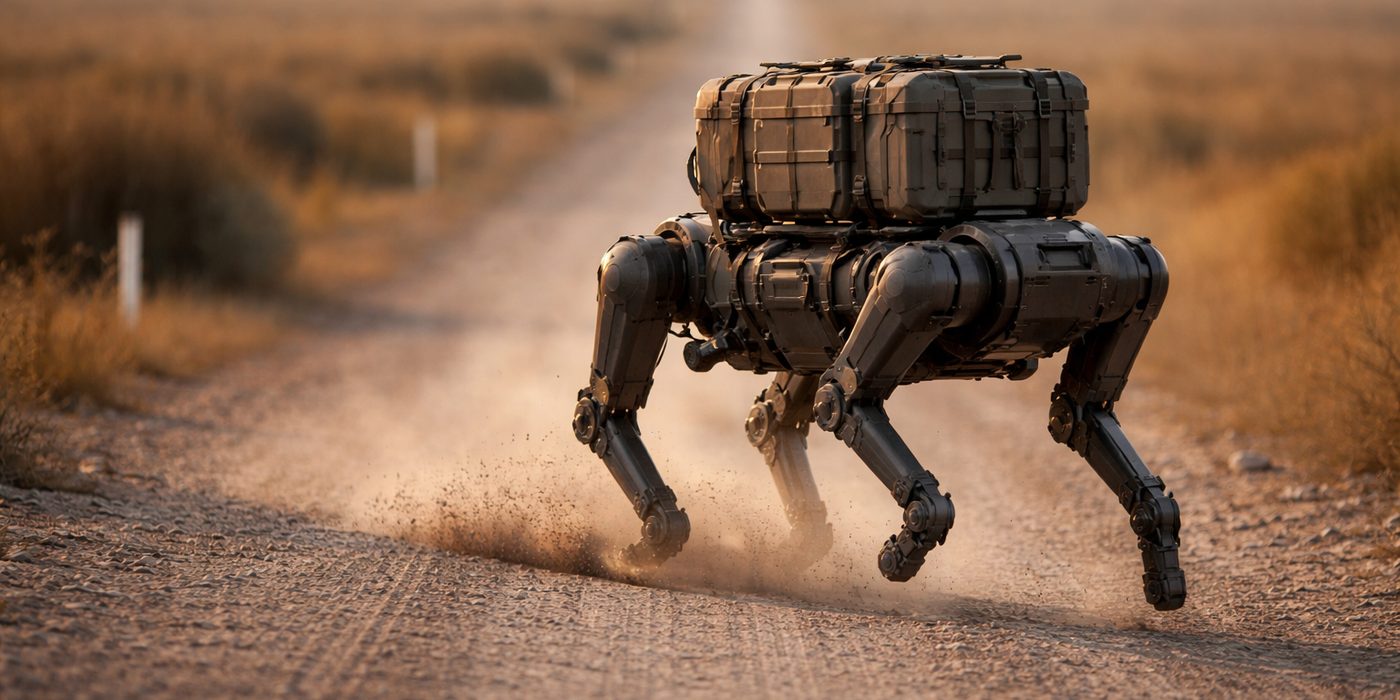
Fifty kilograms for two kilometers at walking-jog speed is a specific enough claim to be tested, and that specificity is what makes the X50 worth attention. DEEP Robotics says its new quadruped can carry that load at 3 m/s across the full distance, a figure that describes endurance under load rather than a brief laboratory lift. For anyone who has watched legged robots wilt on a long haul, the distinction matters. Most quadrupeds can stand up under heavy weight for a few seconds. Fewer can keep walking with it until the battery says otherwise.
The launch lands in a segment that has spent a decade proving legged locomotion is possible and a few years arguing about whether it is useful. Boston Dynamics' Spot established the template for inspection work, but its payload ceiling, roughly 14 kilograms, keeps it in the sensor-carrier category. Chinese manufacturers have pushed the other way. Unitree has driven prices down across the board, while DEEP Robotics, founded in 2017 and long associated with its Lynx and X30 platforms, has leaned toward industrial-grade durability and heavier loads. The X50 extends that logic. A machine that carries 50 kilograms is no longer just a camera on legs; it can haul tools, spare parts, gas-detection kits, and rescue gear.
The target applications read like a list of places where wheeled and tracked vehicles fail. Substations with stairs and cable trenches. Tunnels and utility corridors. Petrochemical plants with gratings and tight turns. Collapsed or flooded sites where emergency teams need supplies moved before a road can be cleared. DEEP Robotics has built its reputation on this kind of unstructured terrain, and the company has previously supplied platforms to power-grid operators and public-safety agencies in China. The three-meters-per-second figure is the quieter detail here. It is brisk enough to cover a plant perimeter in a useful time, and it suggests the control stack is managing load dynamics rather than simply shuffling along cautiously under weight.
The harder questions sit behind the headline numbers. Payload claims depend heavily on terrain, gait, ambient temperature, and how a manufacturer defines the test. A flat-floor run at 3 m/s with 50 kilograms is a different proposition from the same load on a 30-degree stairway or a wet slope, and the gap between them is where field reliability is won or lost. Actuator thermal management, battery capacity per kilogram carried, and fall recovery under load are the specifications procurement engineers will chase first. For the broader industry, a credible 50-kilogram quadruped compresses the distance between inspection robots and logistics robots. If the figures survive third-party testing, the X50 pressures competitors to publish sustained-payload data, not peak numbers, and gives Chinese suppliers another argument in cost-sensitive industrial tenders.
What to Watch The first signal is independent testing: look for utility operators, research labs, or integrators publishing X50 results on mixed terrain and stairs rather than level ground, which will either confirm or trim the 50 kg at 3 m/s claim. Track DEEP Robotics' announcements of named customers, particularly in power-grid inspection and emergency services, where its earlier X30 platform already has a foothold. Watch how Unitree and Boston Dynamics respond on payload disclosure, since a shift toward standardized sustained-load specifications would reshape how these machines get compared in tenders. Pricing is the other open variable; any published unit cost or leasing structure over the coming weeks will show whether the X50 is aimed at flagship pilots or fleet deployment.