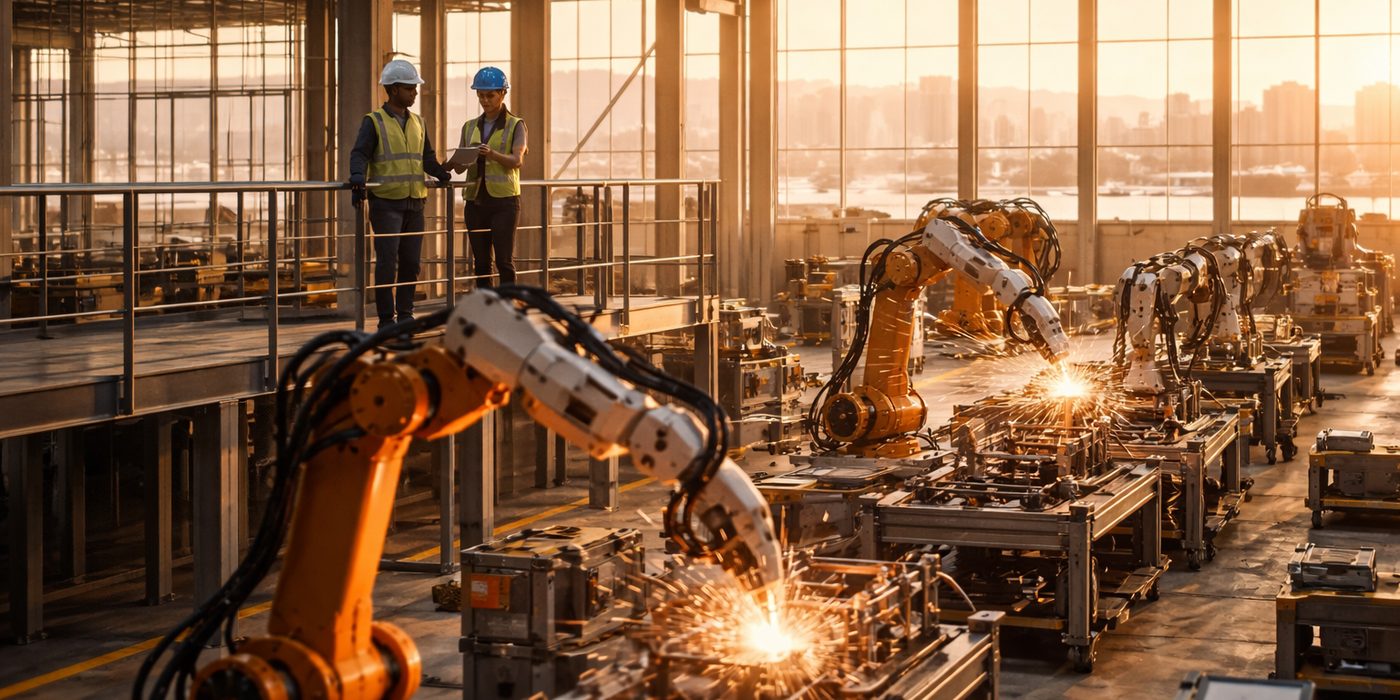
A $100 million Series A is a rare thing in industrial robotics, and the way Foundry Robotics plans to spend it is rarer still. The Emeryville, California company said Wednesday, October 28, that the round will fund an expansion of its own manufacturing footprint, with the Emeryville facility as the center of that buildout. Foundry describes itself as an autonomous factory company. That wording matters. It is not pitching a robot arm, a vision stack, or a fleet-management dashboard. It is pitching the factory itself as the product, and it intends to build more of that product with the new capital.
The strategy cuts against how most of the industry has financed itself over the past decade. Robotics startups have typically sold hardware or software into established plants, accepting long integration cycles, customer-specific edge cases, and the gravitational pull of legacy lines that were never designed for autonomy. Foundry's approach inverts that. By operating its own production environment in the San Francisco Bay Area, the company controls the variables that usually sink pilots: part presentation, fixturing, material flow, and the quality data loop. A facility it owns is also a living test bed, one where every failed cycle becomes training signal rather than a warranty dispute with a customer.
The capital intensity is the obvious risk, and it is where the Series A size becomes legible. Floor space, tooling, power infrastructure, and the robots themselves cost far more than a software team's burn, and a company that runs production directly carries inventory, yield, and utilization risk that a pure technology vendor never touches. A $100 million first round buys runway to absorb those costs while the system matures, but it also raises the bar. Investors writing checks of this size at the Series A stage are underwriting not just a technical thesis but an operating business, with the margin structure and working-capital demands of a manufacturer.
For the wider industry, the more interesting question is what Foundry's model says about where value is accumulating. Humanoid and general-purpose manipulation companies have absorbed most of the headline funding, yet the hard problem on a real production line is rarely a single gripper or a single policy. It is the integration of dozens of processes into a stable, high-uptime system. A company that treats the whole line as a learning machine is making a claim about where defensibility lives: in accumulated process knowledge and throughput data rather than in any one component. If that claim holds, it pressures both traditional automation integrators, who sell bespoke cells, and component makers, who risk commoditization beneath a vertically integrated operator.
What to Watch
The first signal to track is hiring and facility activity in Emeryville over the next 30 to 90 days, including permit filings, equipment orders, and senior manufacturing and controls roles posted by Foundry, which will show how fast the buildout is moving. Watch for any disclosure of the company's first named production customers or product categories, since the Series A announcement did not detail them and that choice will reveal what Foundry thinks its factory is best at making. Keep an eye on follow-on rounds and competing raises from other vertically integrated automation startups through the end of 2026, which would indicate whether investors are rotating from robot-as-product toward factory-as-product. Finally, look for throughput, uptime, or yield figures at industry events and investor briefings, because without published operating metrics the autonomous-factory thesis remains a funding story rather than a production one.