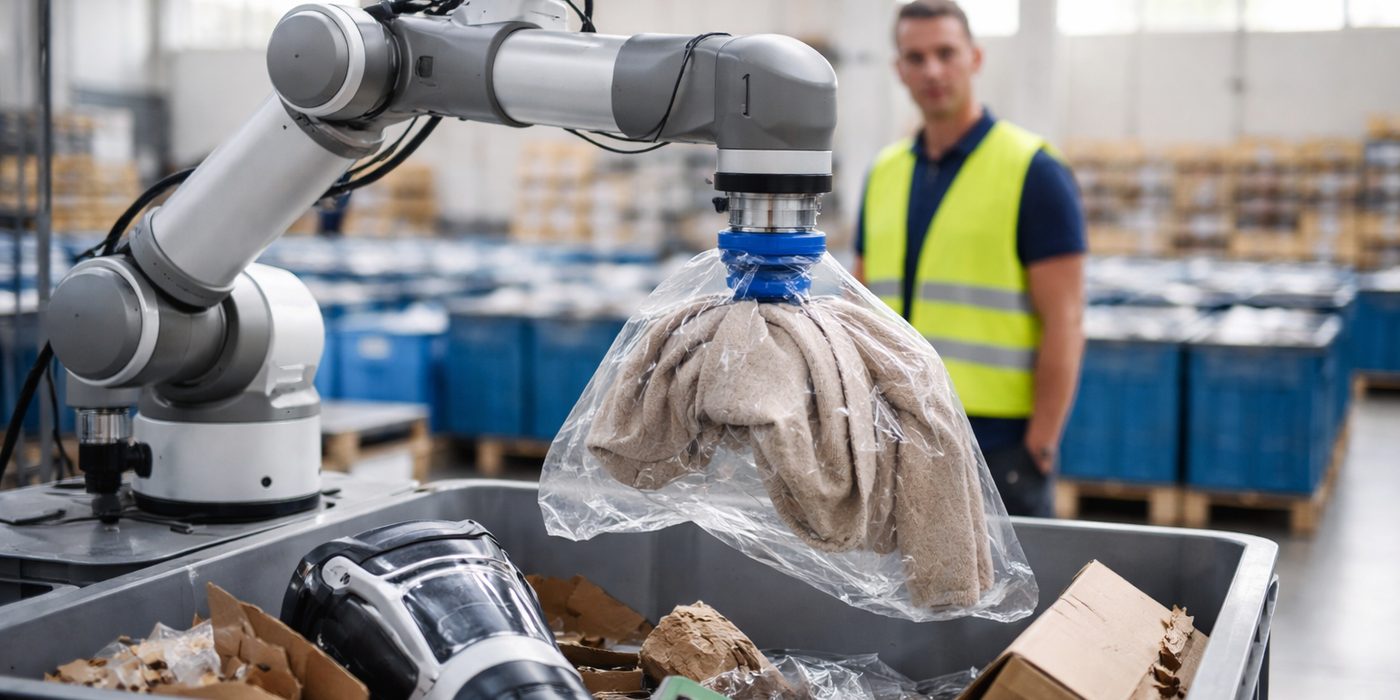
Returns handling is where warehouse automation goes to fail. A customer sends back a sweater, a blender, a phone case in a torn polybag, and nothing about the item, its packaging or its condition is predictable. On October 21, 2026, in Berlin, Teradyne Robotics and Sereact announced a partnership aimed squarely at that problem: Sereact's Cortex physical AI platform will now run Universal Robots arms, giving retailers and logistics operators a way to automate the messy, unstructured tasks that have defeated conventional pick-and-place programming for a decade. The pairing joins the world's best-known cobot arm to one of Europe's more closely watched robot-foundation-model startups.
The logic is easier to see from Teradyne's side of the table. Universal Robots built its business on a simple proposition: a lightweight arm that a technician could program in hours rather than weeks, safe enough to work without a cage. That proposition produced a very large installed base, but the arms themselves are increasingly a commodity input. The value is migrating to whatever tells the arm what to do when the world refuses to cooperate. Teradyne also owns Mobile Industrial Robots, the autonomous mobile robot maker, which means the group already sells both the manipulators and the vehicles that move goods between stations. What it has lacked is a perception-and-planning layer that generalizes across items it has never seen. Cortex is meant to be that layer.
Sereact has spent its short life attacking exactly that gap. The Stuttgart-founded company builds vision-language-action models that let a robot interpret a natural-language instruction, identify an unfamiliar object and decide how to grasp it, without a human hand-tuning a gripper strategy for each SKU. That is the practical definition of physical AI as the term is now used in logistics: software that treats manipulation as a learned skill rather than a scripted one. Running that software on a standardized, widely deployed arm solves a problem startups routinely underestimate. Hardware integration, safety certification and field service are slow and expensive, and a model that performs beautifully in a lab still has to survive a peak-season sorting shift.
For integrators and end customers, the commercial structure matters more than the press language. Universal Robots sells through a broad network of distributors and system integrators, many of whom already know how to commission a UR cell. If Cortex arrives as something those partners can quote, install and support using familiar hardware, the sales cycle for AI-driven manipulation shortens considerably. That is the real prize for Sereact, which would otherwise have to build channel relationships one customer at a time. It also raises a pointed question for competitors. Rivals pairing foundation models with their own proprietary arms now face a group offering open-ended AI on the most recognizable cobot brand in the market, and the cost of that comparison falls on anyone selling a closed stack.
The harder test is economic, not technical. Returns processing is labor-intensive, seasonal and low-margin, which makes it an appealing automation target and an unforgiving one. A system that handles most items but stumbles on a meaningful fraction creates exception queues that human workers must clear, and the savings evaporate quickly. Buyers will want to see throughput in picks per hour on mixed returns, the rate at which the system escalates to a human, and how performance holds up when item assortments change between seasons. Those numbers, more than any model benchmark, will determine whether this partnership produces repeat orders or a string of extended pilots.
What to Watch Track whether Teradyne and Sereact name pilot customers in retail or third-party logistics before the end of 2026, since named deployments with disclosed throughput figures would be the first real evidence beyond announcement-stage claims. Watch for Universal Robots' fourth-quarter commentary in Teradyne's earnings cycle, where management may quantify AI-attached orders or integrator interest. Also monitor how the system-integrator channel responds, particularly whether major UR partners begin listing Cortex-enabled cells in their catalogs by early 2027. Finally, keep an eye on competing foundation-model vendors for counter-partnerships with other arm makers, which would show whether this deal sets a template for the cobot market or stands alone.