Taiwan's precision transmission component manufacturers posted double-digit revenue growth in the first quarter of 2026, capitalizing on a resurgence in industrial automation spending that favored AI-integrated systems and early humanoid robot deployments. The suppliers who produce harmonic drives, planetary gearboxes, and electric actuators—the mechanical heart of every robotic joint—captured the bulk of gains as manufacturers expanded automation footprints in electronics assembly and logistics operations. Systems integrators also reported strong order books, though margin pressure from dual compliance frameworks tempered profitability for smaller firms navigating export control requirements on AI chips destined for certain markets.
The quarter's performance breaks a prolonged stretch of conservative capital allocation in industrial automation that began in mid-2024. Manufacturing customers had delayed major automation projects as AI vision systems and adaptive control algorithms were still proving their reliability in production environments. Those technologies have now matured to the point where return-on-investment timelines shortened enough to justify large-scale deployments. Electronics manufacturers in particular are installing vision-guided robotic cells that can handle component placement with tolerances under 50 microns while adapting to part variations without reprogramming. Logistics operators are deploying mobile manipulation systems that combine autonomous navigation with AI-driven grasp planning, a capability that remained experimental until late 2025. Rising labor costs in historically low-wage manufacturing regions provided additional economic pressure favoring automation, with some facilities reporting 15 to 18 percent annual wage inflation that automated systems can now undercut on a three-year payback horizon.
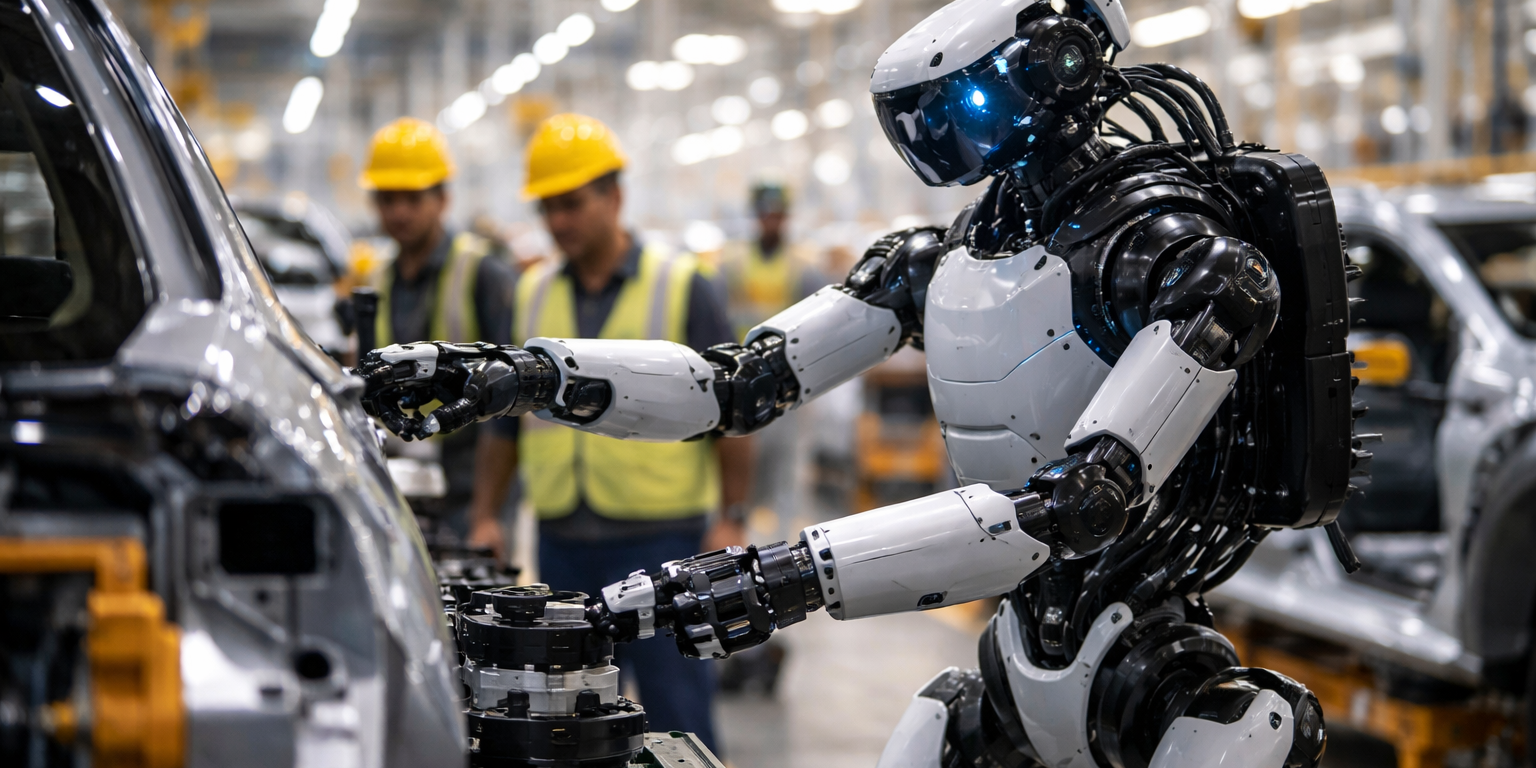
Humanoid robot installations, while still accounting for a small fraction of total deployments, moved decisively beyond demonstration phases during the quarter. At least three electronics contract manufacturers in Taiwan initiated production pilots using humanoid platforms for kitting operations and light assembly tasks in constrained workspace configurations where traditional industrial arms cannot fit. Each humanoid platform requires between 20 and 40 precision actuators distributed across its joints, compared to the 4 to 6 actuators in a standard six-axis industrial arm. Taiwan-based transmission component suppliers control approximately 60 percent of global production capacity for harmonic drives and planetary gearboxes used in robotics applications, positioning them to capture disproportionate revenue if humanoid adoption expands beyond current pilot programs. One Taipei-based actuator manufacturer reported that humanoid robot orders represented 8 percent of Q1 bookings, up from effectively zero in the prior year quarter. Another supplier noted it is already allocating dedicated production lines for humanoid-specific joint modules that require tighter backlash tolerances and higher torque density than conventional industrial robot components.
Export control complications continue reshaping business models across Taiwan's robotics ecosystem. Several systems integrators have established parallel product lines—one incorporating advanced AI accelerators for unrestricted markets, another using less capable processors that fall below regulatory thresholds for customers in restricted territories. The administrative burden of maintaining dual compliance frameworks, separate supply chains, and distinct engineering documentation has compressed gross margins by 3 to 5 percentage points for integrators with annual revenues below $50 million. Larger players with dedicated trade compliance teams absorbed the overhead more easily. Component suppliers face less direct impact since precision mechanical transmissions carry no inherent export restrictions, though they must track which integrators serve which end markets to maintain their own compliance posture. Two mid-sized Taiwanese robotics firms announced they would exit certain geographic markets entirely rather than sustain dual compliance operations, consolidating their focus on regions with straightforward regulatory environments. Industry observers note the segmentation may persist for years, effectively splitting the robotics market into parallel ecosystems with different capability ceilings determined by component access rather than engineering limits.
What to Watch: Taiwan's precision transmission suppliers will report Q2 earnings in mid-July 2026, providing visibility into whether humanoid robot orders continue expanding or plateau at pilot-program levels. Export control frameworks may shift if trade negotiations scheduled for June yield regulatory adjustments—watch for announcements from the Bureau of Industry and Security regarding actuator and motion control classifications. Three major electronics manufacturers are expected to complete humanoid robot pilot evaluations by August and decide whether to proceed with broader deployments that could represent hundreds of units each.