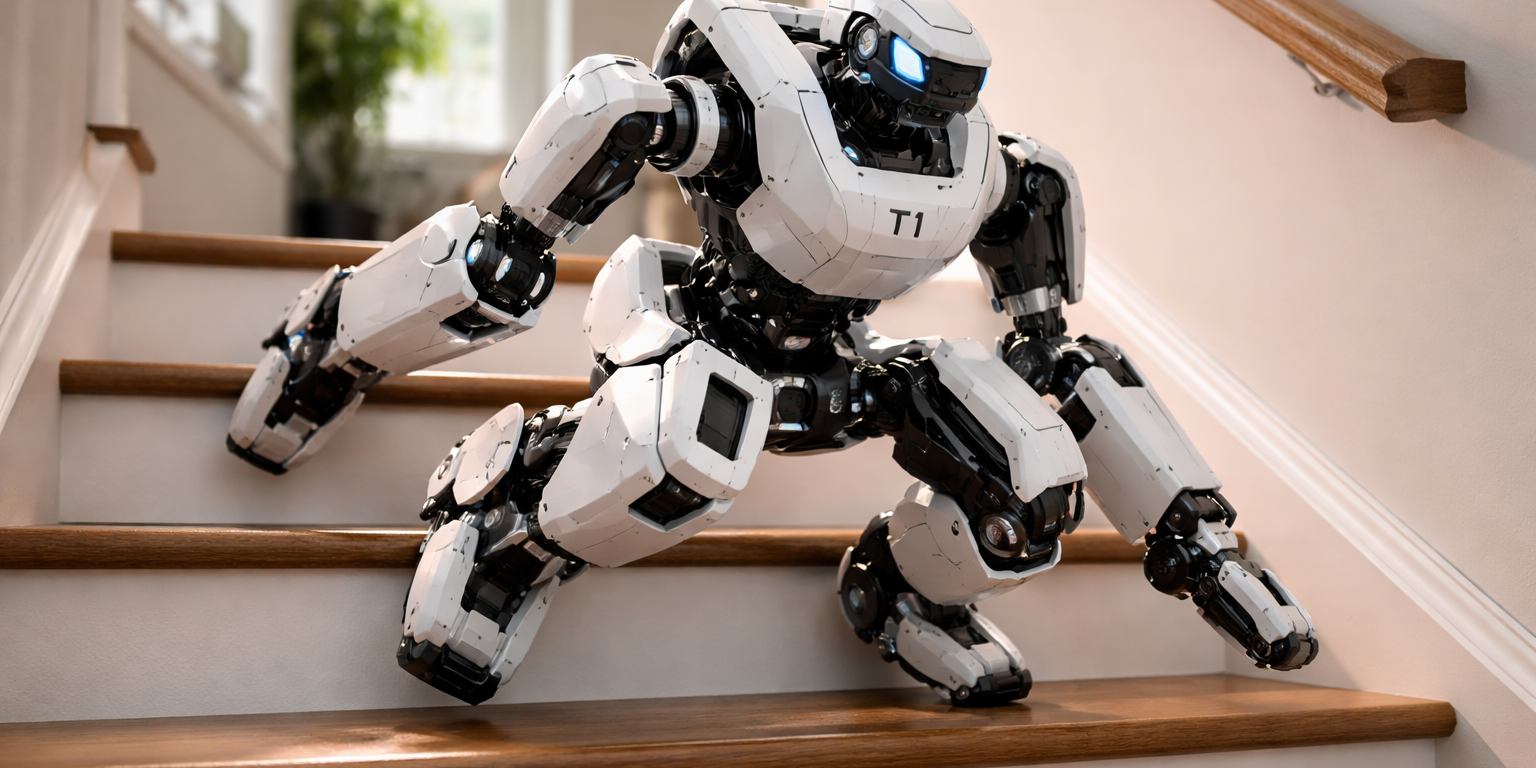
Stairs have defeated more household robots than any other architectural feature. The T1 personal robot sidesteps that limitation entirely by reconfiguring its body structure mid-task, shifting from a humanoid walker to a quadruped climber when vertical surfaces demand it. The machine represents the first transformable domestic helper aimed at consumer deployment, combining bipedal upright locomotion for flat surfaces with four-legged stability for stairs, inclines, and uneven flooring. Unlike fixed-form robots that excel in one mode of movement, the T1 adapts its physical configuration to match environmental demands. The system carries objects while upright and drops to all fours when climbing or descending stairs, distributing weight across four contact points rather than balancing on two.
Transformable robotics have existed in research labs for years, but commercial applications lagged due to mechanical complexity and control system challenges. Boston Dynamics demonstrated quadruped-to-biped transitions in experimental platforms, yet those systems never targeted residential use cases. The T1 brings transformation mechanics into a form factor designed for hallways, kitchens, and living spaces rather than industrial floors or outdoor terrain. The robot's long-term memory system tracks household layouts, user preferences, and routine patterns, building a persistent model of its operating environment rather than treating each task as an isolated event. Smart following capabilities allow the unit to trail users through multi-room spaces, maintaining visual or sensor lock while navigating doorways and furniture obstacles. The combination of adaptive locomotion and environmental learning addresses two fundamental problems in home robotics: getting from point A to point B across varied surfaces, and understanding context well enough to anticipate needs rather than simply responding to commands.
The transformation mechanism itself involves reconfiguring limb positions and joint angles to shift the robot's center of gravity and contact pattern. In humanoid mode, the T1 walks upright with arms free to manipulate objects, open doors, or carry items at waist height. Transitioning to quadruped mode redistributes those same limbs into a four-point stance that lowers the chassis and increases stability. The shift takes seconds and happens autonomously based on sensor input detecting stairs, steep inclines, or surfaces that exceed the bipedal system's safe operating parameters. This approach differs from modular robots that physically detach and recombine components, or from wheeled systems that deploy temporary leg structures. The T1's limbs serve dual purposes without requiring add-on hardware or manual reconfiguration. Engineering challenges include maintaining joint integrity across two distinct load profiles, managing cable routing through limbs that adopt multiple positions, and ensuring motors provide adequate torque in both configurations without overbuilding for the worst-case scenario.
Consumer robotics companies have struggled to justify the cost and complexity of humanoid forms when wheeled bases handle most household navigation more efficiently. The T1's answer involves making the humanoid shape conditional rather than constant, deploying bipedal locomotion only when task requirements demand hands-free or the environment suits upright movement. Quadruped mode serves as the fallback for reliability rather than the primary operating state. This inverts the usual design philosophy where robots optimize for a single best-case scenario and accept limitations elsewhere. Market timing matters here. Personal robot deployments have accelerated as component costs drop and AI control systems mature, but differentiation remains difficult when most platforms offer variations on wheeled bases with articulated arms. Shape-shifting introduces a mechanical differentiator that software alone cannot replicate, potentially justifying premium pricing in a category where consumers have proven reluctant to pay more than appliance-level prices. Whether that differentiation translates to actual utility in residential environments depends on how often real-world use cases demand the transformation capability versus how often the added mechanical complexity creates maintenance burdens or failure points.
What to Watch: Track whether the T1 reaches retail channels before the end of 2026 or remains in limited pilot deployments. Monitor announcements from established robotics firms like iRobot, Samsung, or Chinese manufacturers regarding their own transformable platforms, as competitive response timelines will indicate whether this approach gains traction. Watch for technical specifications on transformation cycle life and joint durability, since consumer products require thousands of mode shifts without degradation. Pay attention to pricing announcements, which will reveal whether transformable mechanics push the T1 into luxury territory above $5,000 or achieve mass-market positioning closer to $2,000.