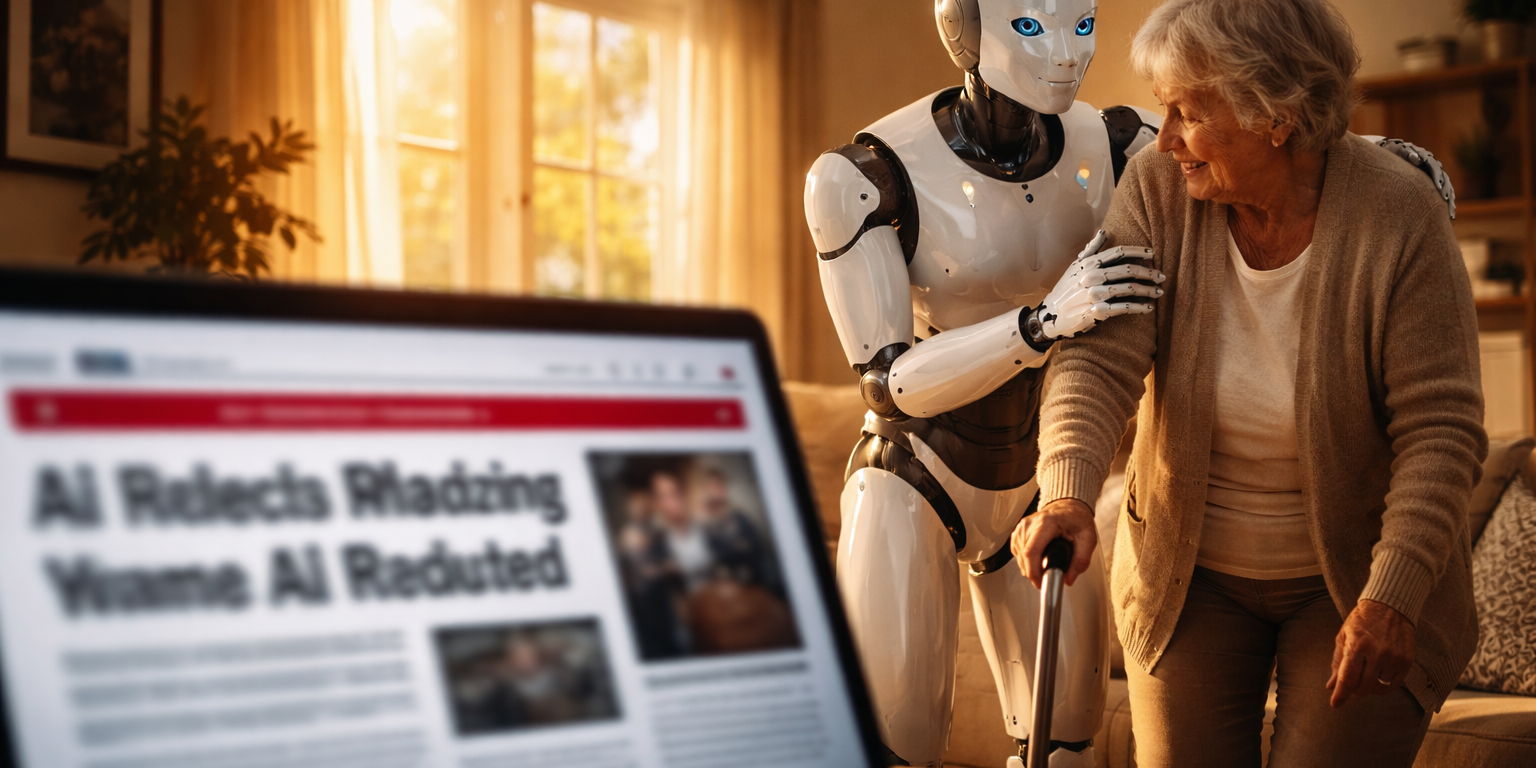
A weekend social media post from 1X's design leadership turned into the robotics industry's latest flashpoint over how humanoid form factors get framed in mainstream coverage. Dar Sleeper, who oversees product and design strategy for the Oslo-based company's consumer robotics division, took direct aim at Wired magazine for what he characterized as gratuitously sexualized language in a profile of NEO Beta, the $20,000 wheeled humanoid that began limited home deployments in late 2025. Sleeper's criticism centered on specific word choices and framing devices that he argued distorted the engineering intent behind NEO's human-proportioned upper body and expressive interface design. The company has positioned NEO Beta as a learning-capable home assistant focused on elderly care and household task automation, with 1X targeting initial commercial availability in select U.S. markets by mid-2027.
The dispute arrives as multiple humanoid developers navigate the treacherous gap between anthropomorphic design benefits and cultural baggage that comes with human-shaped machines. Boston Dynamics faced similar narratives around Atlas despite its explicit industrial positioning. Figure AI has deliberately kept Figure 02's aesthetic utilitarian to avoid consumer projections beyond warehouse tasks. Agility Robotics equipped Digit with a decidedly non-human head precisely to sidestep anthropomorphization. But 1X took a different path with NEO Beta, giving the robot an oval head with subtle facial features, articulated arms designed for delicate household object manipulation, and a wheeled base that splits the difference between mobility and approachability. That design calculus makes the robot more immediately relatable to non-technical users, 1X has argued in investor materials, but it also opens the door to interpretations the company clearly did not anticipate or welcome. Sleeper's objections suggest 1X leadership believes media framing could materially impact the $20,000 purchase decision among early adopter households already weighing whether a domestic robot justifies the cost of a subcompact car.
The financial stakes are considerable for 1X, which raised $100 million in a Series B round led by OpenAI's venture fund in March 2024 and has since deployed its bipedal EVE robots across logistics clients including ADT Commercial. NEO represents the company's consumer market entry, a segment where no humanoid has yet achieved meaningful household penetration at any price point. Amazon's Astro, priced at $1,600 and lacking humanoid form, has sold in the low tens of thousands since its 2021 invitation-only launch. Tesla's Optimus remains in prototype phase with no confirmed delivery timeline beyond Elon Musk's projection of limited production in 2027. That leaves NEO Beta as one of the first human-shaped robots available for actual home purchase, albeit in a restricted beta program targeting fewer than 200 households through 2026. Each of those early deployments functions as both a technical validation exercise and a consumer perception test. If beta users or their social circles begin associating NEO with the kind of imagery Sleeper objected to in Wired's coverage, it could poison the broader addressable market before 1X scales production. The company has not disclosed pricing for the commercial version of NEO expected in 2027, but industry observers anticipate a target around $15,000 to $18,000 to achieve volume adoption.
Sleeper's public pushback also reflects broader anxiety within the humanoid sector about narrative control as these machines transition from research labs to living rooms. Multiple robotics executives speaking at the IEEE International Conference on Robotics and Automation in Philadelphia this past May referenced the "uncanny valley problem" not as a design challenge but as a media challenge how to prevent pop culture frameworks from overwhelming the practical value proposition. Sanctuary AI's Phoenix robot emphasizes task completion metrics over appearance in its client materials. Apptronik's Apollo launch campaign centered on industrial payload specs rather than its humanoid silhouette. Even Figure AI, despite its name, has carefully avoided using the word "humanoid" in some investor communications, preferring "bipedal manipulator." 1X took the opposite approach with NEO, leaning into the home assistant positioning and emphasizing the robot's ability to navigate human-designed spaces and use human tools without modification. That strategy requires consumer comfort with a human-shaped machine in intimate domestic settings preparing meals, handling laundry, assisting with mobility which makes media narratives around the robot's form factor especially high-stakes.
What to Watch: Monitor whether 1X adjusts NEO Beta's design language or marketing approach ahead of its anticipated 2027 commercial launch, particularly any changes to the robot's head design or interaction modalities. Track media coverage of other home humanoids from Figure AI and Tesla through late 2026 to see if similar framing issues emerge across the sector. Watch for industry response at RoboticsIntl's Humanoid Summit in Boston this October, where several sessions already address consumer perception challenges for anthropomorphic robots. Finally, observe whether 1X expands its beta program beyond the current 200-household cap or pulls back to reassess positioning before broader release.