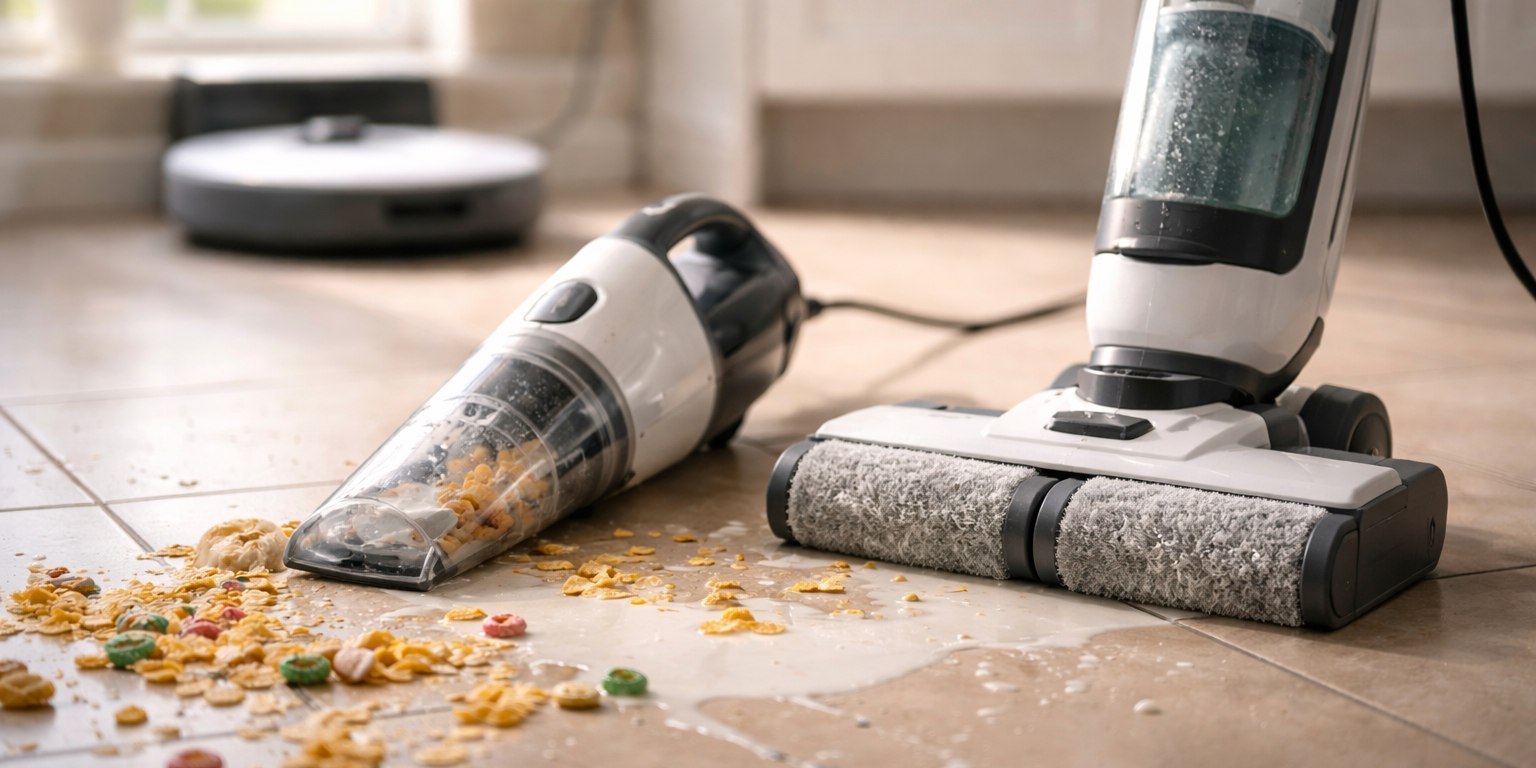
iRobot and Dyson have both launched manual wet-dry cleaning appliances specifically designed to handle the moments when autonomous systems are too slow, too dumb, or too far away to be useful. The Roomba Electro Plus, a corded handheld unit with a 0.5-liter tank capacity, and the Dyson WashG1, a push-model floor washer with twin roller bars, signal something more significant than simple product line extensions. These are targeted retreats from autonomy in scenarios where human reaction time and judgment remain decisively superior to robotic logic, even after two decades of iterative sensor improvements and navigation algorithm refinements.
The timing matters because both companies have spent the past five years aggressively marketing their respective autonomous platforms as comprehensive floor care solutions. iRobot's Roomba Combo j9+ series, launched in 2023 with automatic debris disposal and obstacle avoidance powered by computer vision, retails between $1,099 and $1,399 depending on bundle configuration. Dyson entered autonomous floor cleaning in 2024 with the 360 Vis Nav, priced at $1,199, featuring a 360-degree vision system and piezoelectric sensor array to detect microscopic dust particles. Yet both firms have now acknowledged what their support forums and product review sections have been documenting for years: autonomous vacuums cannot respond to sudden liquid spills, crushed food debris, or sticky residues with the speed or effectiveness that domestic situations frequently demand. The Electro Plus carries a suggested retail price of $349, while the WashG1 is listed at $499, positioning both devices well below their companies' flagship autonomous models but above commodity corded vacuums.
The technical constraints are instructive for anyone tracking robotics deployment beyond the consumer space. Autonomous floor cleaners rely on scheduled or opportunistic cleaning cycles, meaning the earliest they might encounter a fresh spill is on their next programmed run, typically hours later. Even models equipped with persistent mapping and remote activation features require users to open an app, locate the robot's current position, and manually direct it to the affected area, a workflow that takes 30 to 45 seconds under ideal conditions and assumes the user remembers where the robot docked. Liquid absorption presents a separate problem: most autonomous vacuums use microfiber pads with maximum saturation capacities between 150 and 200 milliliters, adequate for routine mopping but insufficient for pooled liquids exceeding a cup's volume. The WashG1's twin-roller system applies 18 liters per minute of cleaning solution while simultaneously extracting moisture, a hydraulic throughput no battery-powered autonomous unit currently matches. iRobot's Electro Plus uses a dual-tank design separating clean water from extracted debris, maintaining suction pressure at 9.5 kilopascals throughout operation, comparable to corded shop vacuums.
The strategic implications extend beyond floor care. Both companies are implicitly acknowledging that autonomy commands a price premium consumers will pay only when the autonomous function delivers clear superiority over manual operation. For scheduled, routine maintenance across unobstructed floor space, autonomous vacuums justify their cost through unattended operation and labor savings. For immediate response to unpredictable events requiring contextual judgment, human-operated tools remain more effective and cost a fraction of the price. This calculus appears in nearly every category where domestic robotics competes with traditional appliances. Autonomous lawn mowers handle regular trimming but struggle with fallen branches or uneven regrowth after heavy rain. Robotic pool cleaners maintain baseline cleanliness but require manual intervention for algae blooms or debris clusters. Window-cleaning robots work on flat glass but fail on divided-light panels or exterior surfaces above the first story. The consumer robotics sector has effectively segmented into maintenance automation, where robots excel, and reactive problem-solving, where they do not.
What to Watch: Track third-quarter 2026 sales data for both models, particularly WashG1 adoption rates in markets where Dyson previously discontinued its 360 Vis Nav due to weak demand. Monitor whether iRobot positions the Electro Plus as a complementary purchase alongside autonomous Roombas or markets it as a standalone alternative, which would signal broader strategic repositioning. Pay attention to patent filings from both companies around hybrid autonomous-manual systems that might attempt to bridge the response-time gap, possibly through voice-activated emergency modes or wearable controls that eliminate app navigation delays.