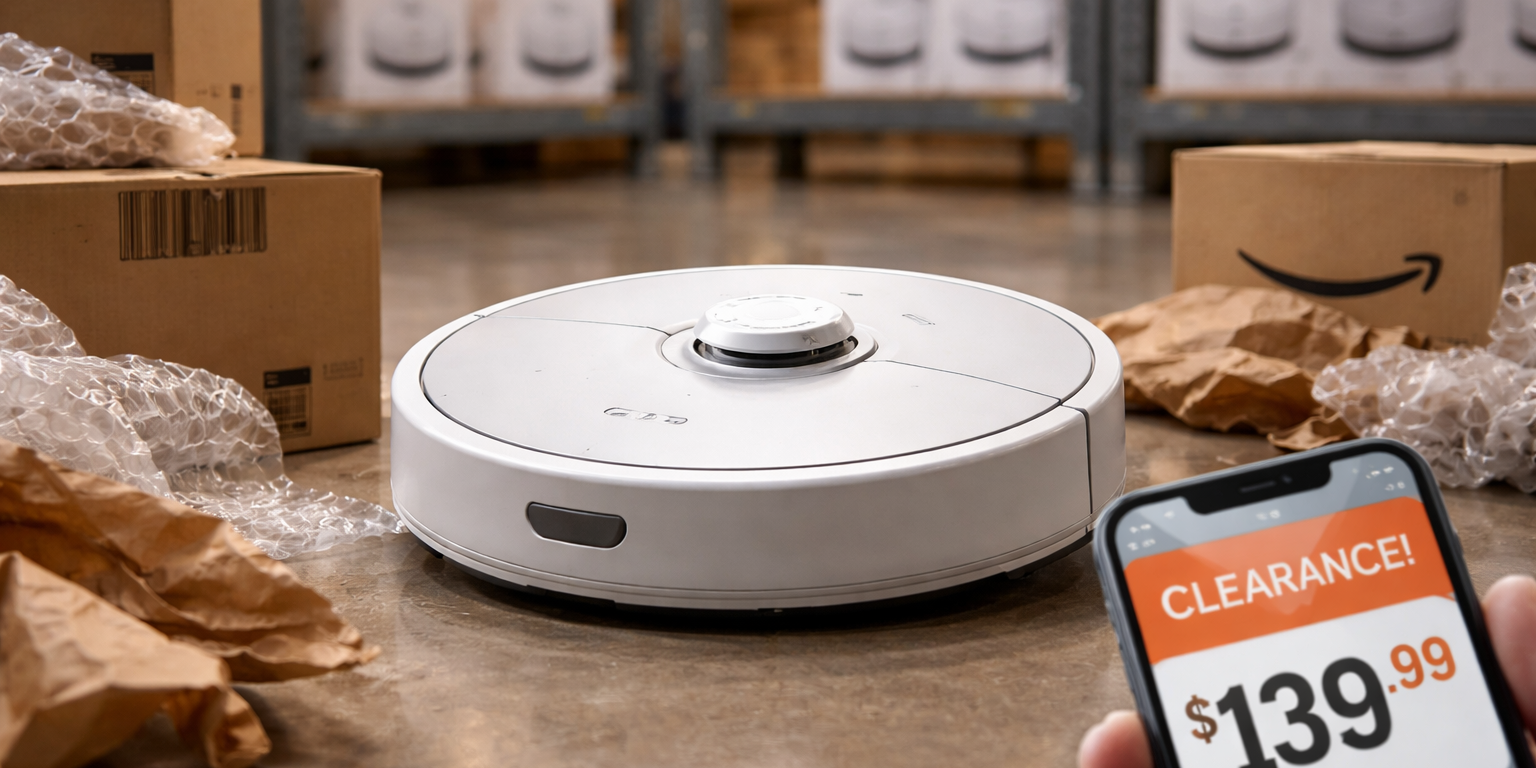
Amazon listed Roborock Technology Co. Ltd's Q7 L5 vacuum-mop hybrid at $139.99 with free shipping on July 12, 2026, marking one of the steepest sustained discounts yet for a tier-two autonomous floor care platform from a major manufacturer. The Q7 debuted at $399 in May 2023, positioning it as a mid-market alternative to Roborock's flagship S-series. Three years later, the unit sits at roughly one-third of its original retail price. The markdown comes as Roborock and rivals including Ecovacs, Dreame Technology, and iRobot clear aging inventory ahead of a product refresh cycle expected to bring vision-language models and improved object recognition to consumer robots by fourth quarter 2026. For engineers tracking the consumer robotics stack, the pricing compression reveals how quickly once-premium features—LiDAR navigation, multi-floor mapping, simultaneous vacuum-mop operation—have commoditized. What commanded a $400 price point in 2023 now competes at the same tier as manual vacuum cleaners.
Roborock shipped approximately 3.8 million robotic vacuum units globally in 2025, according to filings with the Shanghai Stock Exchange, placing it second behind Ecovacs in unit volume but ahead in revenue per unit. The company's gross margin compressed from 51.2% in 2023 to 47.6% in 2025 as competition intensified and component costs—particularly LiDAR sensors and brushless motors—declined. The Q7 L5 specifically uses a PSD (position-sensitive detector) navigation system rather than the spinning LiDAR towers found on higher-end models, a cost-reduction measure that still delivers room mapping but with less precision in cluttered environments. The 470ml dustbin and 180ml water tank remain adequate for apartments and small homes, the platform's target use case when it launched. Maximum suction reaches 2700Pa, competitive with other mid-tier offerings but well below the 6000Pa+ emerging as standard on 2026 flagships. Battery capacity hits 5200mAh, supporting roughly 180 minutes of runtime on hard floors—enough for 2400 square feet in a single charge cycle under ideal conditions.
The discount structure tells a familiar story in hardware commoditization. Roborock introduced the Q-series as a price-conscious alternative to its S7 and S8 lines, aiming to capture households unwilling to spend $600+ on floor care automation. That strategy worked through 2024, with Q-series units accounting for roughly 40% of Roborock's unit sales despite contributing just 28% of revenue. But the value proposition eroded as competitors launched equivalent platforms at lower entry points and as Roborock itself pushed higher-margin products with advanced features: automated dust disposal, carpet detection that lifts mop pads, and voice-assistant integration beyond basic Alexa compatibility. The Q7's static mop pad—it remains in contact with carpet, requiring manual removal—became a liability as rival systems added mechanical lift mechanisms standard. By mid-2025 the Q7 was competing primarily on price, and Amazon's current $139.99 reflects that reality. The platform still functions as designed, but the feature set that justified $399 three years ago now sits at the bottom of the market.
For the robotics industry, consumer vacuum pricing serves as a leading indicator for broader autonomy trends. The same LiDAR sensors, SLAM algorithms, and brushless motor controllers that power a $140 vacuum appear in warehouse AMRs, delivery robots, and even some agricultural platforms. When component costs drop and software stacks mature to the point where a full autonomous navigation system retails for under $150, it reshapes the economics of deploying robots in other domains. Several Chinese manufacturers already offer white-label robotic vacuum platforms for under $100 at factory-gate pricing, available to any company willing to order 1000+ units. That commoditization pressure extends upstream: LiDAR manufacturers like Slamtec and Camsense face margin compression as vacuum makers shift to lower-cost vision systems and time-of-flight sensors. The Q7 discount also highlights inventory risk in fast-moving hardware categories. Roborock likely produced Q7 units in volume during 2024 based on 2023-2024 demand forecasts, only to see the market shift toward premium features faster than anticipated. The result: deep discounts to clear channel inventory before next-generation products launch. Amazon's deal history shows the Q7 has traded in the $170-$200 range for most of 2026; the sub-$140 price suggests either a liquidation push or a test to see how low pricing must go to move remaining stock. Either way, it underscores the risk hardware companies face when product cycles compress and component costs decline faster than sales forecasts anticipated.
What to Watch: Roborock's Q3 2026 earnings call in late October should reveal whether the company took inventory writedowns on Q-series platforms and provide guidance on next-generation launches expected before year-end. Watch for announcements from Ecovacs and Dreame regarding LiDAR-free navigation systems using stereo cameras and neural networks, a shift that could push entry-level pricing below $100. Monitor Amazon's pricing on iRobot's Roomba j-series; if those units also see steep discounts in Q3 2026, it suggests industry-wide inventory pressure rather than Roborock-specific challenges. Finally, track whether any tier-two home robotics brands launch rebranded Q7-equivalent platforms at sub-$120 price points, signaling that white-label manufacturing has reached full commoditization.