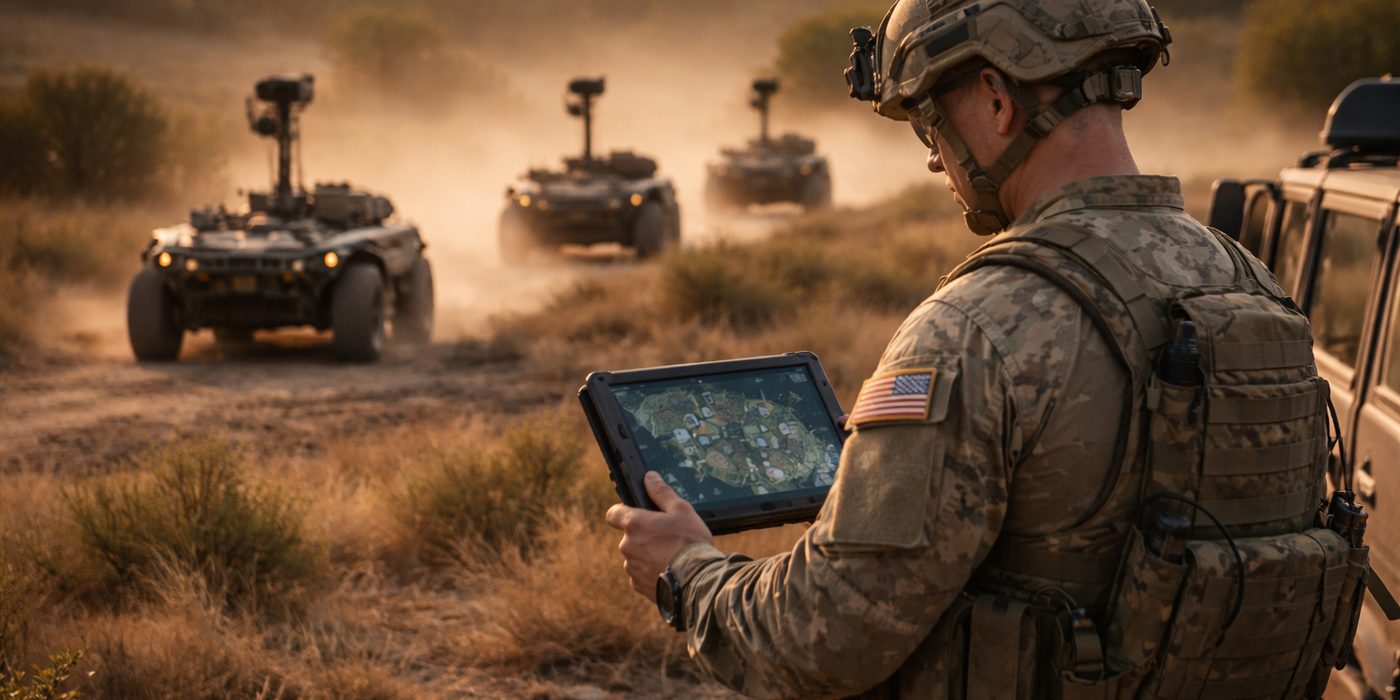
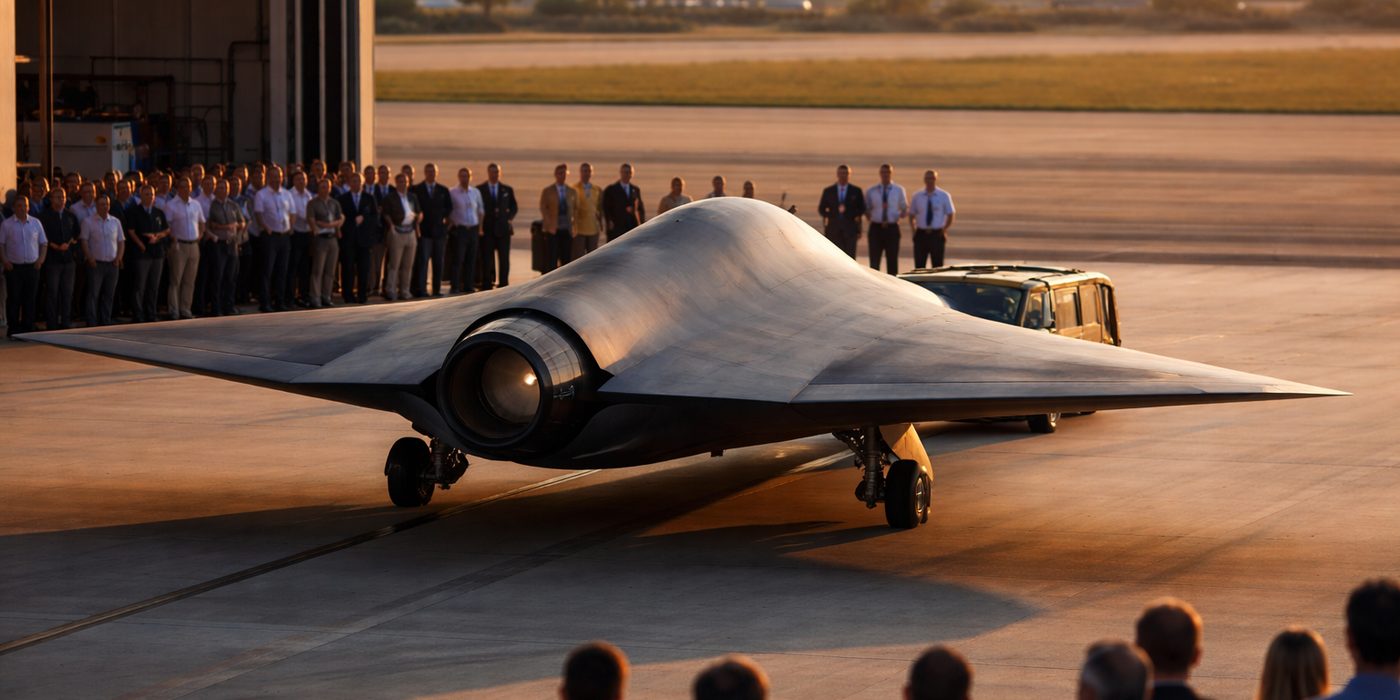
The most telling detail about the X-BAT is not its size or its engine. It is what's missing from the airframe: a cockpit. Shield AI's first full-scale prototype, unveiled at the company's Frisco, Texas facility, is a fighter-class aircraft roughly half the size of a Lockheed Martin F-35 that carries no pilot at all. Its brain is Hivemind, the autonomy software Shield AI has been fielding on smaller platforms for years. Its heart is a General Electric F110 turbofan, the afterburning engine family that powers F-16s and F-15EXs, fitted here with thrust vectoring. The company calls it the world's first autonomous VTOL strike fighter. The hardware now exists to test that claim.
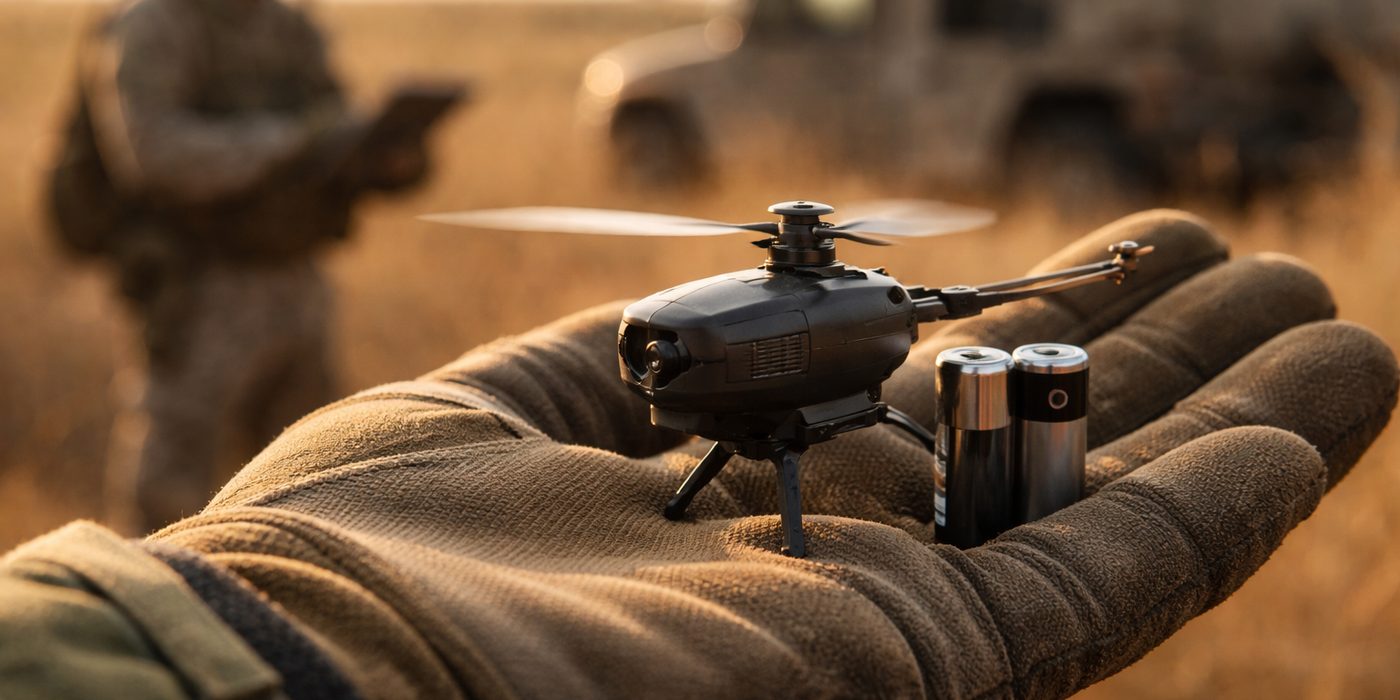
Shield AI is not a newcomer to autonomy, but it is a newcomer to building big, fast airplanes. The San Diego-based company made its name with the V-BAT, a small ducted-fan tail-sitter used by the U.S. Coast Guard, Navy, and allied forces for maritime surveillance, and with Hivemind, which has flown on platforms ranging from quadcopters to a modified F-16 in the Air Force's VISTA test program. Those were software-first and small-airframe stories. The X-BAT represents a deliberate leap in weight class, speed, and cost of failure. Moving from a surveillance drone that a ship crew can launch and recover by hand to a supersonic-capable fighter that takes off vertically is a different engineering discipline entirely, and the Frisco rollout is the company's declaration that it intends to compete there.
The technical premise is straightforward to state and brutally hard to execute. A single afterburning F110 with thrust vectoring has to do two jobs: generate enough sustained thrust to lift a fighter-class airframe straight up, then transition to efficient, high-speed forward flight. Thrust vectoring is what makes that conceivable without a dedicated lift fan or a stack of lift engines, the approach that added enormous weight and complexity to the F-35B. The tradeoff is thermal and structural. Exhaust management during hover, ground erosion, engine inlet behavior at low speed, and the control-law transition between jet-borne and wing-borne flight are the places where VTOL programs have historically bled schedule and money. An uncrewed airframe removes pilot-safety constraints from that envelope, which gives designers latitude, but it does not repeal physics.
For the broader robotics industry, the more consequential story may be what the X-BAT says about where autonomy value is accruing. The aircraft's pitch is that runway independence changes the basing math: a strike asset that can operate from a ship deck, a forest clearing, or a damaged airfield is far harder to pin down and destroy on the ground than one tethered to a few vulnerable runways. That logic sits squarely in the Pentagon's current push toward collaborative combat aircraft, where low-cost, attritable autonomous platforms fly alongside crewed jets. Shield AI is wagering that the software layer, not the airframe, is the durable asset, and that a company controlling Hivemind can swap or scale hardware beneath it. If that holds, autonomy stacks look less like components and more like platforms.
The skeptics' questions are as concrete as the prototype. Autonomy that performs reliably in a surveillance orbit has not necessarily been proven in contested, jammed, communications-denied strike scenarios, and no AI pilot has yet been certified to employ weapons at fighter-class speeds without human oversight in the loop. Supply chain and engine availability matter too: the F110 is a mature, well-understood powerplant, which lowers technical risk, but production capacity and integration schedules are not infinite. Competitors are crowding the same lane. General Atomics, Anduril, Boeing, and Northrop Grumman all have collaborative-aircraft entries, and several are further along in flight testing. Shield AI's advantage is vertical takeoff and a mature autonomy stack. Its burden is proving both on a schedule that matches procurement windows.
What to Watch The first milestone is ground testing: watch for announcements of engine runs, tethered hover trials, and the thrust-vectoring checkout at Frisco, since a first untethered hover would be the clearest proof point for the VTOL claim. Track any Pentagon signals tied to the Air Force and Navy collaborative combat aircraft programs, including whether X-BAT is folded into formal evaluation or a contract vehicle. Keep an eye on Shield AI's funding and partnership activity, as a fighter-class program demands capital on a scale well beyond its V-BAT business. Finally, follow how rivals such as General Atomics and Anduril respond with flight-test footage of their own aircraft through the end of 2026 and into early 2027.