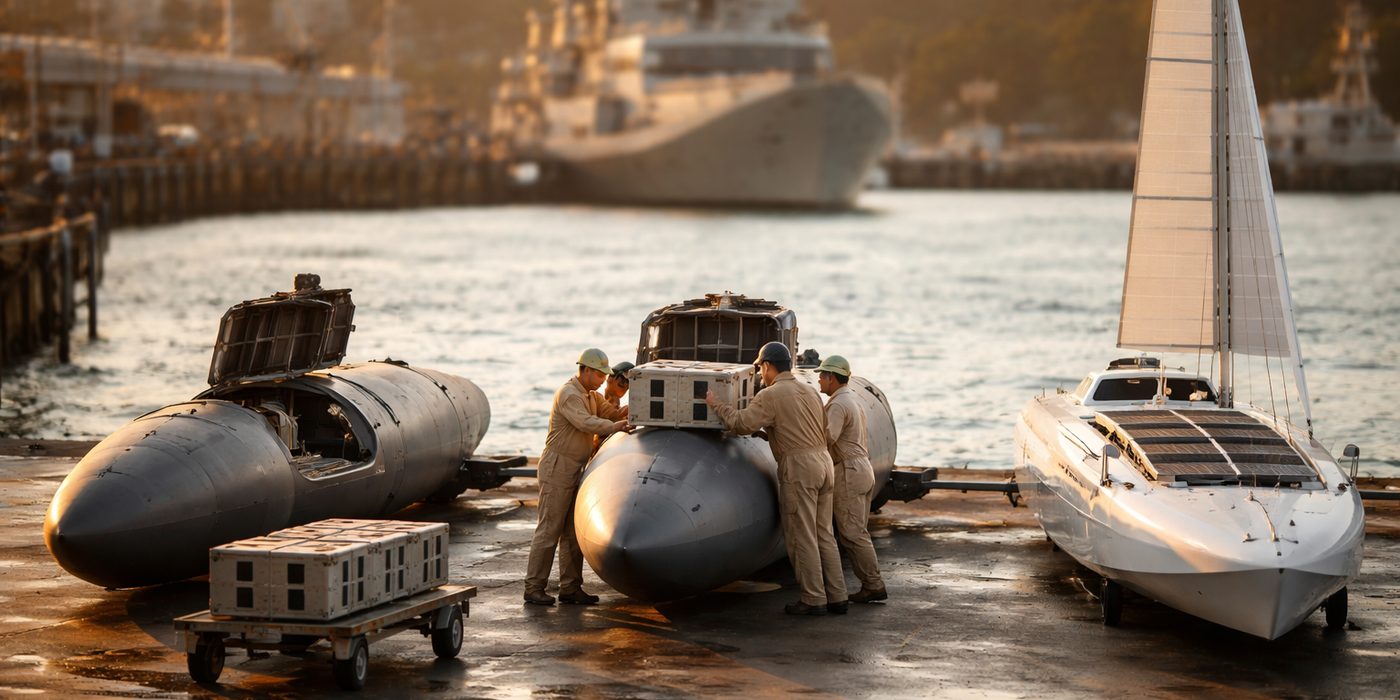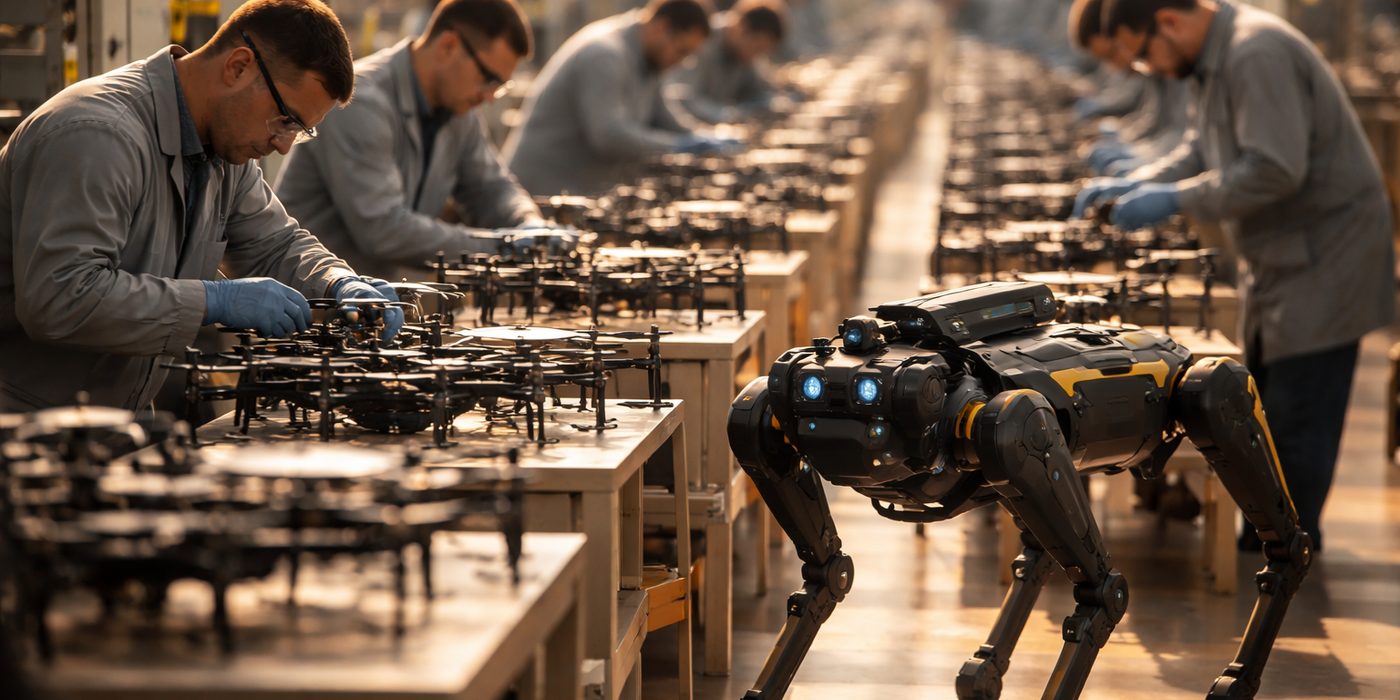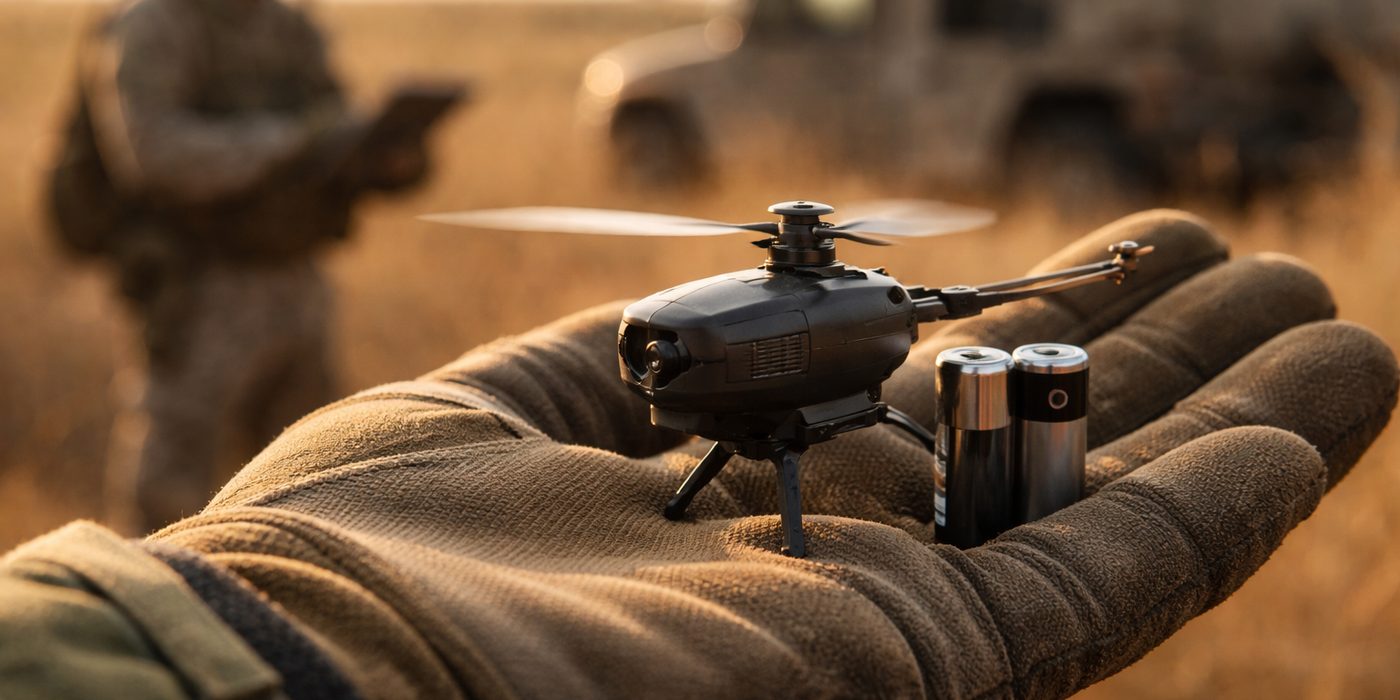
The most telling number in the miniaturization debate is a mass figure: the Black Hornet nano-UAV, now in service with multiple NATO militaries, weighs roughly 33 grams, less than a AA battery pair, and still carries a stabilized camera package and navigation suite. That is the production baseline, not the research frontier. A Small Wars Journal analysis of the trend argues that advances in artificial intelligence, sensors, electronics, and navigation technologies are collectively pushing military robotics toward systems that are smaller, lighter, and more autonomous with each procurement cycle. What once required a vehicle-mounted payload bay now fits in a pocket, and the engineering assumptions behind military robotics are being rebuilt around that fact.
The drivers are less exotic than the end products suggest. Smartphone economics did most of the work. Cameras, inertial measurement units, GNSS receivers, radios, and application processors were driven down in size, power draw, and unit cost by consumer demand across two decades, and defense programs are now harvesting that supply chain. Edge AI accelerators capable of running object detection at single-digit watts have extended the same logic to onboard perception, which means a small airframe no longer needs a constant link to an operator to make useful decisions. The result is a class of machines whose individual cost is low enough to be expended, and whose collective capability depends on software rather than airframe size.
The spectrum of platforms now stretches from hand-launched quadcopters and first-person-view strike drones, through ground crawlers small enough to be thrown into a room or tunnel, down to research efforts on insect-scale flyers and swimmers. Harvard's RoboBee lineage, which has produced flapping-wing microrobots weighing fractions of a gram, remains the reference point for what physics permits at the small end, though those devices are tethered or power-limited and far from fielding. The practical action sits in the middle of the range, where Ukraine's battlefield has turned commercial-derived quadcopters into mass-produced consumables, and where Western militaries are scrambling to build domestic supply chains that avoid dependence on Chinese motors, batteries, and flight controllers.
For the robotics industry, the implications cut across the usual segmentation. Defense primes built their businesses on exquisite, expensive platforms with long development cycles, while the miniaturization trend rewards firms that iterate hardware on commercial timelines and treat autonomy software as the durable asset. That favors startups and component specialists: makers of compact LiDAR and radar, low-power vision processors, solid-state and high-discharge batteries, micro-actuators, and secure mesh radios. It also raises hard engineering questions the analysis flags in various forms. Small platforms have little room for energy storage, so endurance stays punishingly short. They are vulnerable to jamming and weather. And swarming, the capability that makes many cheap units worth more than one expensive one, demands robust decentralized coordination that still struggles outside controlled conditions.
The sharpest observation for investors is that miniaturization inverts the traditional defense value chain. When the airframe is nearly disposable, the margin migrates to the parts no one can easily copy: perception stacks trained on scarce operational data, navigation that works when GNSS is denied, and manufacturing capacity that can scale to tens of thousands of units a month. Counter-drone systems follow the same curve in reverse, since defeating swarms of cheap machines with expensive interceptors is a losing exchange ratio. Expect procurement conversations in 2026 and 2027 to center on cost-per-effect, domestic sourcing of motors and batteries, and certifiable autonomy under electronic warfare, rather than on any single platform's headline specifications.
What to Watch Track the Pentagon's Replicator-era follow-on contracting and the Defense Innovation Unit's small-UAS solicitations through the end of 2026, particularly awards that specify non-Chinese supply chains for motors, batteries, and flight controllers. Watch Teledyne FLIR's Black Hornet 4 deployments and any new nano-UAV orders from NATO members as a read on demand at the smallest scale. Monitor edge-AI silicon announcements from Qualcomm, NVIDIA, and Ambarella aimed at sub-10-watt perception, since those chips set the ceiling on onboard autonomy. Finally, follow Ukrainian and Russian electronic-warfare adaptations over the next 90 days, which continue to dictate how much autonomy small drones need to survive jamming.