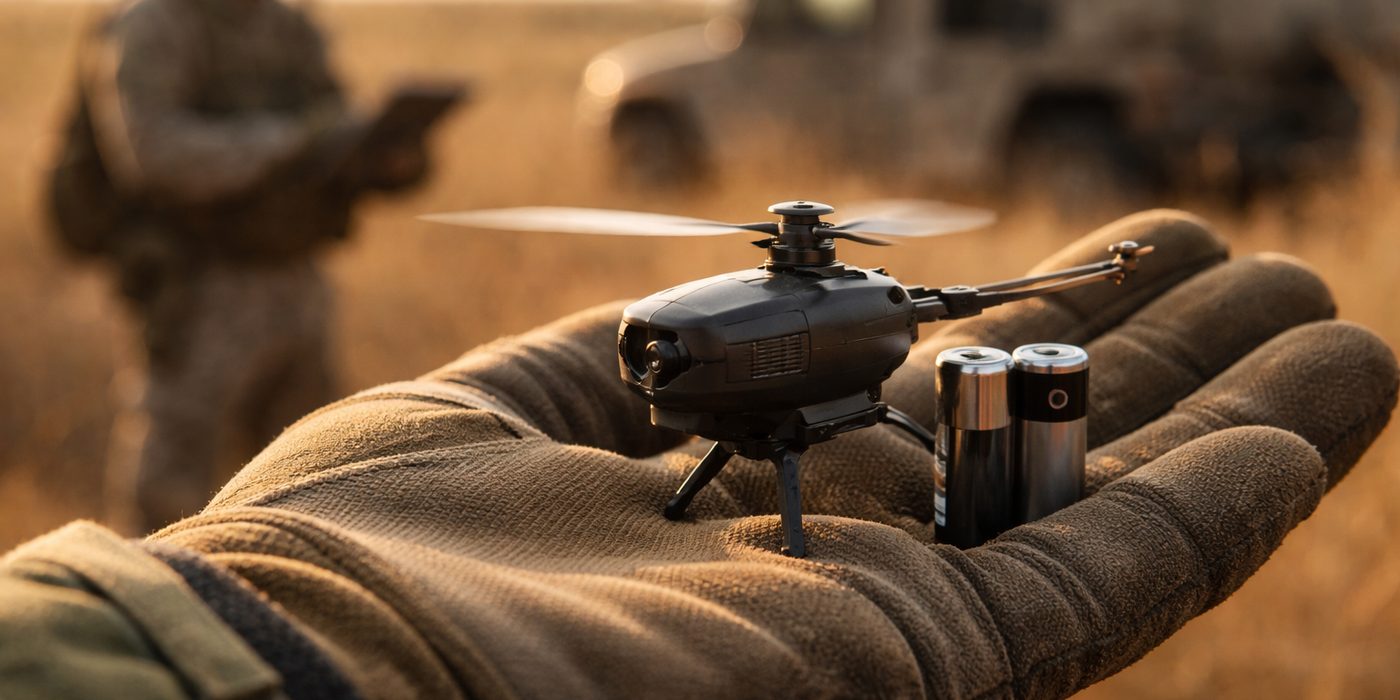
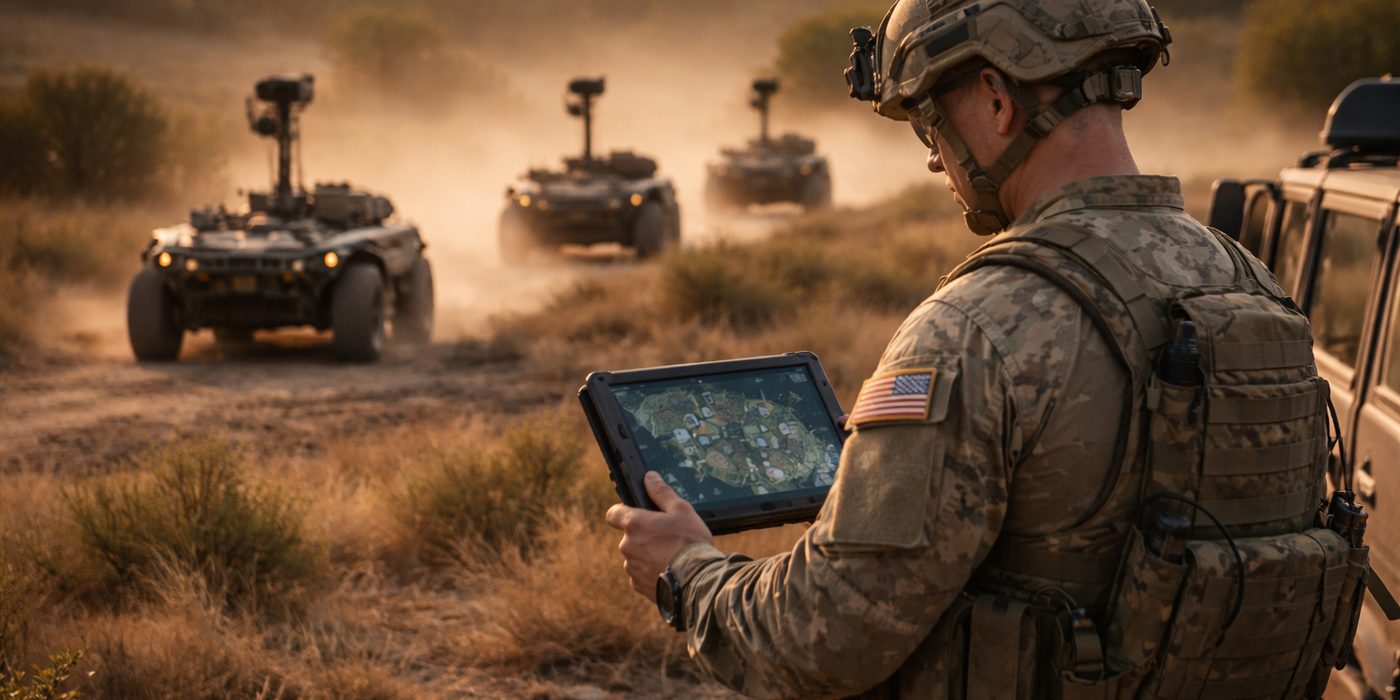
The vehicles drove themselves. The humans decided what happened next. That division of labor was the point of a DARPA demonstration at Fort Knox, Kentucky, where autonomous ground vehicles detected, tracked, and engaged simulated threats while keeping a person in control of the engagement decision. The agency describes the result as command-controlled robotic lethality, a phrase chosen with care. It signals that the experiment was less about proving a machine can find and prosecute a target on its own and more about showing that a human can direct a fleet of unmanned platforms without driving any of them.
What made the demonstration notable to engineers is the lineage of the underlying technology. The vehicles ran on autonomy developed under RACER, short for Robotic Autonomous Systems Experimentation and Resource Concept, DARPA's program to push unmanned ground vehicles to move through unstructured terrain at speeds comparable to human-driven vehicles. RACER was never framed as a weapons program. Its original goal was mobility: keeping a vehicle moving fast across forests, scrub, and broken ground where GPS may be degraded and no road map exists. Bolting a detect-track-engage layer onto that foundation shows how quickly a navigation stack can become a platform for something much more consequential.
The sequencing at Fort Knox is the most instructive detail. The platforms handled the work that humans do poorly at scale, which is continuous perception, route planning over rough terrain, and persistent tracking of moving objects. The operator handled judgment. That split matters because the hardest unsolved problem in multi-vehicle ground autonomy is not driving; it is attention. One person supervising several robots across contested terrain faces a workload problem that no amount of sensor fidelity solves on its own. Interface design, how much the system surfaces and how much it suppresses, becomes as important as the perception stack underneath it. DARPA has not published workload metrics from the demonstration, and those numbers would tell the industry far more than the headline does.
For the commercial robotics sector, the demonstration lands in a market that has been shifting toward modular, software-defined autonomy. Defense buyers increasingly want autonomy as a separable layer that can ride on different chassis, rather than a bespoke system welded to a single vehicle. RACER's architecture was built around that idea, and the Fort Knox exercise suggests the same software can be tasked with very different missions by swapping payloads and mission logic. Companies building off-road autonomy for agriculture, mining, and logistics should read this as a signal about where adjacent defense dollars may flow, and about the dual-use scrutiny that follows. It also sharpens a competitive question: whether primes, venture-backed autonomy startups, or university-derived teams will own the software layer that sits between the sensors and the operator.
The constraints are as telling as the capabilities. A system that depends on a human for engagement decisions depends, in turn, on the link that connects the human to the machine. Contested electromagnetic environments degrade, jam, and spoof exactly those links, and a robot that waits for permission it cannot receive is a robot that stops being useful. Designers face a narrow path between a vehicle that needs constant supervision and one that acts without it, and DARPA's framing of retained human control puts the engineering burden squarely on resilient communications and graceful degradation. How the platforms behave when the command link drops, whether they hold position, withdraw, or continue a defined task, is the question that will separate a compelling demo from a fieldable system.
What to Watch
Track whether DARPA publishes operator-to-vehicle ratios or workload data from the Fort Knox exercise, since those figures will indicate how scalable the concept is. Watch for follow-on solicitations or transition announcements tied to RACER through the end of 2026, particularly any pairing with Army ground vehicle programs. Pay attention to contract awards for modular autonomy software and resilient command-and-control links, where small and mid-sized robotics firms are most likely to land work. And monitor how the Pentagon's existing policy on autonomy in weapon systems is referenced in any public follow-up, because the language chosen there will shape procurement requirements across the sector.