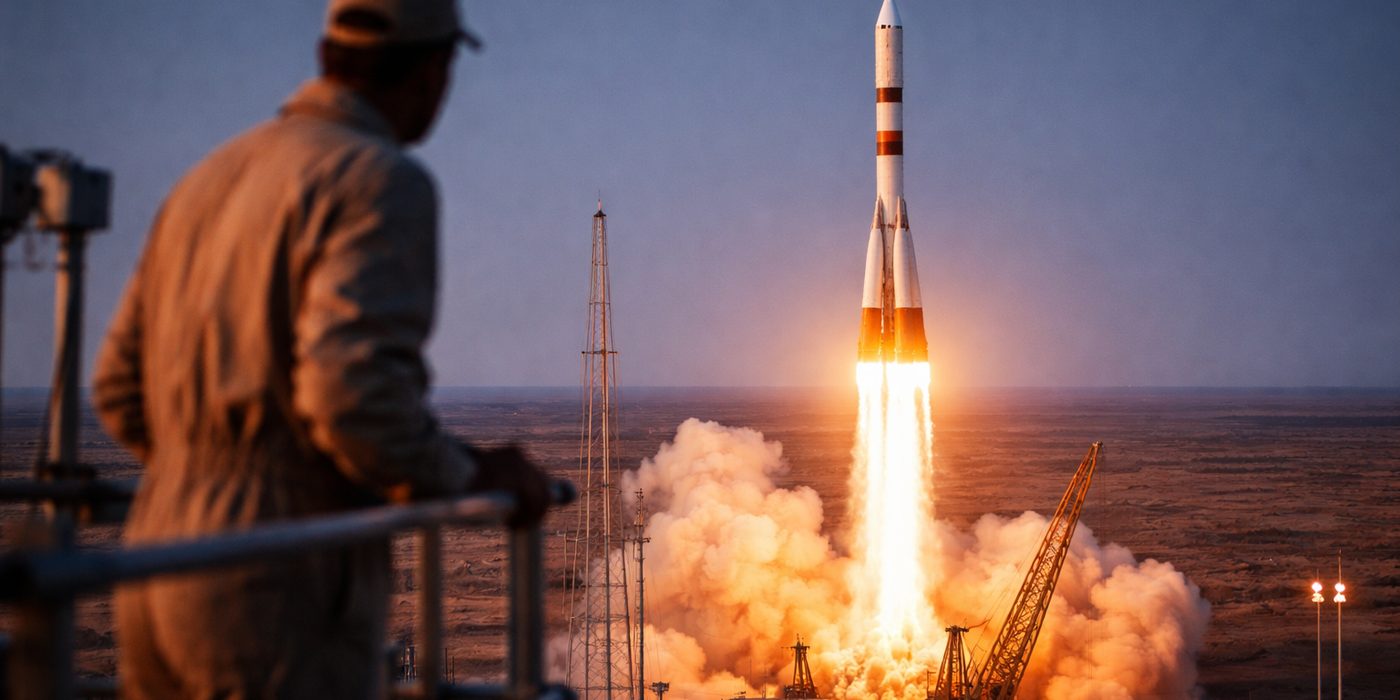
The cargo manifest on a routine Progress flight rarely draws attention beyond the aerospace press. This one carried something different. A Soyuz rocket lifted off with the Progress MS-36 cargo ship bound for the International Space Station, loaded with the usual crates of food, fuel, and equipment, plus a humanoid robot called Teledroid. Progress flights are workhorses, and the Russian program has run them for decades with a reliability that makes them almost invisible. Tucking a humanoid into that routine manifest tells you something about how Roscosmos views the machine: less as a headline experiment than as a payload to be tested under real station conditions.
Humanoids in orbit are not new, but the lineage is thin and mostly American. NASA's Robonaut 2 spent years aboard the station after arriving in 2011, a torso with dexterous hands that never got legs and was eventually returned to Earth after hardware problems. Russia flew its own anthropomorphic robot, FEDOR, to the ISS in 2019 aboard a Soyuz spacecraft, where it famously demonstrated tool handling and was later brought home. Teledroid arrives into that history with the benefit of lessons both programs learned the hard way: microgravity punishes actuators, thermal swings degrade electronics, and every kilogram and watt aboard the station is contested territory.
The name itself offers the most useful clue about intent. Teledroid points toward teleoperation as the central operating mode, with a human controlling the machine remotely rather than the robot acting autonomously. That is a pragmatic choice, and one a senior robotics engineer would recognize as the sensible entry point for space-based humanoids. Autonomy in a spacecraft is a certification problem as much as a technical one, because any robot moving near crew and life-support hardware must be predictable to a standard that learning-based controllers struggle to meet. Teleoperation sidesteps much of that, keeping a person in the loop while still gathering data on how a humanoid form factor handles the station's cramped modules, handrails, and zero-gravity motion.
For the wider humanoid industry, the significance runs in two directions. Commercial developers building general-purpose bipedal machines for warehouses and factories have largely treated space as a distant, symbolic market, yet the engineering overlaps are real: dexterous manipulation, robust teleoperation links, fault-tolerant control, and compact power systems all matter on Earth too. Meanwhile, state-backed programs in Russia, the United States, and China are using orbital hardware to build credibility and gather environmental data that private companies cannot easily replicate. Any telemetry Teledroid returns on joint wear, radiation effects, and control latency will have value well beyond the station, particularly for lunar surface concepts where humanoid-style machines are increasingly discussed as crew support.
What to Watch
Track the Progress MS-36 docking and unloading schedule, since Teledroid's first activation aboard the station will be the earliest confirmation of whether the robot survived launch loads intact. Watch Roscosmos and cosmonaut-crew communications for any published task list, particularly whether tests focus on teleoperated tool use, inspection duties, or simple module-to-module movement. Compare any released performance data against the benchmarks set by Robonaut 2 and FEDOR, especially around control latency and joint durability. And keep an eye on how NASA, China's space program, and commercial humanoid makers respond through 2026, as announcements of orbital or lunar humanoid testing would indicate that Teledroid has pushed competitors to show their own hardware.