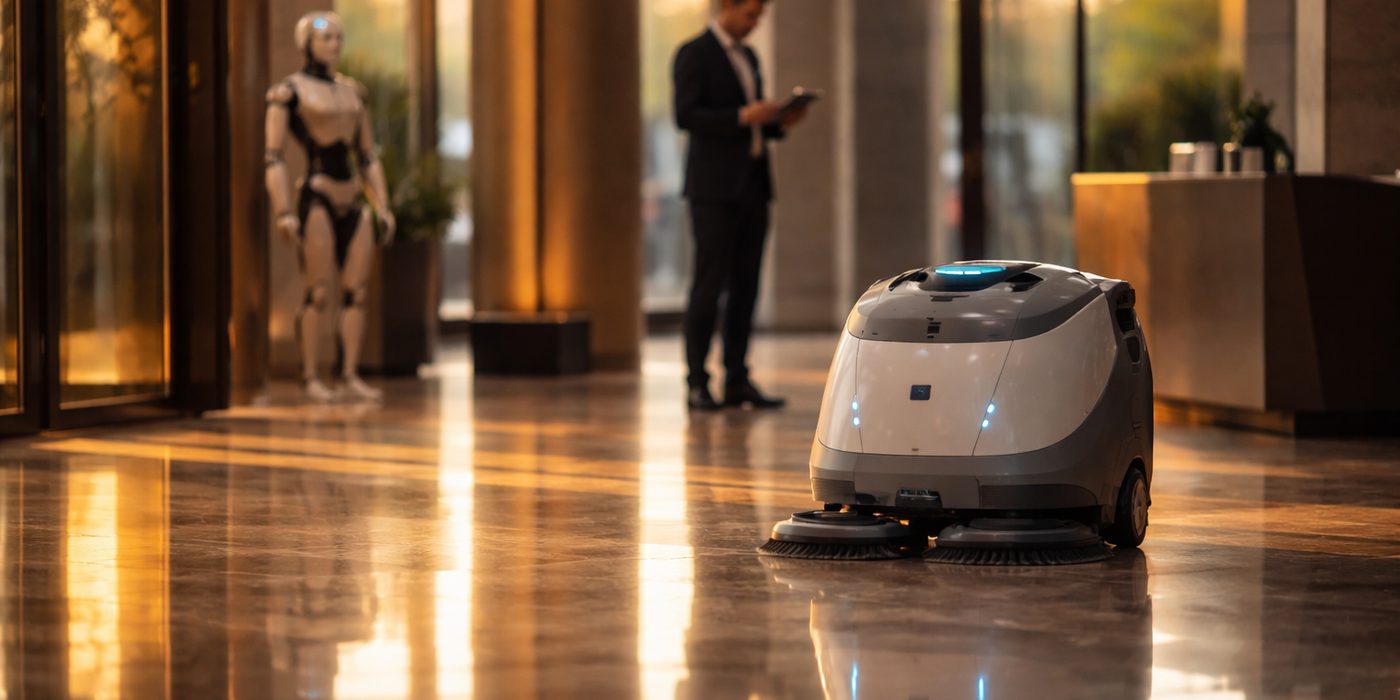
The most telling detail in commercial real estate's flirtation with humanoid robots is what building operators are already buying instead: wheeled machines that cost a fraction of a biped and never try to walk. Autonomous floor scrubbers, rolling security patrol units, and elevator-riding delivery bots have spent years quietly accumulating contracts in office towers, hotels, and logistics campuses. Humanoids, meanwhile, have mostly accumulated viral clips. The distance between those two bodies of evidence is the real story. When property managers run the numbers on a task like overnight lobby patrol or restroom restocking, the question is not whether a humanoid can do it. It is whether a humanoid can do it more cheaply than the alternatives, and so far the answer is no.
The skepticism has roots in how the category took off. Boston Dynamics spent a decade seeding public expectations with videos of Atlas vaulting obstacles and landing backflips, footage that made the machines look one software update away from replacing a workforce. A wave of well-funded entrants followed, including Figure AI, Agility Robotics, Apptronik, Tesla with its Optimus program, and a crowd of Chinese manufacturers led by Unitree and UBTech, each promising a general-purpose worker. The pitch was seductive: buildings are designed for human bodies, so a human-shaped robot should slot in without retrofitting. Doors, stairs, elevator buttons, and countertops all assume two arms, two legs, and a certain reach. Property technology consultants have heard that argument for years, and many now call it the wrong abstraction.
The reasoning goes like this. Most building tasks are repetitive and bounded, which is exactly the profile where specialized hardware wins. A scrubber does not need hands. A security rover does not need to climb stairs if it can ride the elevator and be cleared through access control by software. Delivery platforms have already solved the door and elevator problem with API integrations rather than anatomy. Add in the economics, with current humanoid platforms still priced in the tens of thousands to well into six figures depending on the maker and configuration, plus the maintenance burden of dozens of actuators, and the retrofit-free advantage evaporates. A building can adapt its infrastructure to a cheap wheeled robot for far less than it would pay to put a biped on the payroll. Liability and insurance questions around a heavy, two-legged machine moving among tenants and visitors add another layer of friction that wheeled units largely sidestep.
For humanoid developers and their investors, the implication is uncomfortable but useful. Commercial real estate is a rough proxy for the broader service-economy thesis, the idea that human-shaped machines can enter existing workplaces and absorb a patchwork of tasks. If that thesis cannot clear the bar in environments built around human proportions, it will face tougher scrutiny in settings where purpose-built automation is already entrenched. The more defensible near-term markets look narrower: structured factory and warehouse work, where a single high-value task justifies the hardware, and cases where terrain or tool use truly demands a human-like form. Engineers should read the building-management reaction less as rejection than as a demand signal. Customers want proven uptime, predictable unit economics, and a clear task, not a body plan.
What to Watch Track pilot disclosures from Agility Robotics and Apptronik over the next 30 to 90 days, particularly any contract that names a commercial property or facilities-services operator rather than a logistics or manufacturing site. Watch whether Figure AI and Tesla publish concrete uptime and cost-per-task figures for their humanoids, since building owners will not move without them. Follow announcements from established facilities-robotics suppliers adding manipulator arms to wheeled bases, the hybrid approach most likely to compete directly with bipeds on price. Finally, monitor property-technology trade events and REIT earnings calls through early 2027 for any capital-expenditure line items tied to humanoid deployments, which would be the first hard evidence of real adoption.