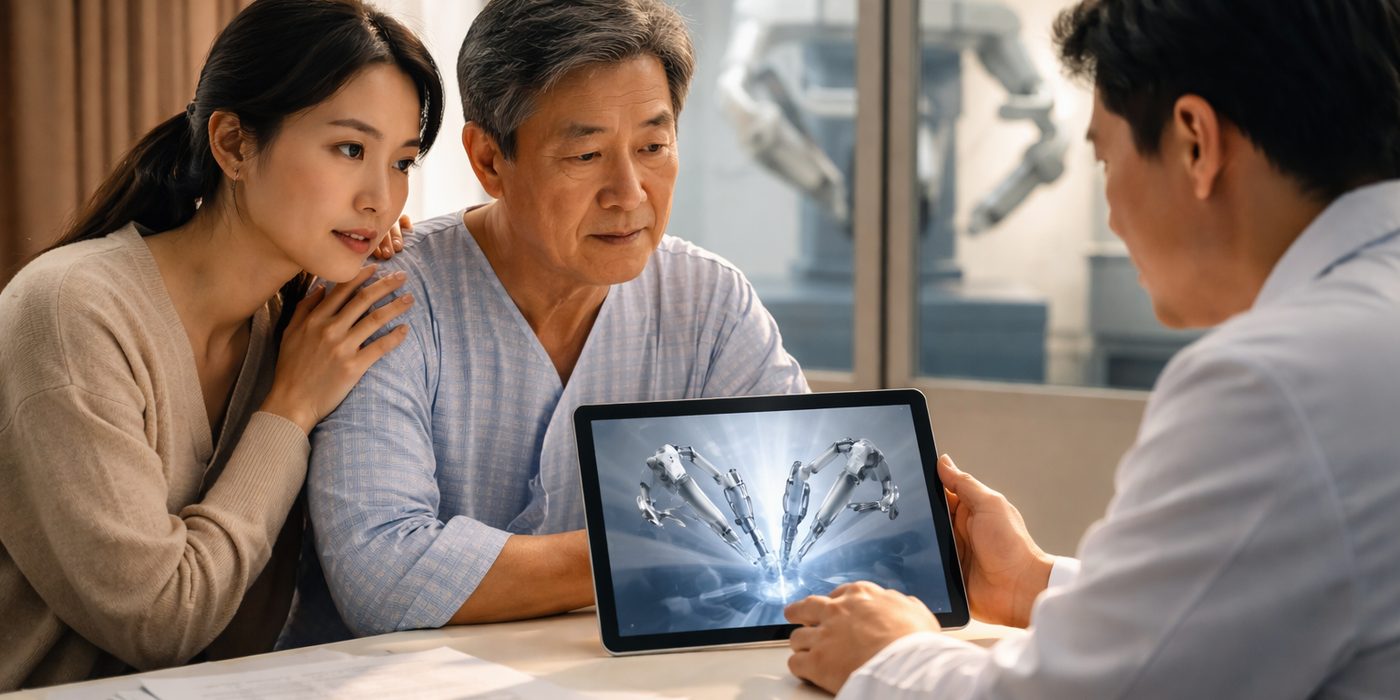
Before a patient ever signs a consent form for robotic surgery, someone else has usually shaped the decision. That is the starting premise of a nationwide survey of South Koreans published in PLOS, which asks a question the robotics industry has largely sidestepped: when ordinary people weigh a hypothetical robotic procedure, whose opinion actually moves them? The researchers framed robotic surgery as a high-cost option in which input beyond the treating physician may carry real weight. Prior literature, by the authors' account, has told us far more about institutional adoption and surgeon attitudes than about the individuals on the receiving end. This study tries to close that gap, using a health-beliefs lens to map the pathways of influence.
The design matters for how far the results can be pushed. Respondents were asked about hypothetical scenarios, not real operations, which means the study captures stated preference rather than behavior at the point of care. That distinction is familiar to anyone who has watched survey enthusiasm for a product fail to translate into purchase. Still, South Korea is a revealing place to ask. The country pairs dense urban hospital networks and high consumer digital literacy with a mature national insurance system, and its hospitals have been among the more aggressive adopters of surgical robotics in Asia. A nationwide sample in that environment offers a cleaner read on public sentiment than a single-institution poll could.
The health-beliefs framework underlying the work treats decisions as the product of perceived risk, perceived benefit, and cues to action, with external sources of influence supplying many of those cues. In practice, that means family members, online information, peer experience, and clinician recommendation may each pull in different directions. Robotic surgery sharpens the tension because it often carries out-of-pocket costs that conventional laparoscopic or open approaches do not, particularly where national insurance does not cover the robotic component. A patient deciding whether to pay a premium is not simply evaluating a surgeon's skill. They are evaluating a story about technology, told by several narrators at once.
For engineers and investors, the uncomfortable implication is that clinical performance data may be only one input into demand. Surgical robotics vendors have long concentrated their evidence generation on outcomes, operative time, and surgeon ergonomics, and sold primarily to hospital procurement committees. A study of patient-side influence points to a second market that vendors and hospitals rarely instrument: the informal network of relatives, online communities, and media coverage that frames the choice before the surgeon speaks. Hospitals that market robotic programs directly to consumers are already betting on this dynamic. Research like this begins to show whether that bet rests on measurable ground or on assumption.
There is also a governance angle that trade readers should not overlook. If non-clinical sources hold sway over a high-cost procedure choice, then the quality and accuracy of the information circulating in those channels becomes a patient-safety and consumer-protection question, not merely a marketing one. Regulators in Korea and elsewhere have scrutinized how robotic procedures are advertised, since promotional claims can outrun the evidence for specific indications. A survey that identifies which sources people lean on gives policymakers a map of where accurate disclosure would do the most good, and gives vendors a reason to treat patient-facing materials with the same rigor they apply to instructions for use.
The limits deserve plain statement. A hypothetical-scenario survey cannot establish that influence on stated intent translates into the decisions patients make in an actual consultation, where clinical urgency, insurer rules, and surgeon availability constrain the menu. Cultural context also cuts both ways: findings about family involvement or trust in physicians in South Korea may not carry over to markets with different payment structures or care-seeking norms. Even so, the central message travels well. Adoption of expensive surgical technology is a social process as much as a technical one, and the companies that treat it that way will read their markets more accurately than those that do not.
What to Watch Watch for follow-on work that tests whether stated preferences in surveys like this one predict real-world uptake, ideally using hospital-level robotic case volumes and out-of-pocket pricing data from Korean institutions through 2026 and into 2027. Track how Intuitive Surgical, Medtronic, and regional entrants such as Meere Company position patient-facing education as competition in Asian markets intensifies. Monitor whether Korean health authorities revisit advertising guidance or insurance coverage for robotic procedures, since either would directly alter the cost calculus the study describes. Finally, look for hospital systems that begin measuring patient information sources at intake, an inexpensive step that would turn this survey's framework into operational data.