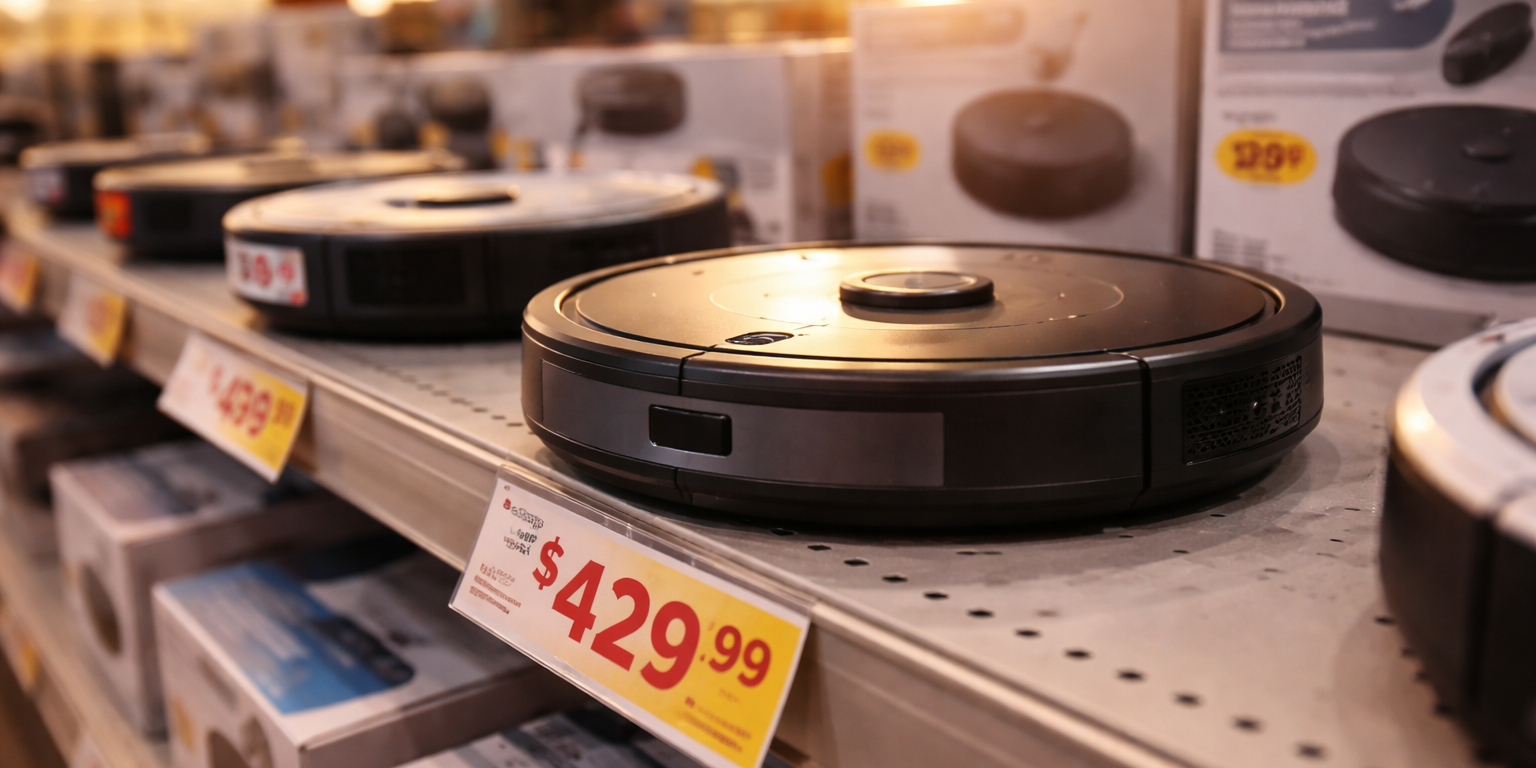
Roborock's Qrevo vacuum-mop hybrid has dropped to $400 with free shipping, down $250 from its original retail positioning of $650. The 38% discount lands the unit squarely in territory previously occupied by iRobot's mid-range Roomba variants and Ecovacs models with fewer sensors and lower suction ratings. The 8,000Pa specification puts the Qrevo roughly on par with offerings from Dreame, Eufy, and Narwal at similar price points, suggesting the Chinese manufacturers competing in this segment have effectively eliminated suction power as a meaningful differentiator.
The pricing reflects industrywide margin compression that began accelerating in late 2025 as manufacturing capacity outpaced demand growth. Companies that raised funding during the 2021-2023 venture boom built production lines expecting sustained consumer appetite for premium features like self-emptying bases, LiDAR navigation, and dual-function mopping. Instead, replacement cycles lengthened and buyers showed resistance to four-figure price tags. Sales data from Q1 2026 showed unit volumes up 14% year-over-year in North America while average selling prices fell 22%, according to NPD Group tracking. Roborock's discount strategy appears designed to claim market share from iRobot, which laid off 350 employees in March after Amazon's proposed $1.7 billion acquisition collapsed under regulatory scrutiny. The vacuum category no longer supports the number of players attempting to carve out sustainable positions.
Roborock operates as a subsidiary of Beijing Roborock Technology, which went public on the Shanghai Stock Exchange in 2020 and has since built a product lineup spanning $300 entry models to $1,400 flagship units with obstacle recognition and real-time video monitoring. The Qrevo line occupies the middle tier, offering dual rotating mop pads and app-based room mapping without the automated water tank refills or heated drying found on the company's S8 MaxV Ultra. The 8,000Pa suction figure represents roughly twice the power of Roomba's j7 series and matches specifications from Dreame's L10s Ultra, which has been selling at $380 through Amazon since April. Engineers familiar with brushless motor sourcing note that 8,000Pa has become table stakes for any manufacturer hoping to compete above the $300 threshold, as component costs have fallen enough to make higher suction economically feasible even on mid-tier bill-of-materials budgets. The real differentiation now comes from software—how accurately the unit maps spaces, avoids obstacles, and returns to charge without getting stuck. Those capabilities depend less on hardware specs and more on the quality of SLAM algorithms and computer vision training data.
The broader vacuum robotics market remains one of the few consumer robotics categories with proven unit economics at scale, even as margins tighten. Global shipments reached 23 million units in 2025, up from 18 million in 2023, and analysts at IDC project volumes will approach 30 million by 2028 as prices continue falling toward the $200-$300 range where vacuums become impulse purchases rather than considered investments. That trajectory puts pressure on everyone except the highest-volume manufacturers with vertically integrated supply chains. Roborock benefits from its parent company's control over key components including motors, batteries, and PCB assemblies, allowing it to undercut rivals who source from third parties. The company's Q1 2026 earnings showed gross margins of 42%, down from 51% a year earlier but still healthy enough to sustain aggressive promotional pricing. Competitors without similar scale advantages face harder choices—either accept unprofitable quarters to defend share or cede volume to better-capitalized players. iRobot's struggles illustrate the risk of the latter approach, as the company's shipments fell 31% in 2025 while it maintained higher retail prices and watched its installed base stagnate.
What to Watch: Monitor whether Roborock holds the $400 price point through the holiday selling season or treats it as a temporary promotional tactic. Track iRobot's Q2 earnings in August for signs the company will match pricing or continue betting on brand loyalty. Watch for Dreame and Eufy to respond with their own discounts, particularly on models in the 8,000-9,000Pa range where specifications overlap. Pay attention to SharkNinja's robotics division, which has been gaining share in the $200-$350 segment and may see an opening if premium brands continue discounting downward.