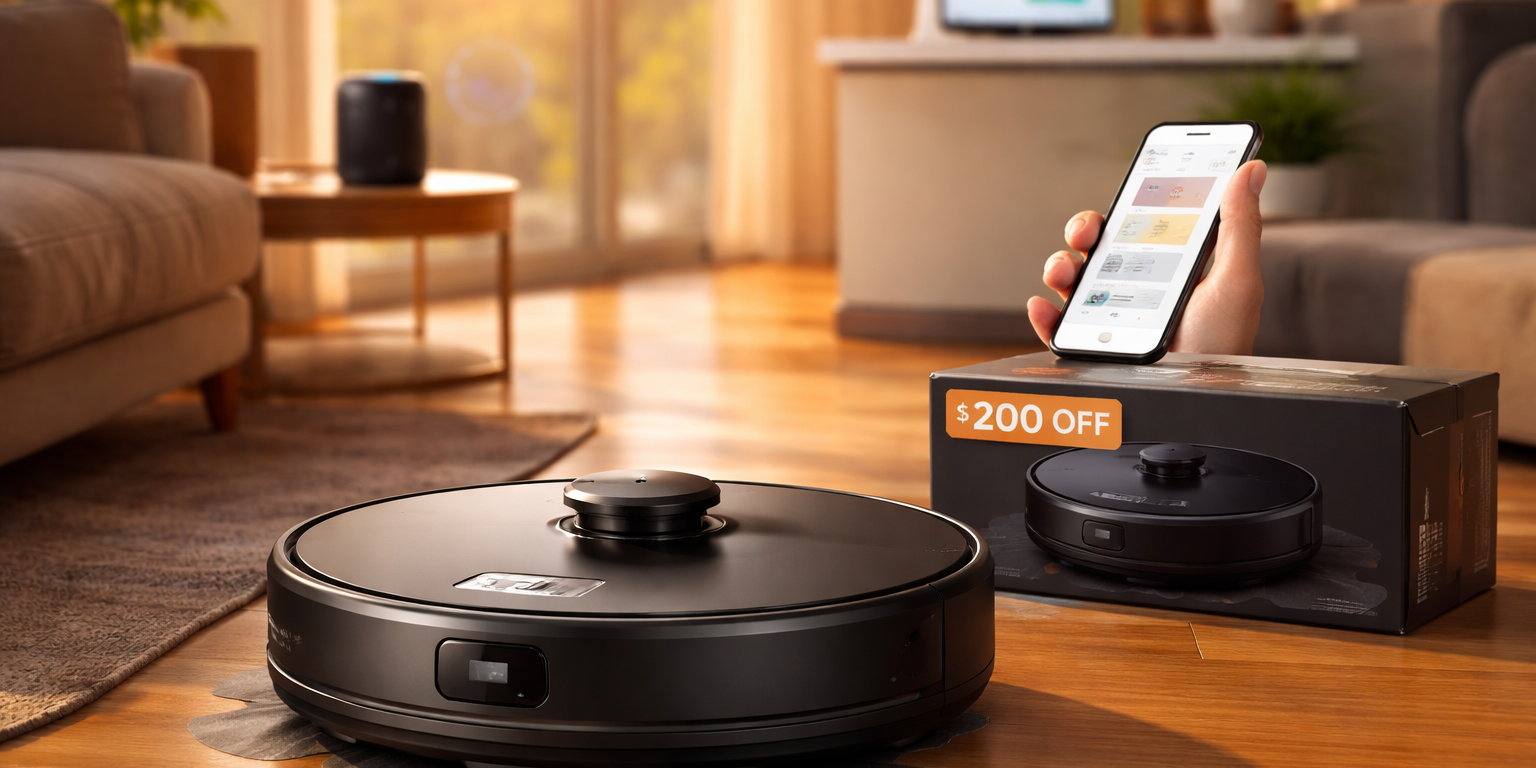
Roborock's Q7 Max robot vacuum landed at $149.98 on Amazon this week, marking one of the steepest price cuts yet for a dual-function autonomous cleaning robot with five-figure pascal suction ratings. The Beijing-based manufacturer, which shipped 2.3 million units globally in the first half of 2026 according to its most recent earnings disclosure, has positioned the markdown as a clearance move ahead of its next-generation lineup expected in Q4. But the pricing also reflects broader economics in consumer robotics: LiDAR modules that cost $45 per unit in 2023 now run under $12, and the brushless DC motors powering these machines have dropped 38% in wholesale pricing since January 2025.
The Q7 Max incorporates technologies that were premium features three years ago—real-time obstacle avoidance using a forward-facing RGB camera, room-by-room scheduling via smartphone app, and a 470ml water reservoir for mopping runs up to 320 square meters. Its 10,000Pa suction specification, while impressive on paper, has become table stakes in the category. iRobot's Roomba Combo j9+, released in March 2026, delivers 12,500Pa. Dreame Technology's L20 Ultra, launched two months later, claims 15,000Pa alongside heated water mopping. Roborock itself has already announced the Q8 series for November 2026 with 13,000Pa suction and improved carpet detection algorithms trained on 4.7 million annotated floor surface images. The rapid spec escalation leaves previous-generation hardware competing primarily on price.
Roborock began as an Xiaomi ecosystem partner in 2014 before spinning out and listing on the Shanghai Stock Exchange in 2020 at a $4.7 billion valuation. The company controls roughly 18% of the global robot vacuum market by unit volume, trailing only iRobot and Ecovacs Robotics, according to September 2026 data from Omdia. Its engineering team of 1,200, split between Beijing and Shanghai, has filed 847 robotics patents since 2020, with a concentration in navigation algorithms and multi-surface cleaning mechanics. The Q7 Max itself runs on a quad-core ARM Cortex processor executing a SLAM implementation that builds 2D floor maps at 10Hz refresh rates—adequate for residential spaces under 300 square meters but less capable than the vision-based systems now emerging in premium models above $800.
The sub-$200 robot vacuum segment has become a margin graveyard. Component commoditization combined with direct-to-consumer distribution through Amazon and Walmart has compressed gross margins from 42% in 2023 to an estimated 23% in Q2 2026 for mid-tier models, per analysts at Bernstein Research. Smaller entrants like Eufy, Ultenic, and Lefant compete almost exclusively on price, with models frequently dipping below $100 during promotional windows. iRobot, which saw its $1.4 billion acquisition by Amazon collapse in January 2024 under regulatory scrutiny, reported a 31% year-over-year revenue decline in its most recent quarter and has laid off 370 employees since March 2026. The competitive pressure explains why Roborock has shifted R&D focus toward commercial applications—the company is currently piloting an autonomous floor scrubber for warehouses and distribution centers with Beta partners including JD Logistics and SF Express in China. Those industrial machines, priced between $8,500 and $14,000 depending on battery configuration, carry gross margins above 50% and operate in environments where navigation complexity and duty cycle requirements justify premium pricing.
The $149.98 price point positions the Q7 Max against competitors that often sacrifice features for cost. Many sub-$200 models still use gyroscope-based navigation rather than LiDAR, resulting in less efficient cleaning patterns and longer run times. The inclusion of mopping functionality, even with a basic drag-pad system rather than rotating mops, differentiates Roborock's offering from single-function vacuums in the same range. For comparison, the Shark AI Ultra 2-in-1, which also combines vacuuming and mopping at 8,500Pa suction, currently retails for $279. Ecovacs' Deebot N10 Plus, with 9,000Pa suction and auto-empty functionality, sits at $399. The Q7 Max lacks a self-emptying base station—a feature that adds $120 to $180 in manufacturing cost—but includes multi-floor map storage and virtual no-go zones configurable through Roborock's mobile app, which has logged 14.2 million downloads across iOS and Android platforms.
What to Watch: Track whether Roborock maintains this pricing through the November holiday shopping period or if it represents temporary inventory clearance ahead of Q8 series availability. Monitor iRobot's quarterly results in October 2026 for signals on whether the company can stabilize revenue amid intensifying low-end competition. Watch for Dreame Technology's rumored U.S. market expansion announcement expected before year-end, which could further pressure pricing across the $150-$400 bracket where most volume concentrates.