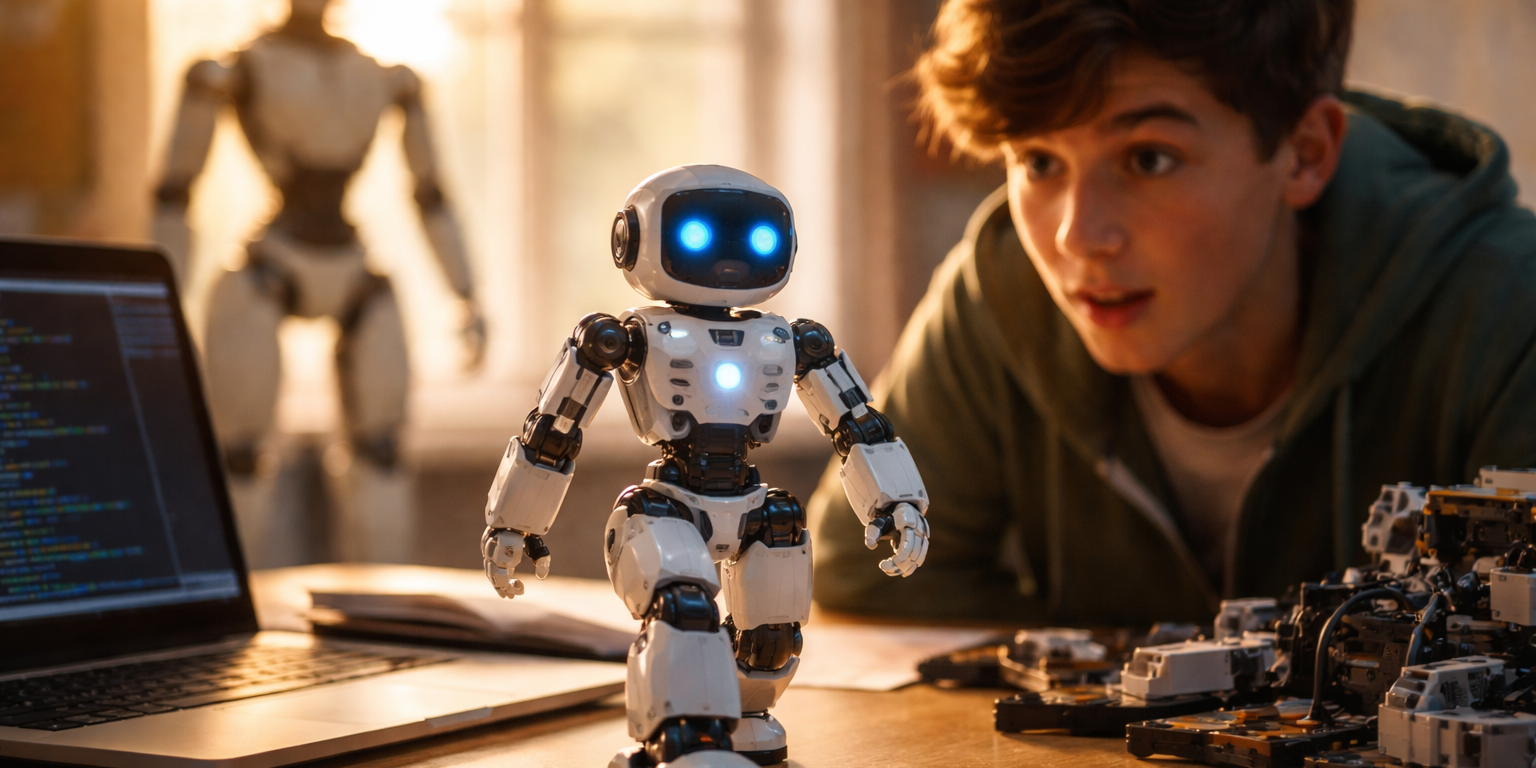
Most humanoid robots sold to researchers arrive as sealed boxes: capable, expensive, and opaque below the API layer. RoboParty is betting that is the wrong product. On October 15, the Shanghai company launched RP1, branded ROBOTO 01, a humanoid it describes as full-stack open source, meaning researchers get access to both the mechanical hardware and the software running it. The pitch is aimed squarely at the embodied AI community, where the gap between a model that performs well in simulation and one that survives contact with a real actuator is the central unsolved problem. A platform you can open up, modify, and instrument end to end is a different kind of tool than one you can only command.
The launch lands in a market that has split into two camps. On one side are commercial humanoids from Figure AI, Agility Robotics, and Tesla, built for eventual deployment and tightly controlled. On the other are research-oriented machines, led by Chinese manufacturers such as Unitree, whose G1 and H1 platforms became default hardware in university labs largely on price. Unitree opened some interfaces and SDKs, but its mechanical designs and core control firmware remain proprietary. RoboParty is staking out the far end of that spectrum, where the bill of materials, structural design, and control software are all meant to be inspectable. That is a meaningfully different promise than an open SDK wrapped around a closed machine.
What the company has and has not disclosed matters here. The announcement emphasizes high performance and full-stack access, but the PRNewswire release leaves the details that engineers will scrutinize first, including degrees of freedom, payload, actuator specifications, compute, and unit pricing, for the project documentation rather than the headline. That is a reasonable choice for a developer-facing launch, and it also means the claims are not yet independently testable. Open-source hardware has a long history of announcements that outrun repositories: a license file and a GitHub organization are easy to publish, while complete CAD files, wiring diagrams, calibration procedures, and maintained firmware are not. Researchers will judge RP1 on the completeness and currency of those materials, not on the press release.
The sharper observation is about where the value in humanoids is migrating. Hardware is commoditizing quickly, particularly in China, where supply chains for actuators, reducers, and sensors have driven research-grade humanoid prices down sharply over the past two years. As that happens, the scarce resource shifts to data and to the software that turns data into behavior. An open platform lets a lab publish results on identical hardware, share policies and datasets that actually transfer between machines, and fix bugs without waiting on a vendor. That reproducibility is what open source offers that a closed fleet cannot, and it is why a platform with modest unit sales could still matter if it becomes a common reference. The risk is the familiar one: open projects need maintainers, documentation, and a community large enough to sustain them, and RoboParty must prove it can fund that work after the launch attention fades.
What to Watch Track the completeness of RoboParty's public repositories over the next 30 to 60 days, specifically whether full CAD, firmware, and control code are released under a permissive license and kept current. Watch for published pricing and shipping timelines, since a research humanoid's appeal depends heavily on whether a university lab can actually buy one in 2026. Look for early adopters, in the form of university groups or embodied AI teams posting benchmarks or datasets collected on RP1, as the first real signal of traction. Finally, monitor whether Unitree responds by loosening its own hardware and firmware restrictions, which would confirm that openness is becoming a competitive axis rather than a niche.