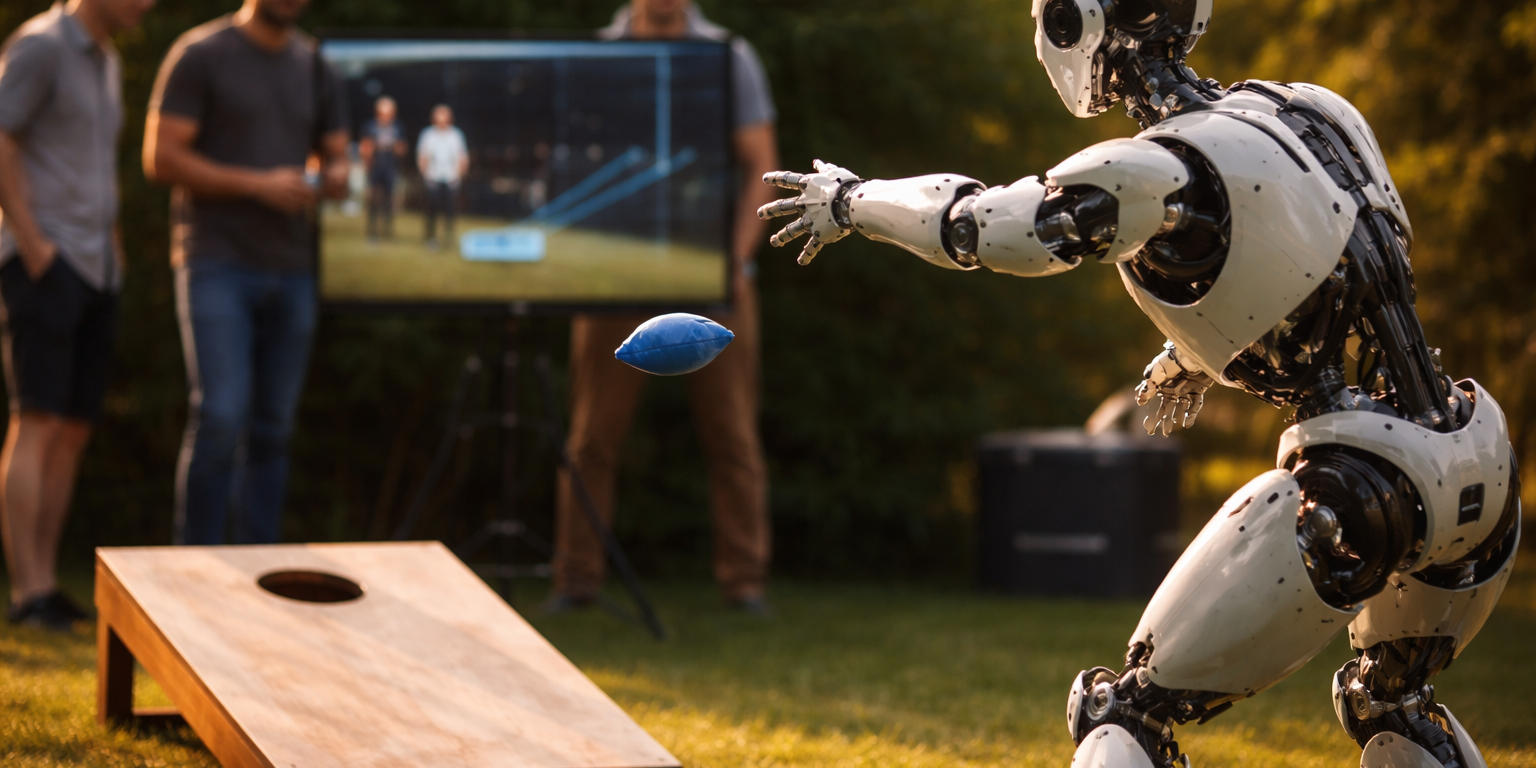
A humanoid robot tossing a bean bag at a slanted plywood board is not, on its face, a demanding spectacle. The demanding part happened before the robot ever moved. Google DeepMind's researchers built a pipeline that starts with video of people playing cornhole, reconstructs the scene and the throwing motion in simulation, trains a control policy there, and then deploys it on a physical humanoid with no task-specific data collected on the real machine. The result, as reported by Crypto Briefing, is a robot that picked up a new skill at a speed that conventional demonstration-driven methods struggle to match.
The bottleneck this attacks is well known to anyone building embodied AI. Teleoperation, where a human wears a motion-capture rig or drives a robot through a task while sensors log every joint angle, produces clean data but scales poorly. Each task demands its own sessions, its own operators, its own hours of robot time. Companies including Tesla, Figure AI, and Agility Robotics have all leaned on some version of this approach, and all have discussed the expense. Internet video, by contrast, already exists in staggering volume. The catch has always been translation: a flat 2D clip carries no force information, no joint torques, and no guarantee that a human body's motion maps onto a robot's very different mass distribution and actuator limits.
That translation gap is what the sim stage is meant to close. By rebuilding the video's physical scene inside a simulator, the system can generate the physics that footage lacks, then let reinforcement learning discover how a robot with its own proportions and motor constraints can reproduce the outcome rather than the exact human motion. The distinction matters. A robot does not need to throw like a person; it needs to land the bag on the board. Cornhole is a deliberate test case here, because it demands release timing and arm trajectory precision while remaining forgiving enough that small errors in the sim-to-real transfer do not produce total failure. Throwing is also a classic stress test for the reality gap, since projectile flight is unforgiving of mismatches in friction, grip, and release dynamics.
For investors and engineering leads, the useful question is not whether a humanoid can play a lawn game but whether this recipe generalizes. Sim-to-real transfer has a long and uneven history, from OpenAI's Rubik's Cube hand in 2019 to the locomotion policies now standard on quadrupeds and bipeds. What DeepMind adds is the video front end, which in principle opens a far larger pool of training signal than any company can generate in-house. If the method holds across tasks with contact-rich manipulation, deformable objects, or tool use, the data advantage that well-funded humanoid startups have been building through fleets of teleoperators could erode. That would reward whoever controls the best simulators and the strongest video-understanding models, an arena where Google's resources are considerable. It would also pressure hardware-first players to show that their moat is something other than a proprietary demonstration dataset.
Caution is warranted on several fronts, and the source material offers few of the numbers an engineer would want. Throw success rate, number of trials, variation in board distance, and the amount of simulation compute consumed are the figures that separate a research demonstration from a deployable capability, and none are prominently reported in the coverage available. Cornhole also takes place in a controlled, flat, well-lit setting. A warehouse or factory floor presents occlusion, clutter, and moving people that a video-derived scene reconstruction may handle poorly. The distance between a convincing lab result and a dependable production behavior has swallowed many promising robotics programs. Still, the direction is clear: the industry is searching for ways to decouple skill acquisition from physical robot hours, and video-to-sim-to-real is now a credible contender in that search.
What to Watch Watch for a DeepMind paper or technical release with quantitative results, specifically throw success rates and the range of tasks tested beyond cornhole, since that will show whether the pipeline generalizes. Track whether competitors such as Figure AI, Tesla's Optimus team, and Agility Robotics respond with their own video-derived training announcements before the end of 2026. Keep an eye on NVIDIA's Isaac Sim and Omniverse updates, as simulator fidelity is the load-bearing component of any such pipeline. Finally, monitor whether DeepMind opens any portion of the tooling to outside researchers, which would determine whether this stays a Google advantage or becomes an industry baseline.