
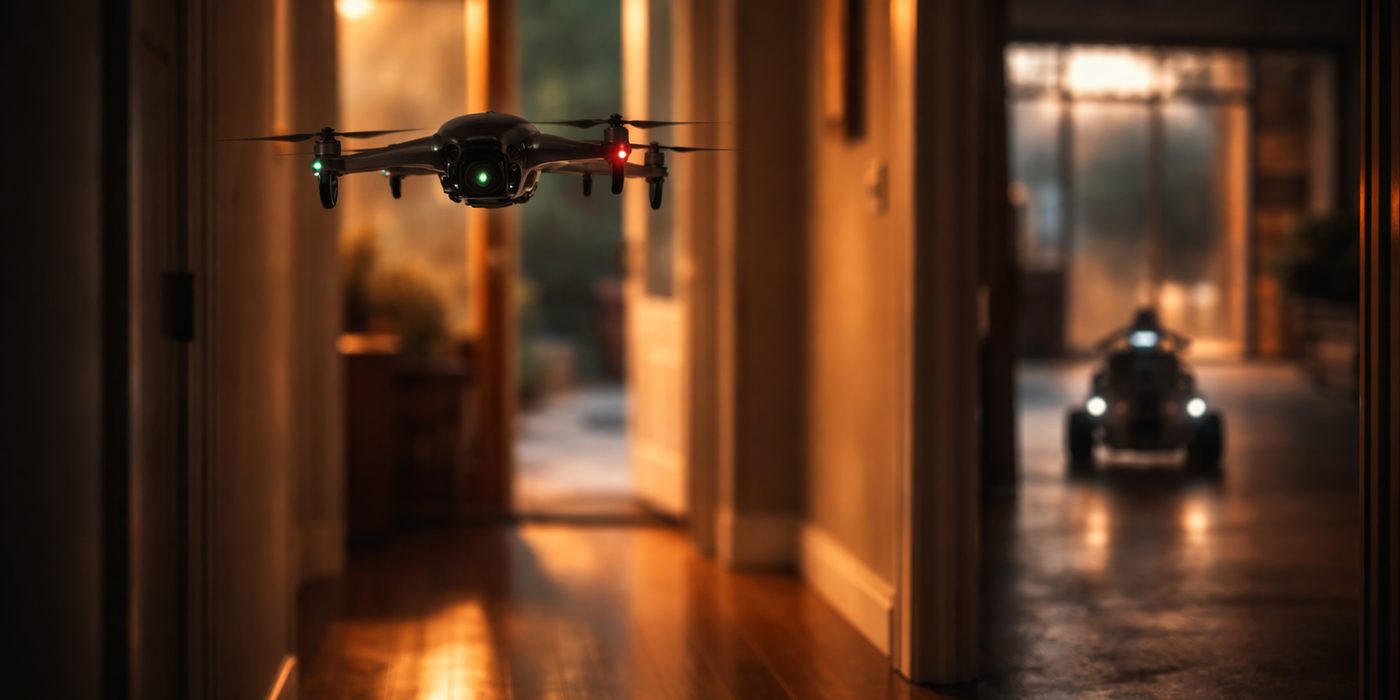
A doorbell company now sells a drone. Ring, the Amazon subsidiary that built its business on fixed cameras bolted to front doors, has created a Ring Robotics brand and filled it with two autonomous machines: the Drone Cam, which flies through a home to check out disturbances, and the Rover Cam, a wheeled patrol unit that records 4K video across commercial properties. The split is deliberate. One product targets the household, the other the storefront, warehouse, or office. Both are designed to leave the wall mount behind and go look at the problem themselves, a shift from watching a scene to investigating it.
The logic follows a long-standing complaint about home security: a camera sees only what happens to wander into its field of view. A motion alert at 2 a.m. hands the homeowner a blurry clip and a decision. A machine that can move toward the sound, reframe the shot, and return with footage turns that alert into something closer to an answer. Ring has spent years assembling the surrounding infrastructure, including cloud storage, a subscription model, and a base of millions of installed cameras. Mobility is the logical next layer, and Amazon's other robotics efforts, from warehouse fleets to the Astro home robot, have given the parent company a deep bench of navigation and fleet-management experience to draw on.
The two form factors face very different engineering problems. An indoor drone must navigate cluttered rooms, doorways, stairwells, and pets without a pilot, using sensors small and light enough to leave payload margin for a camera and battery. Flight time is the unforgiving constraint: consumer-scale multirotors typically manage minutes, not hours, which explains why a drone is better suited to short, event-triggered investigations than continuous patrol. The Rover Cam inherits the opposite trade-off. Wheels buy endurance and a steadier 4K image, but they confine the robot to floors it can traverse, and commercial buildings add curbs, glass doors, and foot traffic. Neither problem is exotic, yet solving both reliably at consumer price points is where products like this tend to succeed or stall.
For the wider industry, the interesting signal is not the hardware but the buyer. Security has long been a proving ground for mobile robots, with companies like Knightscope and Cobalt Robotics selling patrol units to enterprises for years, but those products carry enterprise price tags and service contracts. A Ring-branded entry reaching mainstream retail channels could pull component costs down and normalize the idea of an unattended robot moving through private space. That normalization cuts both ways. Suppliers of lidar, depth cameras, edge AI chips, and small-form-factor flight controllers stand to gain volume. Meanwhile, Ring's history of controversy over footage sharing with law enforcement means a roaming camera will draw tougher scrutiny than a static one, and regulators in the United States and Europe have yet to settle how indoor autonomous recording devices should be governed.
The open questions are mostly about trust and liability. A flying machine inside a home raises obvious safety concerns around propellers, children, and pets, and certification regimes for indoor consumer drones remain thin. A commercial patrol robot that records continuously invites workplace-privacy disputes and data-retention obligations that differ by jurisdiction. Ring will also have to answer a plain business question: whether customers will pay recurring fees for a machine that responds to incidents rather than merely documenting them. If the answer is yes, expect rivals in smart-home and security, along with Chinese drone makers with far more flight experience, to move quickly into the same territory.
What to Watch Track final U.S. pricing and availability for both products, since the gap between a premium commercial Rover Cam and a mass-market Drone Cam will reveal which segment Ring is really chasing. Watch for FAA and consumer-safety guidance on indoor autonomous drones, along with any state-level privacy action aimed at mobile recording devices, through the first quarter of 2027. Monitor competitive responses from established players like Knightscope and Cobalt Robotics, and from home-security rivals such as Google Nest and Arlo. Finally, follow Amazon's next earnings disclosures for any language on Ring Robotics unit volumes or subscription attach rates, the clearest early measure of whether customers want a security camera that moves.