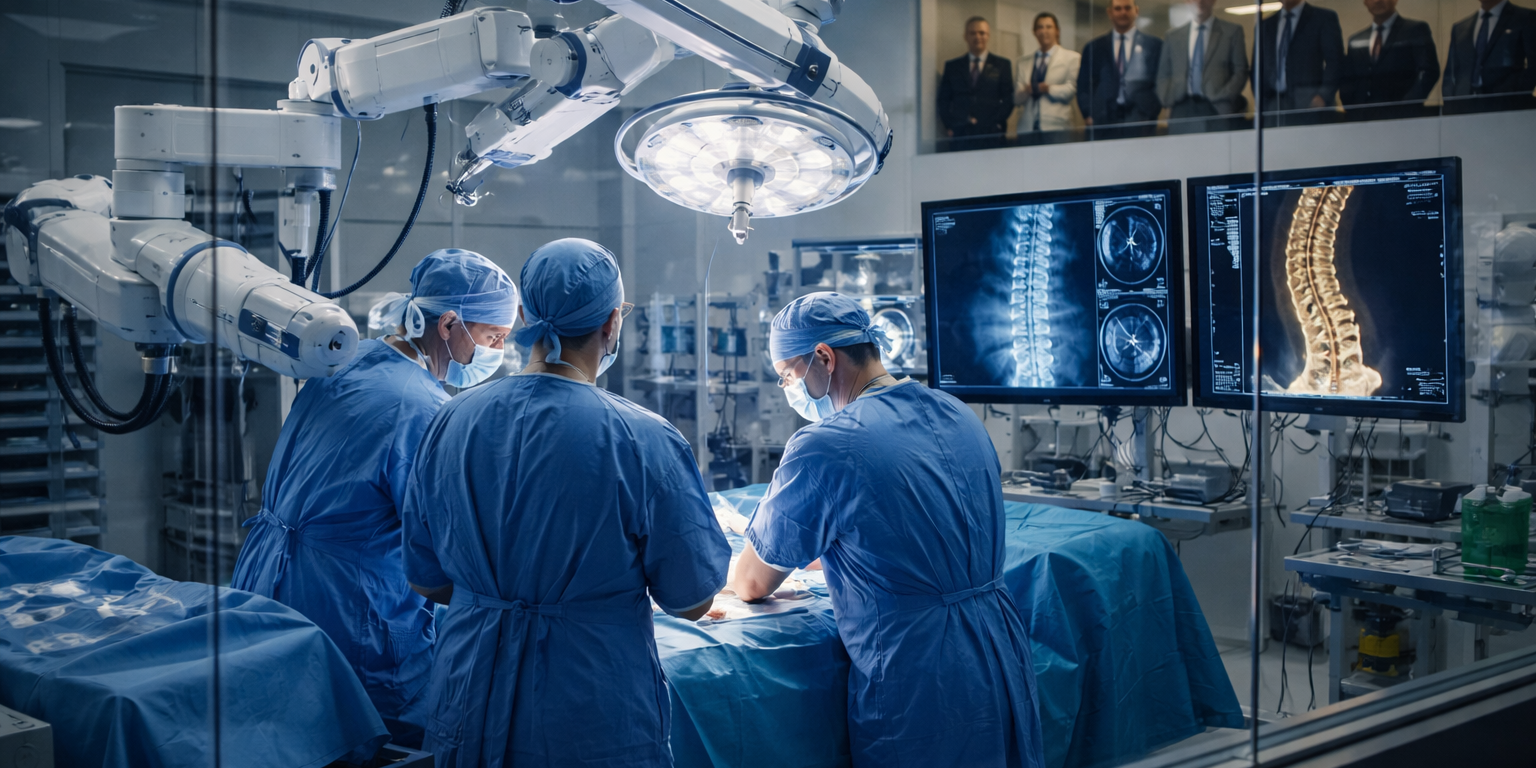
Four companies control the installed base of orthopedic surgical robots currently operating in hospitals worldwide, and each faces the same strategic challenge: how to expand beyond the total knee replacement procedures that justified their systems' seven-figure price tags. A market report released this week by an industry research firm maps the competitive landscape around anatomical expansion—particularly into shoulder and spine applications—and the integration of artificial intelligence into surgical planning workflows. The companies named in the analysis—Stryker, Zimmer Biomet, DePuy Synthes, and Medtronic—have collectively shipped more than 2,000 robotic systems since the segment began scaling in the late 2010s, but revenue growth now depends on utilization rates rather than unit sales alone.
The original business case for orthopedic robotics centered on knee procedures, specifically total knee arthroplasty, where pre-operative CT scans feed three-dimensional models that guide bone cuts with sub-millimeter precision. Stryker's Mako system, launched in 2006 and acquired through a $1.65 billion deal in 2013, became the reference architecture for the category. Zimmer Biomet followed with the Rosa Knee System in 2019. DePuy Synthes entered through its Velys Digital Surgery platform in 2021, and Medtronic arrived with the Hugo RAS system in 2022, though Hugo initially targeted soft tissue procedures before expanding into orthopedics. The knee remains the highest-volume joint replacement procedure in developed markets, but growth has plateaued as penetration rates in the United States approach 15 percent of all knee arthroplasties. Shoulder and spine applications offer lower procedure volumes but higher complexity, longer OR times, and correspondingly higher reimbursement rates—exactly the profile that justifies robotic assistance from a hospital CFO's perspective.
The report emphasizes AI-driven surgical planning as the next technical differentiator, though it stops short of quantifying how many systems currently deployed incorporate machine learning models. Stryker announced in late 2025 that its Mako 3.0 software update would include predictive ligament balancing algorithms trained on anonymized data from more than 500,000 procedures. Zimmer Biomet has pursued a different strategy, partnering with Surgical Safety Technologies to integrate computer vision systems that track instrument positions in real time and flag deviations from the surgical plan. DePuy Synthes has focused on interoperability, designing Velys to accept DICOM data from any CT scanner and export kinematic data to electronic health record systems without proprietary middleware. Medtronic's approach layers AI onto its existing image-guided surgery business, using the Hugo console as a front end for pre-operative models generated by its Mazor X Stealth Edition spine platform. Each pathway reflects a different theory about what hospitals will pay for: procedural data, real-time safety alerts, workflow integration, or cross-platform compatibility.
Geographic expansion represents the second major growth vector, particularly in Asia-Pacific markets where orthopedic surgery volumes are climbing but robotic penetration remains below 2 percent. China approved its first domestically manufactured orthopedic robot, the Yuanhua PrimBot, for commercial use in 2024, and at least six other Chinese manufacturers have systems in clinical trials as of mid-2026. Japan's aging population has driven demand for joint replacement procedures up 8 percent annually since 2023, but hospital reimbursement policies have not kept pace with robotic capital costs, creating a price-sensitive market that favors lower-cost systems. India represents a longer-term opportunity with significant regulatory and infrastructure barriers; only three hospitals in the country currently operate orthopedic robots, all of them Mako systems in private specialty centers in Mumbai and Delhi. The report highlights South Korea as the most immediate growth market, where national health insurance began covering robot-assisted knee replacement in 2025 and hospital adoption has accelerated accordingly. Samsung Medical Center in Seoul now performs more than 60 robotic joint replacements per month, a utilization rate that rivals high-volume U.S. centers.
What to Watch: Stryker's shoulder application for the Mako system, currently in limited release, should receive full FDA clearance and broader commercial availability by the fourth quarter of 2026. Zimmer Biomet has signaled plans to integrate its Rosa platform with its Persona IQ smart implant, which contains an embedded sensor that transmits joint kinematics post-operatively—expect a formal announcement before year-end. Track Medtronic's orthopedic case volume growth as Hugo systems mature beyond their initial soft tissue focus; the company has not disclosed procedure counts since early 2025. Finally, monitor Chinese regulatory approvals for export of domestic orthopedic robots; if NMPA-approved systems begin seeking CE marks or FDA submissions, pricing pressure on Western manufacturers will intensify.