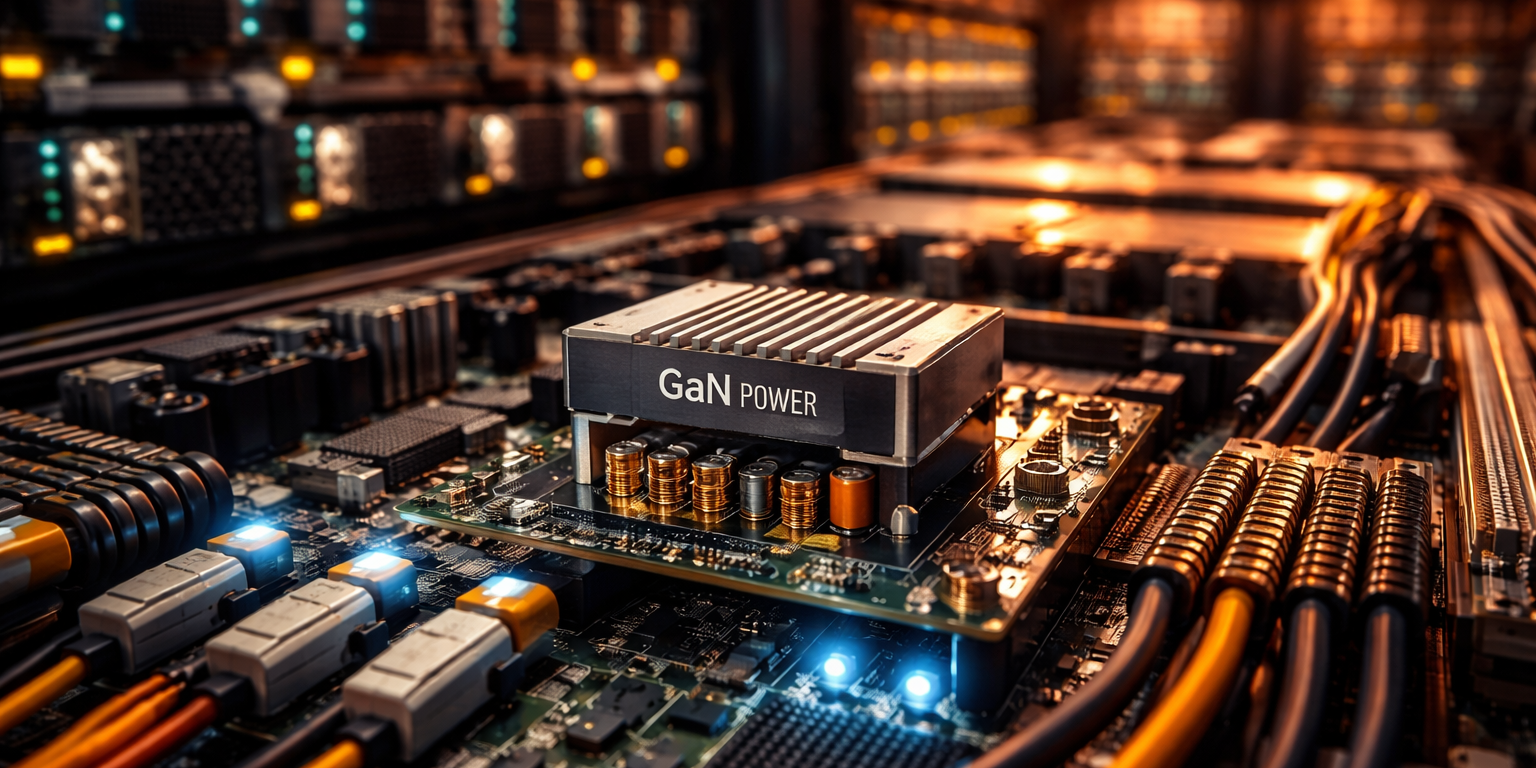
ON Semiconductor released its GaNEXUS portfolio, a gallium nitride power platform engineered specifically for AI data center infrastructure and robotics motion control. The Phoenix-based semiconductor manufacturer enters a market where GaN adoption has accelerated sharply since 2022, driven by power density requirements in GPU clusters and the thermal constraints of humanoid robot actuators. The company joins Texas Instruments, Infineon Technologies, and Efficient Power Conversion in targeting GaN devices at AI workloads, a segment where power delivery architecture has become a primary bottleneck. Data center operators now allocate roughly 40 percent of capital expenditure to power and cooling systems, according to Uptime Institute figures from Q3 2024, creating urgency around conversion efficiency improvements that GaN promises.
Gallium nitride semiconductors switch faster and generate less heat than silicon MOSFETs at equivalent power levels, advantages that translate directly to smaller power supply footprints and reduced cooling loads. For robotics applications, GaN enables motor drives with higher switching frequencies, which improves torque ripple characteristics and position control precision in actuators. Collaborative robots and autonomous mobile robots both benefit from reduced inverter mass, a critical factor when power electronics sit onboard battery-powered platforms. Tesla deployed GaN inverters in its Optimus humanoid prototype in late 2023, and Figure AI followed with custom GaN motor drives in its Figure 02 platform revealed in March 2024. The technology has moved from experimental to production-critical in under 18 months within the robotics sector. ON Semiconductor's timing reflects this shift, arriving as multiple humanoid robot manufacturers finalize supply chains for volume production expected to begin in late 2025.
The GaNEXUS portfolio architecture remains undisclosed in initial product announcements, but industry context suggests ON Semiconductor will offer discrete transistors, integrated half-bridge modules, and likely gate driver ICs optimized for high-frequency switching. Efficient Power Conversion currently leads in discrete GaN transistors with over 60 products spanning 15 to 650 volts, while Texas Instruments dominates integrated GaN solutions for power supplies below 500 watts. Infineon targets industrial drives and automotive applications with CoolGaN devices rated for 600-volt operation. ON Semiconductor brings established relationships with tier-one server manufacturers including Dell Technologies, Hewlett Packard Enterprise, and Lenovo, giving the company direct channels into the data center buyers who will deploy thousands of AI accelerator racks through 2026. The company also supplies power management ICs to Boston Dynamics, ABB Robotics, and FANUC, though those relationships have historically centered on silicon-based controllers rather than wide-bandgap semiconductors. Whether ON Semiconductor prices GaNEXUS competitively enough to displace incumbents remains unclear; GaN devices still command 30 to 50 percent premiums over silicon equivalents, and customers resist switching costs unless efficiency gains justify requalification timelines.
AI data centers present the most immediate revenue opportunity for GaNEXUS. NVIDIA's GB200 Grace Blackwell Superchip draws up to 2,700 watts per node, and a single rack housing 72 GPUs can consume over 120 kilowatts. Power delivery to these systems requires hundreds of DC-DC converters operating at 95 percent efficiency or better to avoid overwhelming facility cooling capacity. GaN-based converters achieve 97 to 98 percent efficiency at multi-kilowatt levels, recovering 20 to 30 watts per converter compared to silicon alternatives. Across a 10-megawatt data center, cumulative savings approach 200 kilowatts, equivalent to an entire additional rack of compute capacity. Hyperscalers including Microsoft, Google, and Meta have each committed publicly to evaluating GaN power stages in next-generation AI clusters, creating addressable markets measured in millions of units annually. ON Semiconductor reported $8.2 billion in revenue for fiscal 2023, with power solutions representing approximately 35 percent of sales. Capturing even single-digit share of the GaN data center market would add meaningful revenue, particularly as the company navigates softer demand in automotive and industrial segments during 2024 and 2025.
What to Watch: Monitor ON Semiconductor's Q1 2025 earnings call in April for specific GaNEXUS product SKUs, voltage ratings, and design win announcements with named data center customers. Track whether FANUC or ABB Robotics publicly adopt GaNEXUS devices in servo drive platforms, which would signal acceptance beyond early-stage robotics startups. Watch for GaN pricing trends from Efficient Power Conversion and Texas Instruments; if 600-volt GaN transistors fall below $2 per device in volume, adoption accelerates sharply across industrial robotics. Finally, observe NVIDIA's power supply reference designs for the Blackwell Ultra platform expected mid-2025, as supplier selection there often dictates industry-wide component choices.