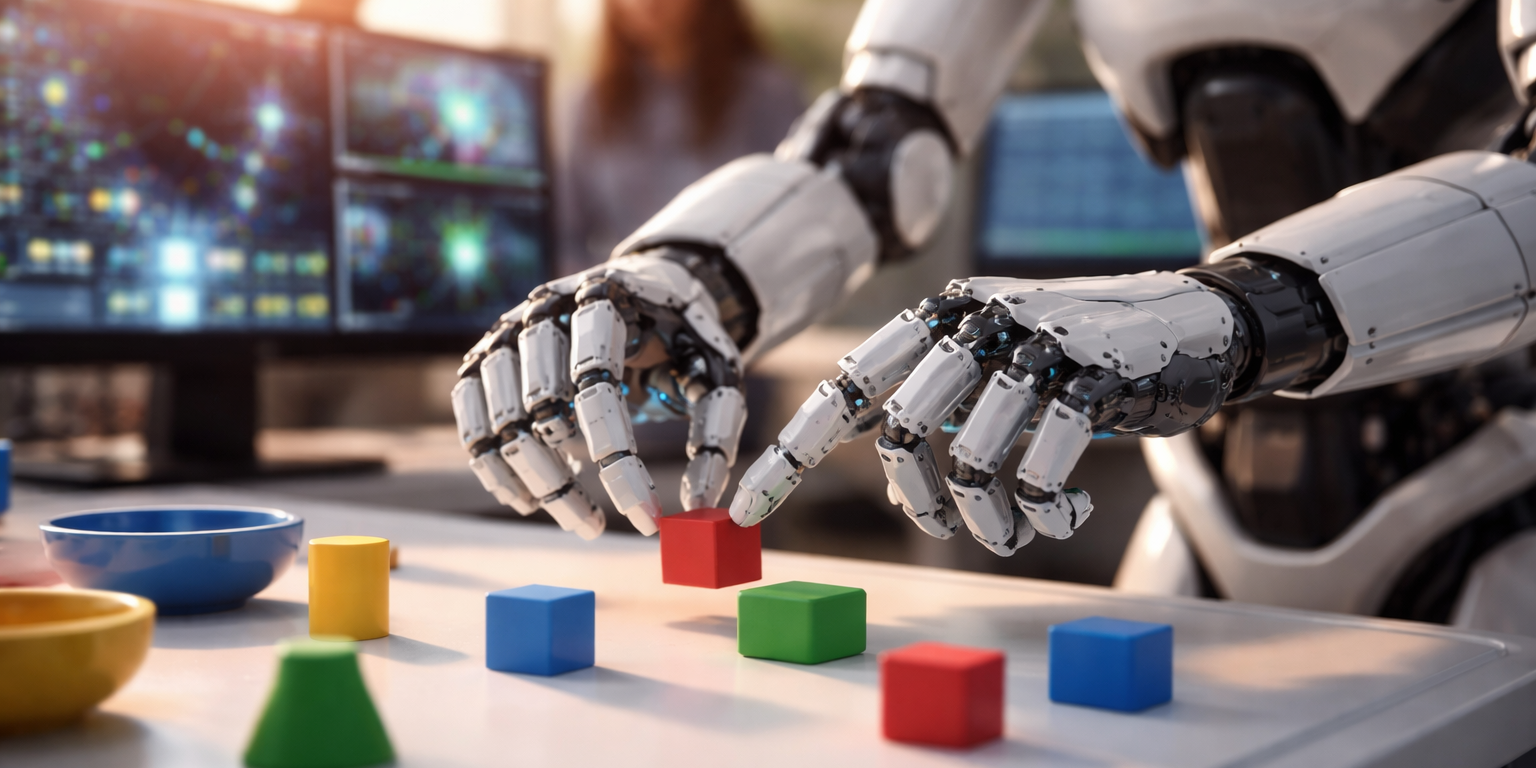

NVIDIA's robotics division chose Unitree Robotics' G1 humanoid as the reference hardware platform for its GR00T foundation model initiative, a decision that pairs one of China's most cost-efficient robot manufacturers with Silicon Valley's dominant AI compute architecture. Spencer Huang, who leads robotics strategy at NVIDIA, described the selection as deliberate arbitrage between hardware economics and software capability. The G1 retails at roughly $16,000 per unit, a fraction of competing platforms from Figure AI or Tesla, while NVIDIA's Jetson Thor compute module brings the same GPU acceleration that powers large language models to real-time motion planning and vision processing. That combination addresses the industry's core tension: humanoid robots require both physical affordability at scale and neural network inference fast enough to navigate unstructured environments without cloud latency.
Unitree shipped its first production G1 units in August 2024, positioning the Hangzhou-based company as the volume leader in sub-$20,000 humanoids before most Western competitors finalized their prototypes. The robot stands 180 centimeters tall with 23 degrees of freedom and a walking speed of 2 meters per second, specifications that place it firmly in the general-purpose category rather than the specialized industrial niche Boston Dynamics occupies. NVIDIA tested multiple platforms before settling on the G1, according to Huang, evaluating hardware from Agility Robotics, Apptronik, and Figure AI alongside Chinese manufacturers including Fourier Intelligence and LimX Dynamics. The decision hinged on three factors: mechanical reliability across temperature ranges, compatibility with standard ROS2 middleware, and Unitree's willingness to share CAD files and joint controller specifications with third-party developers. That openness matters because NVIDIA's strategy depends on ecosystem velocity, not hardware margin. The company wants every robotics lab, logistics startup, and manufacturing integrator building on GR00T to default to Jetson Thor for compute and Isaac Sim for training, which requires a reference platform cheap enough for widespread adoption.
GR00T itself represents NVIDIA's bid to do for humanoid robots what CUDA did for deep learning: create a proprietary bottleneck in an open ecosystem. The foundation model ingests teleoperation data, synthetic training scenarios from Isaac Sim, and real-world deployment logs to generate motion policies that transfer across robot morphologies. Huang positioned it as infrastructure rather than product, arguing that the robotics industry wastes resources on duplicative motion planning and vision systems when the actual differentiation lies in application-layer software and vertical integration. Whether that argument gains traction depends partly on proving the GR00T-trained policies perform reliably on affordable hardware. Early demonstrations showed the G1 executing warehouse picking tasks and navigating crowded retail spaces, but those environments were controlled and the task success rates remain unpublished. NVIDIA plans broader third-party validation through its Inception program, which now includes 47 humanoid robotics startups, up from six eighteen months ago. The company also faces competition from Google DeepMind's RT-X project and Tesla's Optimus training pipeline, both of which emphasize end-to-end learning rather than foundation model abstraction.
The Unitree partnership also highlights shifting manufacturing geography in robotics. Tesla manufactures Optimus at its Texas facility, citing supply chain control and IP protection, while Figure AI contracts with BMW's Spartanburg plant for near-term production. NVIDIA's embrace of Unitree signals confidence that Chinese hardware maturity now rivals domestic alternatives, at least for development platforms. That calculus could shift if export controls tighten or if logistics around warranty service and component supply prove cumbersome for U.S.-based developers. Huang acknowledged those risks but pointed to Unitree's existing distribution network, which includes partnerships with research labs at MIT, Carnegie Mellon, and ETH Zurich. The company also maintains inventory and service operations in California through its subsidiary Unitree Robotics USA, addressing concerns about lead times and regulatory compliance. For NVIDIA, the reference design strategy amplifies its core business: selling compute modules and software licenses. Each G1 configured for GR00T development ships with a Jetson Thor board priced at $2,499, and commercial deployments require annual Isaac platform subscriptions starting at $12,000 per robot. If NVIDIA captures even 30 percent of the humanoid market's compute layer, projected to exceed 200,000 annual unit shipments by 2027, the revenue approaches $750 million annually from software alone.
What to Watch: NVIDIA will demonstrate multi-robot GR00T deployments at its GTC conference in March 2025, with at least three logistics customers expected to present case studies using Unitree G1 hardware. Unitree plans a G1 Pro variant in Q2 2025 with upgraded torque specs and IP54 dust resistance, directly targeting warehouse environments. Watch whether Agility Robotics or Figure AI adopt GR00T as their training stack, which would validate NVIDIA's foundation model approach beyond its chosen reference platform. Tesla's Optimus production ramp, scheduled to begin limited external shipments in late 2025, will test whether vertically integrated manufacturing can match the distributed model NVIDIA and Unitree represent.